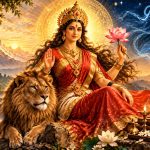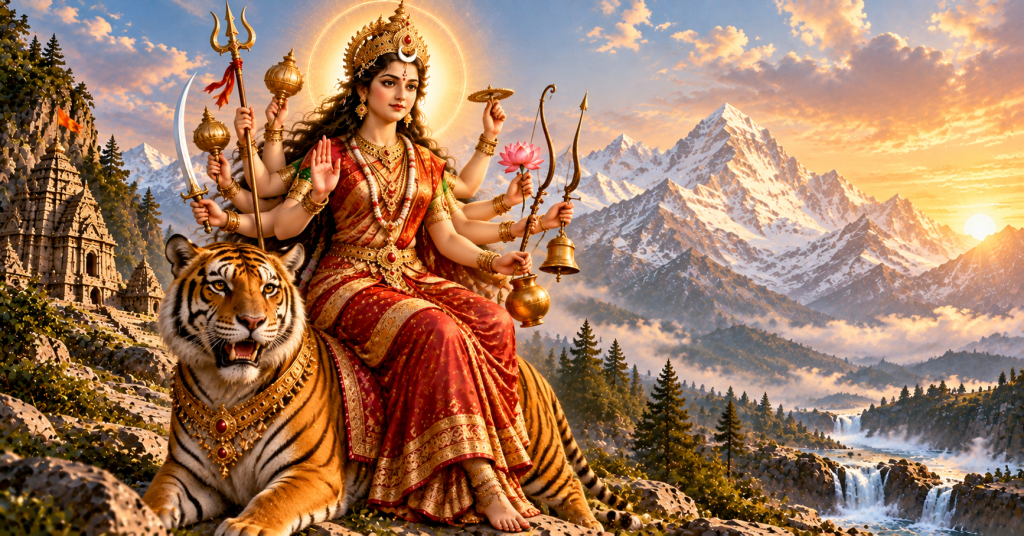
On the third evening of Navratri a thin crescent of the moon can be seen low in the western sky shortly after sunset, curved like the rim of a bell. The Goddess worshipped on this day wears that crescent on her forehead, and she takes her name from it: Chandraghanta, she whose brow carries the moon shaped like a bell. The Devi Kavacha places her third among the Navadurga, tritiyam Chandraghanteti. She has ten arms and rides a tiger, her face is serene, and her posture is that of one about to rise from her seat. In her the tradition shows the meeting of two qualities usually kept apart, the coolness of the moon and the readiness of a warrior. Brahmacharini taught the patience of long practice, and Chandraghanta shows what that patience prepares a person for, which is to meet fear with a settled mind. This article follows her story, her form, and the long Indian reflection on sound and on the mind that her name holds together.
The Name and the Crescent
The name joins chandra, the moon, with ghanta, the bell. The crescent on her forehead has the shape of a temple bell, and the tradition has taken both halves of the name seriously. The moon is cool, luminous and changing, and in Indian thought it is the heavenly body of the mind. The Purusha Sukta (Rigveda 10.90.13) says that the moon was born from the mind of the cosmic Purusha, and Chandra has been linked with manas, the mind, ever since. The bell is the instrument of sound, and sound is the earliest thing the tradition knows about creation, since Vak, the speaker of the Devi Sukta met in the first article of this series, is speech as a cosmic power. Chandraghanta therefore carries a settled mind and a sounding bell together on her brow.
The Wedding Procession
Popular tradition connects Chandraghanta with the wedding of Shiva and Parvati. After the long tapas described in the previous article, the marriage is fixed, and Shiva comes to the house of Himavat with a procession unlike any other. The Shiva Purana (Rudra Samhita, Parvati Khanda) describes ghosts, goblins and spirits walking beside the bridegroom, who is smeared with ashes, wears matted hair and rides his bull. Kalidasa, in the seventh canto of the Kumarasambhava, gives a more graceful account of the same procession. In the Puranic version Mena, Parvati’s mother, sees the party from the palace and faints in terror, and she refuses at first to give her daughter to such a groom.
The tradition says that at this moment Parvati took the form of Chandraghanta, ten-armed, golden and composed, and with the authority of that form asked Shiva to appear as a handsome bridegroom for the sake of her family. He did so, and the wedding went forward. The identification of this scene with Chandraghanta belongs to popular and devotional tradition, and the Puranic text itself does not give the form this name.
The Bell in the Devi Mahatmya
The bell appears in the Devi Mahatmya as well. In the eleventh chapter the gods sing the hymn of Narayani, and one of its verses addresses the bell of the Goddess, whose sound fills the world and destroys the strength of the demons, and asks that it protect the devotees from their sins as a mother protects her sons. Chandraghanta draws from this tradition. Where Brahmacharini is silent and inward, Chandraghanta is the Goddess whose presence is heard.
Her Form
Chandraghanta is shown with a complexion of burnished gold. She has ten arms, which hold a trident, a mace, a sword, a bow and arrow, a lotus, a water pot and other weapons and emblems, the list varying slightly across traditions, with one hand raised in the gesture of blessing that removes fear, the abhaya mudra. She rides a tiger or a lion, and her seat is drawn in a posture of readiness, as if she were about to stand. The verse used in her worship describes her as riding the finest of beasts and bearing fierce weapons, and asks that she be gracious to the one who prays. The weapons are read as powers held in readiness, and the lotus and the blessing hand as the grace that governs their use. Her face is serene, and that is the point of the form: the Goddess is formidable to what threatens and calm in herself.
Popular tradition associates her with the Manipura chakra, whose name means the city of jewels. It is placed at the navel and linked with fire, will and vitality. In this reading the energy gathered through the previous day’s tapas becomes the force of will on the third day. As before, the chakra scheme is one reading among several.
Sound and the Mind in Indian Thought
Indian thought holds that sound comes before form, and the Upanishads give this teaching its fullest expression in the syllable Om. The Mandukya Upanishad opens with the statement that Om is the whole of this world, and it assigns the three measures of the syllable to the waking, dreaming and deep-sleeping states, with the silent fourth as the Self that lies beyond them. The Katha Upanishad (1.2.15) says that the word all the Vedas declare is Om, and the Bhagavad Gita (8.13) names it as the one syllable of Brahman whose utterance at the last breath leads to the highest goal. The bell used in worship carries this teaching into the household. Puja manuals prescribe ringing it at the opening of worship with a verse that speaks of the bell as an invitation to the gods and a dismissal of what is harmful, and the long lingering note of a well-made bell is traditionally said to resemble the sound of Om.
The mind has a place in the same teaching. The Gita (6.34) calls the mind restless and strong, as hard to hold as the wind, and the next verse (6.35) says that it is held by practice and by detachment. Chandraghanta places the moon, the lord of the mind in the tradition, on the forehead where attention gathers, and the bell beside it. Commentators read the bell as the sound that calls attention back whenever the mind has wandered.
The Spiritual Significance of Chandraghanta
The first teaching of Chandraghanta is fearlessness. The Gita (16.1) places abhaya, freedom from fear, first among the divine endowments, and the raised hand of the Goddess is the gesture that gives it. Her weapons keep the causes of fear at a distance, and the tradition teaches that fear leaves a person through steadiness. Chandraghanta is steadiness with its weapons in hand.
The second teaching lies in the union of calm and force. The moon and the tiger sit in one figure, and the tradition reads this as a statement about the relation of power to the mind that directs it. Strength guided by a settled mind protects, and strength without one does harm, which is why the moon rests on the brow of a Goddess who carries ten weapons.
The third teaching is found in the wedding story. Her form appears to serve the peace of a household, and her ferocity is placed in the service of harmony. A power that can be fierce and chooses to speak gently to a frightened mother and a strange bridegroom is the kind of power the tradition honours.
The fourth teaching is that of the bell itself, which asks for attention. The third night calls the devotee to wake to the practice begun on the first two nights, to the ground laid by Shailaputri and the discipline taught by Brahmacharini, and to bring to them the courage that lets practice continue when it becomes difficult. The order of the days is the order of an inner life: a place to stand, a way of staying, and the courage to remain.
Seen Through the Natural World
The moon of the third night can be seen. A few days after the new moon, a young crescent hangs low in the western sky after sunset, and each evening of the festival it will stand a little higher and be a little fuller. The Indian calendar is built on this motion. A tithi, the lunar day by which the days of Navratri are counted, corresponds to an increase of twelve degrees in the angle between the moon and the sun, so that the festival follows the visible waxing of the moon.
Sound has its own physical account. A bell rings because the struck metal vibrates, and a well-made bell produces a fundamental tone with overtones that fade slowly, which gives it the lingering note that worshippers hear. Temple bells are traditionally cast from alloys of copper, tin and other metals chosen for how long they ring. The resemblance of the note to Om is a traditional observation, and popular claims that the vibration of a bell purifies the air or destroys germs have not been supported by evidence. People do respond to sound a little faster than to light, and hearing remains open when the eyes are shut, which is why alarms and bells have always been sounds.
Fear also has a physical side. Slow, regular breathing is widely taught in clinical settings as a way to settle the body’s response to alarm, and slow recitation is often reported to be calming for the same reason. These are observations about the body and the breath, and the chakra scheme remains the tradition’s own account and has not been established by measurement.
The Sound at the Threshold
As the third evening deepens, the small bell of the household shrine is rung, and its note lingers in the room after the hand has left it. In the sky outside, a thin moon hangs low in the west, and with each night of the festival it will sit a little higher. Chandraghanta has no speech to offer the devotee, and what she gives is a sound and a look, the sound that turns attention toward the Goddess and the look of one who is not afraid. Tomorrow the series turns from the bell to the laughter of Kushmanda, the Goddess who is said to have brought the universe into being with a smile.
Sources and Further Reading
Primary texts
- Rigveda 10.90.13 (Purusha Sukta) and 10.125 (Devi Sukta)
- Mandukya Upanishad; Katha Upanishad 1.2.15
- Bhagavad Gita 6.34 to 6.35, 8.13 and 16.1 to 16.3
- Devi Mahatmya, chapter 11 (Narayani Stuti); Devi Kavacha
- Shiva Purana, Rudra Samhita (Parvati Khanda)
- Kalidasa, Kumarasambhava, canto 7
Translations and studies
- Wendy Doniger, The Rig Veda: An Anthology (Penguin Classics)
- Patrick Olivelle, The Early Upanishads (Oxford University Press)
- Swami Gambhirananda, Eight Upanishads (Advaita Ashrama)
- Swami Gambhirananda, Bhagavad Gita with the Commentary of Shankaracharya (Advaita Ashrama)
- Guy L. Beck, Sonic Theology: Hinduism and Sacred Sound (University of South Carolina Press, 1993)
- J. L. Shastri (ed.), The Siva Purana (Motilal Banarsidass)
- David Smith, The Birth of Kumara (Clay Sanskrit Library)
- Thomas B. Coburn, Devi Mahatmya: The Crystallization of the Goddess Tradition (Motilal Banarsidass, 1984)
- David Kinsley, Hindu Goddesses (University of California Press, 1986)