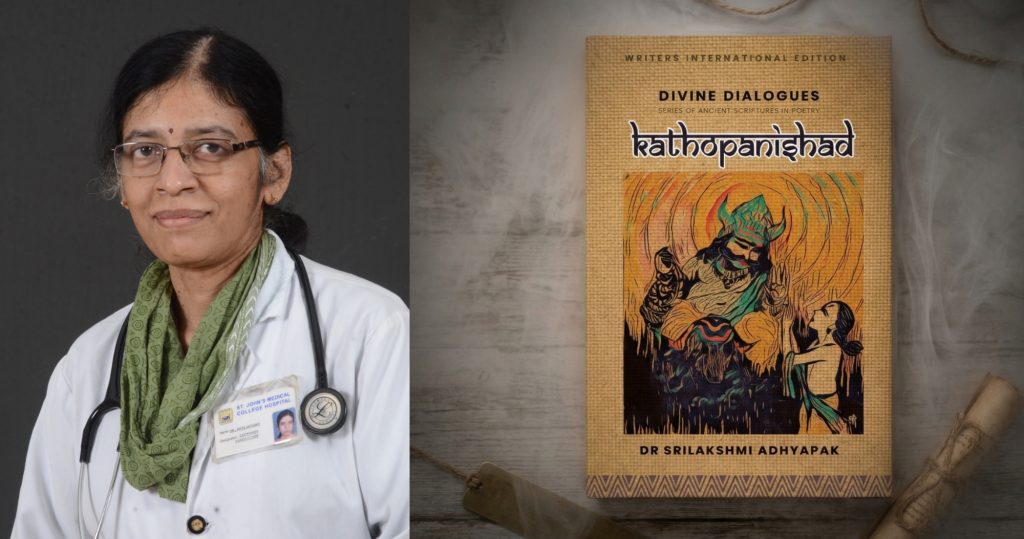
As we celebrate Panorama International Book Festival 2026, bringing together significant books from across the world, we are delighted to present Kathopanishad in Verse by Dr Srilakshmi Adhyapak. This volume is part of Divine Dialogues, a Series of Ancient Scriptures in Poetry, published by Writers International Edition from Mysore and Athens (ISBN 978-81-973585-4-8).
The Kathopanishad has attracted translators and commentators for more than a thousand years, and each generation has had to decide how much of its dramatic force and philosophical precision can survive a change of language. Dr Adhyapak takes up that question in a form few have attempted for this text: sustained English verse in rhyme. By the author’s own account in the Preface, the work is a rendering into poetry and makes no claim to be a translation or a treatise. It is written by a practising physician for whom the certification of death is a professional routine and for whom its meaning remains unsettled. That fact explains much about the book’s seriousness. The poet has stood at the bedside and found the clinical definition of death inadequate to the question the Upanishad poses.
Structure and fidelity to the source
The poem follows the narrative sequence of the Upanishad with a clarity that readers new to the text will appreciate. It opens with an invocation to the Sun and to the lord of death, and moves through the gift-giving of the sage Vajashrava, the boy’s challenge to his father, the three nights Nachiketa spends unattended at Yama’s door, and the three boons that follow. The reconciliation with the father and the instruction in the fire sacrifice occupy the first two boons. The third boon, the question whether the self persists after death, carries the philosophical weight of the work, and the poet gives it proportionate space. Yama’s attempts at dissuasion, in which he offers progeny, cattle, land, long life and celestial companions, are rendered as a catalogue of attractions that the boy dismisses in turn. The distinction between the good and the pleasant, which the Foreword by Dr Lakshmi Bandlamudi and the critical study that follows both identify as the central teaching, is presented through the image of twin paths, “like darkness and light in hours opposite stream.”
The later sections preserve the principal images by which the Upanishad has been remembered. The body as a chariot, with intellect as charioteer and the senses as horses, is given its full development. The razor’s edge on which the path to the self is walked, the self smaller than the smallest and greater than the greatest, the person the size of a thumb dwelling in the lotus of the heart, the inverted peepal tree with its roots above, and pure water poured into pure water all appear in order. The poem closes with the peace invocation asking protection for teacher and taught. A reader who knows the Sanskrit will find the architecture intact, and a reader who does not will be given the whole arc of the dialogue without interruption.
The choice to render the text as a continuous poem has one notable consequence. The Upanishad is traditionally divided into two chapters of three sections each, and the verse numbering allows scholars to cross-refer. Dr Adhyapak’s version moves through these divisions without marking them, so that the poem reads as a single meditation. This suits the oral character of the tradition, which the study “From Silence to Song” rightly emphasises, and it gives the work a momentum that a verse-by-verse translation seldom achieves.
Formal achievement
The most conspicuous feature of the book is its commitment to rhyme. Almost every couplet closes on a matched sound, and many of the matches are ingenious: “fire” with “desire,” “heaven” with “seven,” “bliss” with “kiss,” “sword” with “word.” Rhyme at this density imposes a discipline that free verse does not, and sustaining it across some forty-seven pages of text without lapsing into filler is a real technical accomplishment. The Foreword advises that the poems be read aloud, and the advice is sound. The lines are short, the stresses fall predictably, and the cumulative effect in recitation resembles the chanting that has always been the Upanishad’s primary mode of transmission. Dr Bandlamudi’s comparison of the cadence to a river and to the rhythm of the damaru is a reader’s response, but it points to something verifiable in the verse: it moves forward with a steady pulse and gathers force by repetition.
The poet also shows a sure instinct for compression. Philosophical statements that occupy several lines of prose in standard translations are often contained in a couplet. The lines on the self’s relation to the body, “Mortal wounds the body destroy, / Uninjured it exits, a glorious alloy,” state the doctrine of the imperishable self in two lines and attach to it an image from metallurgy that is the author’s own addition. The opening stanza describing Upanishad as “a trisyllabic word, / Of pregnant knowledge, a seeker’s sword” gives a memorable gloss on the etymology, in which the word is understood as that which cleaves ignorance. The Foreword singles out this passage, and it merits the attention. It shows that the poet works from a command of the tradition’s own commentarial understanding of its terms, which is rarer in verse renderings than in prose ones.
Imagery and thematic emphasis
The critical study included in the front matter identifies three clusters of metaphor: fire as knowledge, ignorance as fetters, and material attainment as mirage. These readings are well supported by the text. The poet’s treatment of the sacrificial fire is particularly effective, because the Nachiketa fire is presented both as a literal ritual of “bricks of earth in equal measure, in patterns geometric” and as an interior fire kept “in heart’s caverns mysterious, / Guarded by meditation and sacrifice zealous.” The movement between the ritual altar and the inner flame carries the Upanishad’s argument that the external rite prepares the ground for realisation.
The scene of temptation is the dramatic centre of the poem, and the image chosen for Nachiketa’s response deserves mention. He stands “placid as a lake of waves devoid,” while the offered pleasures are “swirling mirages in a diaphanous void.” The stillness of the boy is set against the movement of what he refuses, and the contrast communicates his state of mind without any statement about it. The same sensibility appears in the passages on the self as light. The Sun that illumines pure and impure things without being stained by them describes the self’s freedom from the sorrows of the world, and the author places the image among the epigraphs of the Foreword. The stanza on pure water poured into water keeps the identity of substance that the Sanskrit emphasises.
The poem’s handling of death as passage is consistent throughout. The lines describing death as a “rite of passage” between existence and a further state, and the later insistence that realisation occurs “before dying,” keep the focus on liberation within life, which is the more difficult and more characteristically Upanishadic claim. The Preface asks whether death is a cessation of bodily activity or something more subtle, and the poem answers with the figure of a self that leaves the body unwounded. A physician’s scepticism remains visible in the framing, and the resolution is offered as a teaching with no claim of clinical proof.
Place among existing renderings
The critical study situates the work against the prose translations of Swami Vivekananda and S. Radhakrishnan and against the lyric mysticism of Tagore’s Gitanjali. The comparison with prose translators is apt, since those versions favour literal accuracy and the present one favours cadence. The comparison with Tagore is looser, because Tagore wrote free-standing devotional lyrics and Dr Adhyapak retells a narrative dialogue, but the shared aim of making Upanishadic thought sing in English is real. The Foreword adds a further parallel with Sri Aurobindo’s Savitri, a poem that also stages an encounter between a human being and Yama. The parallel is useful because it places this volume within an English-language tradition of verse engagement with Indian scripture, in which sustained narrative poetry has been rare. This book contributes to that tradition at a time when shorter and more fragmentary forms dominate.
The volume also belongs to a series, and the series is a worthwhile project in its own right. A set of ancient scriptures rendered consistently in poetry by a single poet builds a body of work in which the choices made in one volume can be compared with those made in another. The Kathopanishad, with its strong narrative line, is a sensible text to include, and it gives readers an accessible entry to the Upanishadic corpus.
Considerations for future editions
A review of a work like this has an obligation to note where the achievement could be extended, and the observations below are offered in that spirit.
The demands of rhyme occasionally shape the diction more than the sense requires. Forms such as “sans,” “thee,” “doth,” and “quired” appear at points where the rhyme scheme calls for them, and a few word choices, such as “Paens” for paeans or “pelf” for worldly possessions, will send some readers to a dictionary. In the stanzas on the third boon, the compression sometimes outruns the syntax, so that a line like “Force not like a creditor, a hanging sword” asks the reader to reconstruct the connection to Yama’s plea. Readers familiar with the Sanskrit will recover the meaning readily. Readers coming to the text for the first time may welcome a little more room in such places. Because the poem intends to reach “those interested in spirituality and poetry,” as the Preface says, a short glossary of terms such as shreya, preya, atman and agni, together with a note on which sections of the Sanskrit each passage corresponds to, would extend its reach without altering a line of verse.
The spelling of the protagonist’s name varies between Naciketas, Nachiketas and Nachiketa across the Foreword, the study and the poem, and the Foreword refers to the stanzas as quatrains while the verse is arranged in rhymed couplets grouped in fours. These are matters of editorial consistency, and a final proofreading pass could settle them. A handful of typesetting slips, among them a run-together word in the passage on the two kinds of seekers and some irregular hyphenation, are minor in a book of this length and would be corrected easily in a second printing.
None of these points diminishes the central accomplishment. They indicate where a good book can be made more accessible to the wider readership it deserves.
Assessment
Dr Adhyapak has produced a rhymed English retelling of one of the most demanding texts in the Indian philosophical canon, and it holds its form from the first line to the last while staying close to the sequence, imagery and argument of the source. The prosodic discipline is considerable, the selection of imagery is well judged, and the poem carries the Upanishad’s central teaching, that the self is distinct from the body and cannot be harmed by death, with conviction. The supporting material, which includes the Foreword by Dr Lakshmi Bandlamudi of the City University of New York and the analytical study of the poet’s method, places the work in a scholarly context and gives readers a framework for approaching it. The Preface is modest in tone, and the modesty is more than courtesy: the author is open about what she has attempted and what she has left to others.
The volume will be of value to several kinds of reader. Students and teachers of Indian philosophy can use it as a companion to the Sanskrit and to prose translations. Readers of devotional and philosophical poetry will find a sustained work in a form that is increasingly uncommon. Those who come to the Upanishad out of personal questions about mortality, as the author herself did, will find a text that treats the question seriously and answers it in the voice of the tradition. The book closes on the line “The lad attained the self, the ultimate fire,” and the choice to end on the image of fire, the element that governed the second boon, gives the work a formal circularity that suits its subject.
As a contribution to the Divine Dialogues series and to English-language verse inspired by the Upanishads, Kathopanishad in Verse is a substantial and carefully made addition. We congratulate Dr Adhyapak on the work and look forward to welcoming her to the festival.