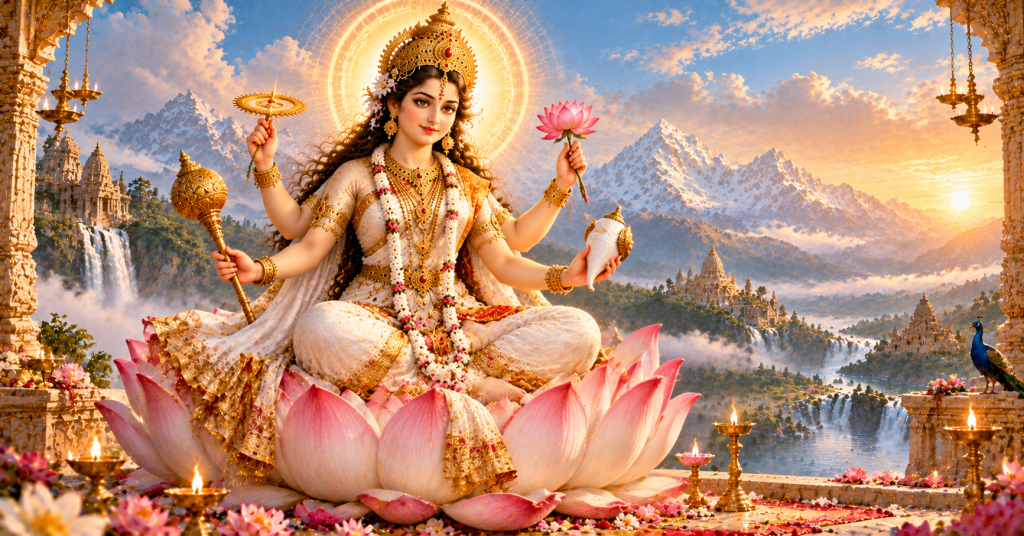
The ninth night of Navratri is the last. The Goddess worshipped on it is Siddhidatri, the giver of siddhis, and the Devi Kavacha closes its list of the Navadurga with her name: navamam Siddhidatri cha. She is shown seated on a lotus, with four arms holding a mace, a discus, a lotus and a conch, and her face is the face of completion. The tradition says that she is served by siddhas, gandharvas, yakshas, asuras and gods alike, and that she gives the accomplishments all of them seek. Where Mahagauri was the light that follows the dark, Siddhidatri is the fullness that follows the light. This article follows her name, her story, her form, the rites of Navami, and the Indian understanding of perfection that she holds at the end of the nine nights.
The Name and the Eight Siddhis
Siddhi comes from the root sidh, to succeed or to be accomplished, and means perfection, attainment, or the powers that are said to accompany spiritual practice. Datri is the giver. Siddhidatri is therefore the Goddess who bestows accomplishment. The tradition counts eight principal siddhis, listed in the Markandeya Purana and elsewhere: anima, the power to become as small as an atom, mahima, to become vast, garima, to become heavy, laghima, to become light, prapti, to attain whatever one wishes, prakamya, irresistible will, ishitva, mastery over creation, and vashitva, the power of control. The Bhagavata Purana (11.15) extends the list to eighteen, adding powers such as hearing and seeing from afar and freedom from hunger and thirst.
The Half Body of Shiva
Popular tradition, drawing on the Devi Purana, tells that Shiva worshipped the Goddess in this form and received from her all the siddhis, and that by her grace one half of his body became that of the Goddess, so that he became Ardhanarishvara, the Lord who is half woman. The image was met in the first article of this series as a sculpted statement of the union of Shiva and Shakti. Its root is older than the Purana. The Brihadaranyaka Upanishad (1.4.3) says that in the beginning the Self was as large as a man and a woman embraced, and that it divided itself into two parts, from which husband and wife came into being. The ninth night thus returns the series to its first teaching, that the power and the one who holds it are two halves of a single figure, and that the Goddess completes what the tradition calls the Lord.
Her Form
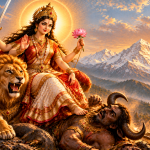
Siddhidatri is shown seated on a lotus, though some images place a lion beneath her. She has four arms. The lower right holds a mace and the upper right a discus, the upper left holds a lotus and the lower left a conch. The verse used in her worship describes her as ever served by siddhas, gandharvas, yakshas, asuras and the immortals, and asks that she, the giver of siddhis, always grant accomplishment. The mace is read as strength, the discus as the turning of time and of the mind in right order, the lotus as purity that has come to flower, and the conch as the sounding of Om. The emblems are those of Vishnu, and the figure brings Shaiva and Vaishnava imagery together in a Shakta image, which suits a Goddess who is said to contain both Lords.
Popular tradition associates her with the Sahasrara chakra at the crown of the head, which some schemes also assign to Kalaratri. As on earlier days, the chakra scheme is one reading among several.
Navami in Worship
Navami is the last day of the nine nights and the day on which many of the rites reach completion. Households that have kept the fast bring it to an end, often after the Kanya Puja begun on Ashtami is completed, and a homa, the fire offering, is performed with the verses of the Devi Mahatmya and closed with the Purnahuti, the final full offering. In Bengal, Maha Navami is a day of the great evening aarti with drums and the incense-pot dance, and the Goddess is offered the grand Bhog. In Karnataka, Tamil Nadu, Andhra Pradesh and parts of Kerala the day is Ayudha Puja, on which tools, instruments, books, vehicles and the implements of every trade are cleaned, decorated and worshipped, and in many homes the day is also given to Saraswati, the goddess of learning. Work is set aside so that the instruments of work may be honoured. The rite is the ritual form of the Gita’s teaching that perfection comes through one’s own work offered in worship (18.46). The farmer honours the plough, the scribe the pen and the driver the vehicle, and each is said to honour through it the power that works in all things, so that the day gives the dignity of worship to ordinary labour.
The King and the Merchant
The Devi Mahatmya shows the Goddess giving fulfilment in a story that frames the whole text. In its first chapter the king Suratha, defeated by his enemies and betrayed by his ministers, goes into the forest and meets a merchant named Samadhi, who has been driven from his home by his wife and sons. Both are still troubled by attachment to the people who wronged them, and they go to the sage Medhas to ask why. He tells them of Mahamaya, the power that draws even the wise into attachment, and in the thirteenth chapter he advises them to take refuge in her. They make an image of earth on a riverbank and worship her with discipline, and the Goddess appears and offers each a boon.
The two ask for different things. Suratha asks for his kingdom back and for a kingdom that cannot be taken from him in a later birth, and the Goddess grants both, promising that he will be reborn as Savarni, the eighth Manu. Samadhi asks for the knowledge that ends attachment, and she grants him that. The giver of siddhis answers each according to the longing brought to her, one with the fulfilment of the world and the other with release from it, and the tradition has read the pairing as a statement that she meets a person where he stands.
Perfection in Indian Thought
Indian thought has long distinguished two senses of siddhi. The first is the powers that practice is said to produce, and the second is perfection, the completion of a life in what it was for. The Bhagavad Gita (7.3) says that among thousands of people hardly one strives for perfection, and that among those who strive and succeed hardly one knows the Lord as he truly is. In the eighteenth chapter (18.46) it says that a person attains perfection by worshipping, through his own work, the one from whom all beings arise. The siddhi of the Gita is fulfilment through action offered, and it comes through the ordinary work of a life.
The texts that list the powers are careful about them. Patanjali’s Yoga Sutra devotes its third chapter to the powers that come from deep concentration, and then says that they are accomplishments for the outward-turning mind and obstacles to samadhi (3.37). The Bhagavata Purana, after listing the eighteen siddhis in its eleventh book, speaks of them as hindrances for the yogi who seeks the highest end. The tradition therefore places the Goddess of siddhis at the end of the nine nights as the one who gives the gifts and as the one who shows what they are for.
The invocation of the Isha Upanishad, which is also found in the Brihadaranyaka (5.1.1), says: that is full, this is full, from the full the full arises, and when the full is taken from the full, the full remains. The verse is recited at the close of many rites, and the Purnahuti of Navami is its ritual form. Completion in this tradition is a fullness that nothing taken from it can reduce.
The Spiritual Significance of Siddhidatri
The first teaching is that perfection is the end of a road and cannot be taken by shortcut. The Goddess of the ninth night follows the ground of Shailaputri, the discipline of Brahmacharini, the courage of Chandraghanta, the creation of Kushmanda, the care of Skandamata, the righteous force of Katyayani, the dark night of Kalaratri and the purity of Mahagauri. Read in order, the nine forms describe a road from a place to stand to a completed life, and the siddhi that the ninth Goddess gives belongs to a person who has walked what came before. Many devotees read the sequence in this way, and the tradition invites the reading by placing the last gift at the last night.
The second teaching is that power is a secondary gift. The Goddess who gives the siddhis is the one whom the Yoga Sutra counts as a distraction when sought for itself, and the tradition holds both statements together. A person who has become able to attend, to remember, to endure, to heal or to teach has received something of the siddhis in an ordinary sense, and the test of it is the use made of it. Some commentators read the eight classical powers as names for developed abilities, anima as the ability to attend to the smallest thing, mahima as largeness of mind, laghima as freedom from heaviness of heart, and so on, and the reading keeps the ancient list close to what practice does to a person.
The third teaching is union. Ardhanarishvara, given by the Goddess of the ninth night, shows power and its possessor as halves of one figure, and the Upanishad’s account of the Self dividing into husband and wife says the same. Completion here takes the form of two seen as one, and the tradition places that image at the end of the festival as the answer to the question put at its start, who the Goddess is.
The fourth teaching is in the number. Nine closes the sequence of single digits, and the tradition has long treated it as the number of completion. Some commentators liken the nine nights to the nine months of gestation, the period in which a life is made ready for birth. The comparison is a reading by commentators and has no source in the texts themselves, and it suits a festival that ends on the threshold of a tenth day, when what has been prepared comes out.
Seen Through the Natural World
The siddhis of the tradition, such as shrinking to the size of an atom or rising into the air, have not been confirmed by any scientific study, and the texts themselves treat them as secondary. What can be observed is that long practice changes the person who keeps it. Imaging studies of experienced London taxi drivers found that the posterior part of the hippocampus, a region involved in spatial memory, was larger than in comparison groups, and that its size rose with the years spent driving (Maguire and colleagues, 2000). Similar findings exist for musicians and for people who practise meditation, although the studies of meditation vary in quality and their conclusions are cautious. The studies of expert performance by K. Anders Ericsson and colleagues point the same way. They found that the differences between experts and others in music, chess and sport track the amount of structured, effortful practice gathered over years, which is the pattern the tradition describes when it makes perfection the end of a long road. Sustained effort leaves a physical mark, and this is the most evident ground for the old claim that a practitioner becomes capable of what an untrained person cannot.
Completion has its natural calendar as well. Navratri falls as the autumn harvest begins across much of India, when the rice and other crops of the monsoon season ripen, and many scholars have noted that the festival keeps an agricultural shape, with seed sown on the first day and green shoots standing on the ninth. A human pregnancy lasts about nine months, which gives the commentators’ comparison of the nine nights to gestation a basis in ordinary life. On the ninth night the moon is more than half lit and moving toward the full moon of Sharad Purnima, a week away. As on earlier days, the chakra scheme remains the tradition’s own account and has not been established by measurement.
The Ninth Lamp
On the ninth night the lamp has burned for nine days, and the barley beneath it stands tall and green in the vessel. The Goddess on the altar sits on her lotus with the mace, the discus, the lotus and the conch in her hands, and nothing remains to be asked of her. In many regions the barley will be taken from the vessel tomorrow and shared among the family as a blessing, and the lamp will be allowed to finish. Tomorrow, on Vijayadashami, the series closes with the theme that gives the tenth day its name, victory, in the stories of Rama and Ravana, of Durga and Mahishasura, and of the Pandavas and the shami tree.
Sources and Further Reading
Primary texts
Brihadaranyaka Upanishad 1.4.3 and 5.1.1; Isha Upanishad (invocation)
Bhagavad Gita 7.3 and 18.46
Yoga Sutras of Patanjali, chapter 3 (3.37)
Bhagavata Purana 11.15
Markandeya Purana, including the Devi Mahatmya (chapters 1 and 13); Devi Purana; Devi Kavacha
Translations and studies
Patrick Olivelle, Upanisads (Oxford World’s Classics, 1996)
Georg Feuerstein, The Yoga Tradition (Hohm Press, 1998)
Eleanor A. Maguire and others, “Navigation-related structural change in the hippocampi of taxi drivers,” Proceedings of the National Academy of Sciences 97 (2000)
K. Anders Ericsson, Ralf Th. Krampe and Clemens Tesch-Romer, “The role of deliberate practice in the acquisition of expert performance,” Psychological Review 100 (1993)
Thomas B. Coburn, Devi Mahatmya: The Crystallization of the Goddess Tradition (Motilal Banarsidass, 1984)
David Kinsley, Hindu Goddesses (University of California Press, 1986)