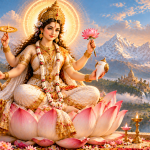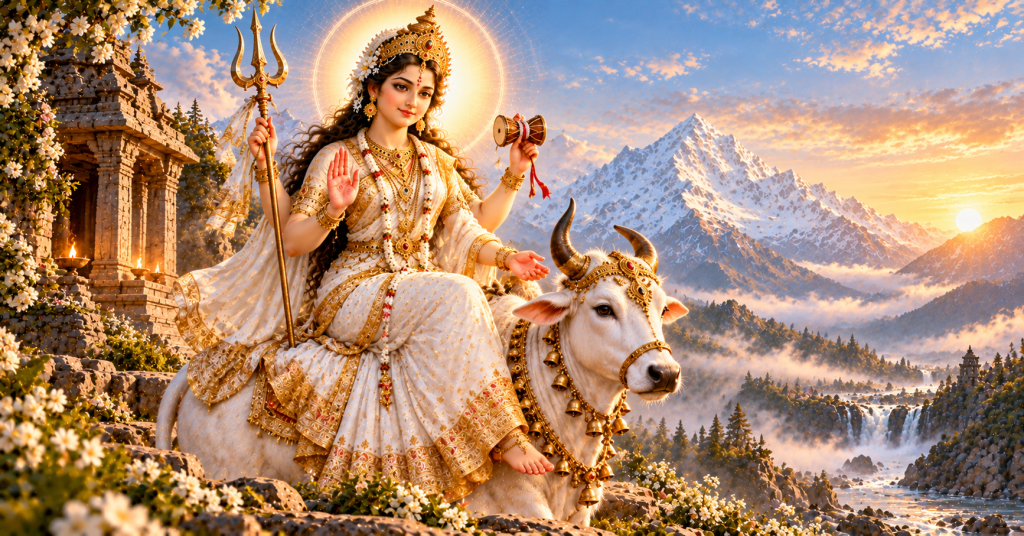
Ashtami, the eighth night of Navratri, is the day on which the festival turns from the dark to the light. The Goddess worshipped on it is Mahagauri, the great fair one, and she is shown in white, seated on a white bull, with a calm face and an air of settled peace. The Devi Kavacha names her eighth among the Navadurga: mahagauriti chashtamam. She follows Kalaratri directly, and the order is deliberate, since the tradition places the radiant Goddess beside the dark one as two moments of a single story. Ashtami is also among the most widely kept days of the festival, with the rite of Kanya Puja across much of the country and the Sandhi Puja in Bengal. This article follows her name, her story, her form, the rites of the day, and the Indian understanding of purity that she embodies.
The Name Gauri
Gauri means fair, radiant or golden-white, and it is one of the best-loved names of Parvati, under which women across India keep vows for the welfare of their households. Maha means great, and Mahagauri is the Goddess in the fullness of her radiance. The whiteness meant here is that of light, and the tradition compares it to the conch, the moon and the white jasmine. A name that begins in colour becomes in this way a name for clarity.
The word is old. In the Rigveda (1.164.41) Gauri is a figure of the waters and of speech, who fashions the waters and takes the forms of one-footed, two-footed, four-footed, eight-footed and nine-footed, and who in the highest heaven has a thousand syllables. The verse is a riddle and its meaning is debated, but the association of Gauri with water and with the word suits the Goddess who is washed in the Ganga.
From Dust to Radiance
Two traditions explain how Parvati became Mahagauri, and they agree on the essential point. The popular Navratri account follows directly from the second day. After years of tapas, Parvati’s body was weathered and covered with the dust of the forest, and Shiva, pleased with her resolve, poured the water of the Ganga over her, and she shone with a pure white light. In several Puranic retellings the story runs differently. Shiva calls her Kali in affectionate teasing, and she, offended, performs tapas until Brahma grants her a golden-white radiance, and from that time she is called Gauri.
The Devi Mahatmya carries the same pairing of dark and fair in another form. In the fifth chapter Parvati goes to bathe in the water of the Ganga, and from the sheath of her body there rises the Goddess Kaushiki, called Ambika, while Parvati herself, left behind, becomes dark and is known as Kalika, who dwells in the Himalaya (5.37 to 5.42). The tradition thus knows one Goddess in two colours, and Kalaratri on the seventh night and Mahagauri on the eighth are the same Mother at two moments of her story.
Her Form
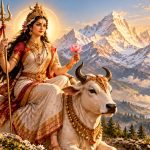
Mahagauri is shown in white garments, seated on a white bull, which is why she shares with Shailaputri the name Vrisharudha. She has four arms. The upper right is raised in the gesture that removes fear and the lower right holds a trident, the upper left holds the small drum called the damaru, and the lower left is held in the gesture that grants boons. The verse used in her worship describes her seated on the white bull, clad in white and pure, and asks that Mahagauri bestow what is auspicious, she who gives joy to the great god. The trident and the drum belong to Shiva, and the Goddess holds them as the sign of her union with him. The calm of her face is the emphasis of the form, and the tradition says that the one who worships her receives peace.
The schemes that assign a chakra to each of the nine forms are least consistent for the last days of Navratri. Mahagauri is variously placed at the crown of the head or at the lunar centre above the brow, and the assignment is best treated as one reading among several.
Ashtami in Worship
Ashtami is one of the great days of the festival, and its rites show the Goddess in more than one register. In much of northern and western India it is the day of Kanya Puja, in which girls of roughly two to ten years are invited into the home, seated, and honoured as forms of the Goddess. Their feet are washed, a mark is placed on the forehead, and they are fed and given gifts, and a boy is often invited with them as a companion. The rite is kept on Ashtami or Navami. In Bengal the same worship is called Kumari Puja, and at Belur Math Swami Vivekananda introduced it in 1901 during the first Durga Puja held there.
In Bengal the morning of Ashtami is the time of the Pushpanjali, the offering of flowers to the Goddess with the recitation of mantras, and it is among the days when the largest crowds visit the pandals. Ashtami also brings the Sandhi Puja, a rite performed at the junction of Ashtami and Navami, in the last twenty-four minutes of the one and the first twenty-four of the other. A hundred and eight lamps are lit and a hundred and eight lotuses offered, and the hour is said to be the time at which the Goddess, in the form of Chamunda, slew the demons Chanda and Munda. Many households also end their nine-day fast on Ashtami or Navami, after the Goddess has been honoured.
Purity in Indian Thought
Indian thought treats purity as a quality of the mind first and of the body second. The Chandogya Upanishad (7.26.2) says that when food is pure the mind is pure, when the mind is pure memory is steady, and when memory is steady all the knots of the heart are loosened. The Mundaka Upanishad (3.1.5) says that the Self within the body is luminous and pure, and that ascetics whose faults have worn away behold it. The Bhagavad Gita (14.6) describes the quality of sattva as stainless and luminous. Patanjali’s Yoga Sutra lists purity, shaucha, among the observances of the yogi, and says that purity of mind brings cheerfulness, concentration, mastery of the senses and fitness to see the Self (2.41).
Water has its own place in the tradition. A Rigvedic prayer (1.23.22) asks the waters to carry away whatever fault is in the one who prays, and the Ganga that Shiva is said to carry in his hair is the greatest of those waters. The river itself came down from heaven through the tapas of King Bhagiratha, and Shiva received her in his locks to break her fall (Ramayana, Bala Kanda; Bhagavata Purana 9.9), so that the water that cleanses Parvati is itself the fruit of tapas. Mahagauri brings these ideas into a single image: a Goddess who has passed through austerity, washed in the water of the Ganga, shining with the light that the Upanishad describes.
The Spiritual Significance of Mahagauri
The first teaching is that purity follows effort. Mahagauri’s radiance comes after the tapas of Brahmacharini and the long dark night, and the tradition places the clean light at the end of the labour. The Upanishadic verse on the shining Self says the same, that the vision belongs to those whose faults have worn away.
The second teaching is that the dark and the fair are one Goddess. In the Devi Mahatmya the dark Kalika and the bright Kaushiki come from a single Parvati, and Kalaratri and Mahagauri on consecutive nights are her two faces. The tradition does not teach that light is better than darkness. It teaches that the Goddess is both, and that the dark stretch of the seventh night and the bright one of the eighth belong to the same journey.
The third teaching concerns skin and worth. The story of Gauri has sometimes been read as praise of a fair complexion, and that reading does not match the texts’ own symbols. The whiteness of Mahagauri is that of light, the conch, the moon and the jasmine, which are signs of clarity, and the same Goddess is honoured as Kali and as Gauri without ranking the two. Readers who meet the story with the idea of complexion in mind may take from it that the tradition’s praise of radiance is praise of inner clarity and says nothing about skin.
The fourth teaching is in the rite of the day. When girls are honoured as the Goddess in Kanya Puja, the tradition holds that the divine is present in the young and the unprotected. Many devotees and educators take the day as an occasion to reflect that the reverence shown to girls on Ashtami asks to be matched through the year in how they are fed, taught and kept safe. The reflection belongs to the readers rather than to the texts, and the rite itself invites it.
Seen Through the Natural World
Water’s power to cleanse has a plain physical basis. It dissolves and carries away a very wide range of substances, and washing with soap and clean water is one of the most effective measures known for preventing the spread of infection, as the World Health Organization has long advised. The Ganga, honoured by the tradition as a purifier, is among the most heavily burdened rivers in the world, and governments and communities have undertaken programmes for its cleaning, among them the Namami Gange mission begun in 2014. The tradition’s reverence for the river gives that work a moral weight.
White is the colour of light that has not been sorted. When all the colours of the visible spectrum reach the eye together, the eye sees white, and objects such as snow, conch shell and jasmine appear white because they scatter or reflect most of the light that falls on them. The moon, to which Mahagauri is compared, shines by reflected sunlight. On the eighth night it stands near its first quarter, half lit, in the southern sky at dusk, since Ashtami falls when the moon has travelled about a quarter of the way round its path.
Human skin colour varies with the amount and kind of melanin in the skin, an adaptation to the strength of ultraviolet radiation across regions of the world, and it has no bearing on character or worth. The chakra scheme, as on earlier days, remains the tradition’s own account and has not been established by measurement.
The Half Moon over Ashtami
On Ashtami evening the girls have eaten and gone, the plates are washed, and the lamp on the altar burns beside the barley, now tall. The half moon stands in the south, and the Goddess in white sits on her white bull with her hand raised. Mahagauri has no word for the dark that came before her. She is the light that follows it. Tomorrow, on Navami, the series turns to Siddhidatri, the ninth form, the Goddess of fulfilment.
Sources and Further Reading
Primary texts
- Devi Mahatmya, chapter 5; Devi Kavacha
- Chandogya Upanishad 7.26.2; Mundaka Upanishad 3.1.5
- Bhagavad Gita 14.6
- Yoga Sutras of Patanjali 2.41
- Rigveda 1.23.22 and 1.164.41
- Ramayana, Bala Kanda (descent of the Ganga); Bhagavata Purana 9.9
- Shiva Purana, Rudra Samhita; Skanda Purana
Translations and studies
- Wendy Doniger, The Rig Veda: An Anthology (Penguin Classics)
- Patrick Olivelle, Upanisads (Oxford World’s Classics, 1996)
- Swami Gambhirananda, Bhagavad Gita with the Commentary of Shankaracharya (Advaita Ashrama)
- Edwin F. Bryant, The Yoga Sutras of Patanjali (North Point Press, 2009)
- J. L. Shastri (ed.), The Siva Purana (Motilal Banarsidass)
- G. V. Tagare (trans.), The Skanda Purana (Motilal Banarsidass)
- Thomas B. Coburn, Devi Mahatmya: The Crystallization of the Goddess Tradition (Motilal Banarsidass, 1984)
- David Kinsley, Hindu Goddesses (University of California Press, 1986)
- World Health Organization, WHO Guidelines on Hand Hygiene in Health Care (2009)