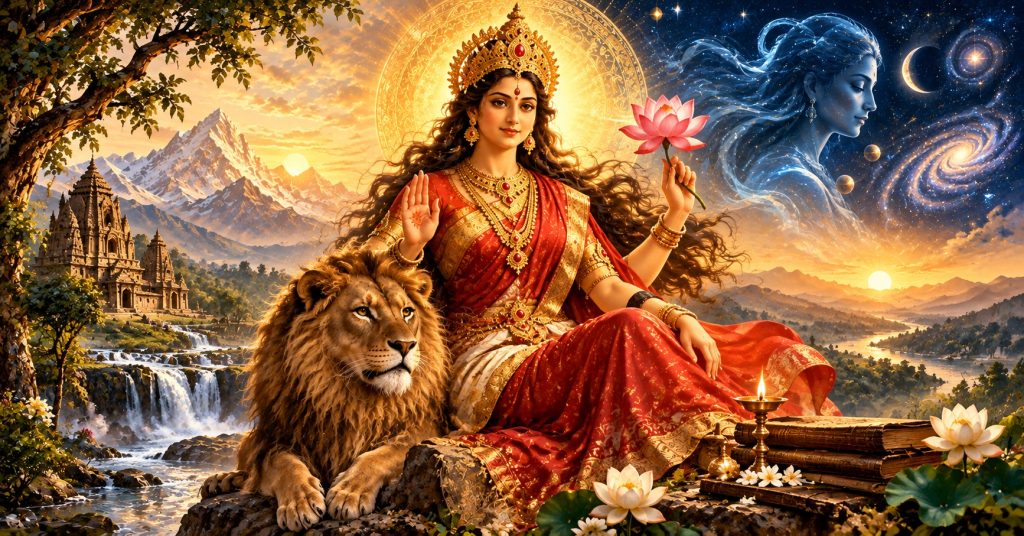
On the first evening of Ashwin, when the rains are withdrawing and the sky over India has cleared to a pale gold, a lamp is lit before a small earthen pot, barley is sown in damp soil, and a hymn recited for more than a thousand years begins again: Ya Devi sarvabhuteshu shakti-rupena samsthita, to the Goddess who dwells in all beings in the form of power, salutations to her again and again. Millions will keep vigil through the nine nights that follow, and most of them will do so as a child turns to a mother, without asking for a definition. This series offers the depth of that definition without disturbing the trust. It follows the Goddess through the Vedas, the Upanishads, the philosophical schools and the Puranas, and then through the nine forms honoured on the nine nights, so that devotion and understanding may walk together. This first article asks the question that stands behind all the others: who is the Goddess in Indian thought?
What the Words Mean
The Sanskrit word Devi is the feminine of Deva, and both rise from the root div, which carries the sense of shining. A devi is a luminous being, one through whom the divine becomes visible to those who seek it. Shakti comes from the root shak, to be able, and names the capacity by which anything acts at all. Fire has the power to burn, a seed the power to open into a tree, a mind the power to know, and Indian thought calls that power Shakti. It treats her as the very ability of each thing to be what it is, and does not regard her as an ornament added from outside.
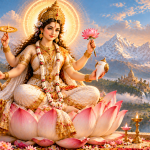
Together the two words give the concept its depth. The Goddess is a person to whom one speaks, offers flowers and sings at dusk, and she is also the energy running through every act in the universe, from the turning of the seasons to the beating of a heart. The tradition holds both meanings together and treats neither as the lesser. A child may call her Maa, and a philosopher may call her the creative power of Brahman, and each is addressing the same presence.
The Goddess in the Vedic Hymns
The oldest surviving text of the tradition, the Rigveda, already honours goddesses of great stature. Aditi, whose name means boundlessness, is spoken of as the mother of the gods. Prithvi is the earth, Usha the dawn that opens each day, Ratri the night, and Sarasvati the river who becomes in time the goddess of speech and learning. Among all the passages on the feminine divine, the one most often cited as the earliest philosophical declaration is the Devi Sukta, Rigveda 10.125.
Its speaker is Vak, the goddess of speech, known in the tradition as Vak Ambhrini, the daughter of the sage Ambhrina, and she speaks in the first person. She declares that she moves with the Rudras, the Vasus, the Adityas and all the gods, that she upholds Mitra and Varuna, Indra and Agni and the two Ashvins, and that she is the sovereign who gathers all treasures. In the eighth verse she says that she breathes forth like the wind while holding all the worlds together, and that in her greatness she stretches beyond the sky and beyond this earth.
Generations of readers have taken from this voice the understanding that the power sustaining the gods cannot be one among them. The Goddess here stands at the foundation of divinity, which is why later centuries could call her the mother of every deity. Her identification with speech carries equal weight, because speech is the means by which a mind gives form to what it knows, and the tradition keeps this thread alive in Sarasvati and, in the later Tantras, in the idea of the Goddess as sound. The Ratri Sukta (Rigveda 10.127) addresses the night, and its night is a watchful presence that comes with many eyes and guards those who sleep. For a festival of nine nights, it is a fitting beginning.
Older Roots
Long before these hymns were composed, people at Mehrgarh and along the Indus shaped small female figures in clay. Scholars have often linked them to fertility and the worship of a mother goddess, though the reading remains debated, since no deciphered script tells us what the makers intended. What can be said with more confidence is that reverence for the feminine divine in this land is very old and was never confined to one region or one class. The goddesses of villages, forests and rivers, the gramadevatas, were gradually drawn into relation with the Sanskritic tradition, and that long meeting of streams explains why the Goddess carries so many names and local faces today.
The Power Behind All Power
The Upanishads give this reverence a metaphysical language. The Kena Upanishad tells how Agni, Vayu and Indra, proud of a victory they believed their own, stood before a mysterious being they could not recognise. Agni and Vayu returned humbled, and Indra alone pursued the vision until a radiant woman appeared in the sky, Uma Haimavati, the daughter of the Himalaya. She told him that the being was Brahman, and that the victory had belonged to Brahman all along. It is worth reflecting that the highest knowledge reaches the chief of the gods through a goddess. The Shvetashvatara Upanishad speaks directly of her power. It describes the self-power of God hidden by its own qualities (1.3), asks the reader to know Maya as Prakriti and the great Lord as the wielder of Maya (4.10), and says that his supreme power is heard of as manifold, with knowledge, strength and action belonging to it by nature (6.8).
The Samkhya school gives this power a systematic form. It recognises two eternal principles. Purusha is pure consciousness, the witness that does not act, and Prakriti is primal nature, the active ground of the manifest world, woven of three strands called gunas: sattva, the clarity that illumines, rajas, the energy that moves, and tamas, the inertia that holds. In the Samkhya Karika of Ishvarakrishna (verse 21) their union is likened to the meeting of a lame man who can see and a blind man who can walk. Consciousness watches without moving, nature moves without seeing, and from their meeting the world unfolds. Verse 59 compares Prakriti to a dancer who leaves the stage once the audience has seen her performance, which is how the school understands the release of the self from the long cycle of experience.
The Shakta tradition inherits this framework and alters it at one decisive point. For the Shaktas the Goddess is Prakriti and Purusha together, power and consciousness in one being. She sees as well as moves, and she is the supreme reality appearing as the world.
Advaita Vedanta adds the idea of Maya, the power by which the one Brahman appears as many. Shakta thinkers recognise this Maya as the Goddess herself. The first chapter of the Devi Mahatmya introduces her as Mahamaya, who draws even the minds of the wise into delusion, and who is also the supreme knowledge that becomes the cause of liberation when she is gracious. The same power that binds also releases, and for this reason the Goddess is worshipped for worldly welfare and for liberation together.
The bond between the Goddess and Shiva is stated in the opening verse of the Saundarya Lahari, a hundred-verse hymn traditionally ascribed to Adi Shankaracharya, though scholars debate the attribution. The verse says that Shiva is able to create only when united with Shakti, and that without her he cannot even stir. The image of Ardhanarishvara, the form that is half male and half female, expresses the same truth in stone and bronze. Ramakrishna Paramahamsa spoke of it in homely words, likening Brahman and Shakti to fire and its power to burn, which cannot be thought of apart from each other.
The Mother in the Devi Mahatmya
The text closest to Navratri is the Devi Mahatmya, also called the Durga Saptashati or Chandi, a section of the Markandeya Purana. Its seven hundred verses fall in thirteen chapters, and most scholars place its composition around the fifth to sixth century CE. Thomas Coburn’s study describes it as the work in which the tradition of the Goddess as the supreme being took lasting form, with a mythology of its own. Devotees recite it through the nine nights, and many hold that to hear it is itself a form of worship.
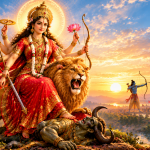
It tells three stories. In the first, the Goddess as Yoganidra, the cosmic sleep of Vishnu, withdraws it so that he wakes and overcomes the demons Madhu and Kaitabha. In the second, she takes form from the combined radiance of all the gods, who each give her a weapon, and she defeats the buffalo demon Mahishasura. In the third she overcomes Shumbha and Nishumbha and their generals, among them Raktabija. Commentators connect the three with Mahakali, Mahalakshmi and Mahasarasvati. The second story carries a meaning worth holding: the strength that restores order to the world is the gathered strength of every divine power, and it takes the form of a Mother.
In the fifth chapter stands the hymn that begins Ya Devi sarvabhuteshu, which fills homes and temples during Navratri. It salutes the Goddess as she abides in every being in many forms: as intelligence, sleep, hunger, shadow, power, thirst, forbearance, modesty, peace, faith, beauty, fortune, memory, compassion, contentment and motherhood. It also names her as error. The presence of hunger and error beside intelligence and compassion shows that the tradition does not confine the Goddess to what is pleasant or exalted. She is present in the whole range of experience, including the parts a person would prefer to set aside, and the devotee is invited to find nothing in life outside her presence. In the tenth chapter the other goddesses who fought beside her withdraw into her body, and she asks whom there is in the world besides herself. The tradition reads that scene as a declaration that the many are modes of the one.
The Devi Bhagavata Purana, in twelve books, treats the Goddess as the highest reality, and its seventh book holds the Devi Gita, in which she instructs the mountain king Himavat in the paths of knowledge, devotion and action. The Lalita Sahasranama, drawn from the Brahmanda Purana, gives a thousand names to her gracious form as Lalita, and generations of devotees have recited it and written commentaries on it.
One Mother, Many Faces
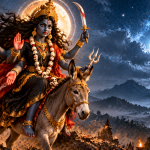
The nine forms honoured on the nine nights, the Navadurga, are named in the Devi Kavacha recited with the Devi Mahatmya: Shailaputri, Brahmacharini, Chandraghanta, Kushmanda, Skandamata, Katyayani, Kalaratri, Mahagauri and Siddhidatri. Each shows one aspect of the divine feminine, and the articles that follow will take them in turn. Beyond them stand the ten Mahavidyas of the Tantric tradition, Kali, Tara, Tripura Sundari, Bhuvaneshvari, Bhairavi, Chinnamasta, Dhumavati, Bagalamukhi, Matangi and Kamala, and beyond these the countless goddesses of the villages, each known to her own people by a name of her own.
None of this describes a crowd of unrelated deities. The tradition’s own answer is that Shakti, being the power behind every action, takes the form that each need requires: a protector in danger, a nourisher in want, a teacher in ignorance. The Vedic line ekam sat vipra bahudha vadanti (Rigveda 1.164.46), that truth is one and the wise speak of it in many ways, is cited in this connection, as it is for the many names of every deity in India. Indian thought has always held monistic, theistic and polytheistic expressions side by side, and the Shakta texts describe the many goddesses as appearances of one supreme power. A devotee may worship her at a village shrine or under the austere names of the Tantras and feel that the same Mother is being addressed.
Night, Battle and the One Mother
The Goddess is worshipped at night because night is the time when the work of the day is withdrawn and the mind turns inward. In Indian thought it holds dissolution and renewal together, and the Ratri Sukta already saw in it a protective presence. The word Navratri itself means nine nights. The twelfth chapter of the Devi Mahatmya refers to the great annual worship of the Goddess performed in autumn, and Sharad Navratri falls in the bright fortnight of Ashwin, when the rains have withdrawn and the seasons are turning. Fasting, recitation and vigil give a disciplined form to that passage between one season and the next.
The weapons and the battles are read by traditional commentators at more than one level. In the mythic account they tell of the defeat of tyrants who threatened the world. In the philosophical account the demons stand for forces within the mind, such as arrogance, delusion and craving, and Raktabija, who multiplies from every drop of his blood, shows how a desire that is fed multiplies itself. Devotees may take either reading or both, and the tradition has left room for each.
The First Night
The tradition teaches that the Goddess is met first in the nearest things. She is the power in the seed, the voice in the hymn, the night that watches over sleepers and the dawn that follows it, and she is the one a child calls Maa long before any philosophy is learned. The texts examined here ask the reader to see these as a single presence, within every being and beyond the world she sustains.
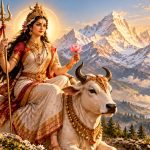
On the first night of Navratri a clay pot is filled with water and set before a lamp, and the barley sown beneath it will turn green before the nine nights are over. The series begins there, with Shailaputri, the daughter of the mountain, from whom the nine days take their first step.
Sources and Further Reading
Primary texts
- Rigveda, Mandala 10, hymns 125 (Devi Sukta) and 127 (Ratri Sukta); Mandala 1, hymn 164, verse 46
- Kena Upanishad; Shvetashvatara Upanishad (1.3, 4.10, 6.8)
- Samkhya Karika of Ishvarakrishna (verses 21 and 59)
- Devi Mahatmya (Durga Saptashati), Markandeya Purana, including the Devi Kavacha
- Devi Bhagavata Purana, including the Devi Gita (Book 7)
- Lalita Sahasranama, Brahmanda Purana
- Saundarya Lahari, traditionally attributed to Adi Shankaracharya
Translations and studies
- Wendy Doniger, The Rig Veda: An Anthology (Penguin Classics)
- Swami Gambhirananda, Eight Upanishads (Advaita Ashrama)
- Patrick Olivelle, The Early Upanishads and Upanisads (Oxford)
- Swami Vijnanananda, The Srimad Devi Bhagavatam (Sacred Books of the Hindus)
- Swami Tapasyananda, Saundarya Lahari (Sri Ramakrishna Math)
- Thomas B. Coburn, Devi Mahatmya: The Crystallization of the Goddess Tradition (Motilal Banarsidass, 1984)
- Thomas B. Coburn, Encountering the Goddess (SUNY Press, 1991)
- David Kinsley, Hindu Goddesses: Visions of the Divine Feminine in the Hindu Religious Tradition (University of California Press, 1986)
- John Woodroffe (Arthur Avalon), Shakti and Shakta (1918)
- Gerald James Larson, Classical Samkhya (Motilal Banarsidass)