Writers International Edition

Education

Not Broken Children, But Unprepared Ones: Rethinking Why We Are Losing Our Young

There is a number that should stop every parent in this country mid sentence. Every year, thousands of Indian students take their own lives, a majority of them still in school or college, most of them under the weight of an exam, a rank, or a comparison they were never taught how to carry. We talk about this loss in hushed, careful language, as though naming it too plainly might make it worse. But the silence has not protected anyone. It has only allowed the same pattern to repeat, year after year, exam season after exam season.

I want to say something that will sound uncomfortable to many parents reading this, myself included. When a child is pushed to the point where death feels like the only exit from a difficult moment, the failure is rarely the child’s. It is ours. Not the failure of love, because most parents love their children fiercely, but the failure of preparation. We have raised a generation of children who are extraordinarily equipped to chase success and almost entirely unequipped to survive its absence.

Earlier this year, a Supreme Court appointed task force examining student suicides in India reached a conclusion that deserves far more attention than it received. It described the crisis not as a mental health problem in isolation, but as a structural and institutional one, rooted in how our schools, our households, and our systems are built. That framing matters, because it moves the conversation away from a lazy and frankly cruel narrative, the idea that children today are simply weaker, softer, less resilient than the generations before them. That narrative is not just false. It is a convenient way for the adults in the room to avoid looking at their own part in this.

Think about what we actually teach a child from the age of six or seven. We teach them to read, to calculate, to memorise, to compete. We measure them constantly, through report cards, through rank lists, through the silent comparison every parent makes at a family gathering when someone else’s child scores higher. What we very rarely teach, in any structured or intentional way, is how to fail. How to sit with disappointment without believing it defines you. How to ask for help without believing it makes you weak. How to separate a bad result from a bad self.

A child who has never been allowed to fail at anything small will not know what to do the first time they fail at something big. And for an enormous number of Indian students, the first real experience of failure arrives all at once, in the form of a board exam, an entrance test, or a rank list, at precisely the age when their sense of identity is most fragile and least separable from their achievements. We spend eighteen years building a child’s entire self worth around performance, and then act astonished when a single bad performance feels, to that child, like the end of the world.

Part of this comes from how we as parents were raised ourselves. Many of us grew up in households where emotional conversations were rare, where a child’s sadness was met with distraction rather than discussion, where the phrase beta sab theek ho jayega was offered as comfort but rarely followed by an actual conversation about what was wrong. We inherited a way of parenting built on discipline and provision, and it served its purpose in a different India, facing different scarcities. But that model was never built to help a child process anxiety, comparison, heartbreak, or the specific, crushing pressure of a hundred million students competing for a small number of seats. We are still using an old map to navigate a world that has changed completely underneath our children’s feet.

None of this is said to assign blame to any individual parent who has lost a child. No parent sends their son or daughter to school in the morning imagining they will not see them again. Grief of that kind does not need an outside voice adding guilt to it, and I want to be careful not to do that here. What I am asking is something different, aimed not backward at individual tragedies but forward at the millions of households still raising children today. We have the chance, right now, to change how we prepare our children for a difficult life, before difficulty arrives.

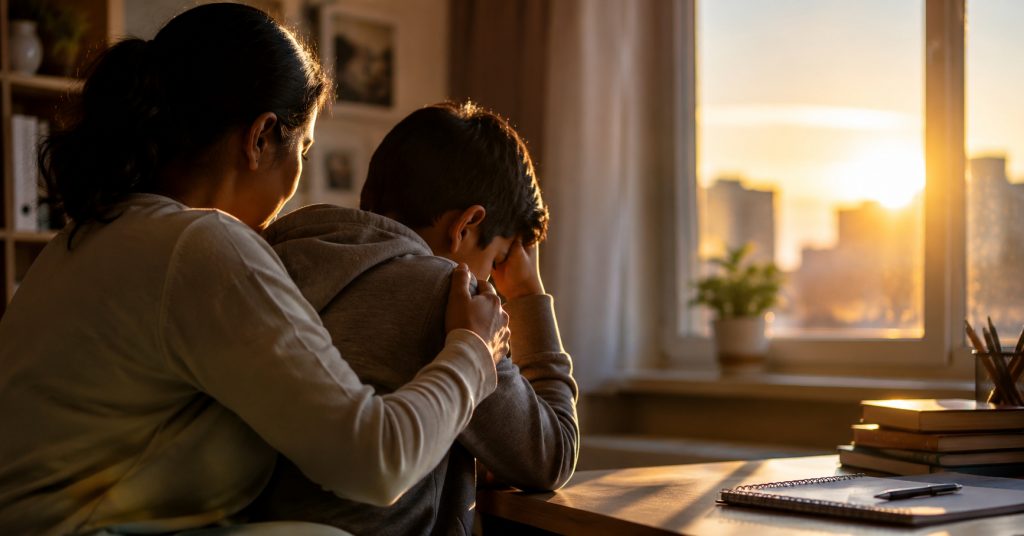
That preparation has to start early, and it has to be deliberate. Children need to hear, repeatedly and without irony, that their worth is not contained in a mark sheet. They need parents who ask about their day before they ask about their score. They need to watch adults in their own home fail at something and recover from it, openly, so that failure stops looking like a catastrophe and starts looking like a normal Tuesday. They need permission to say I am struggling without immediately being handed a solution, a lecture, or a comparison to a cousin who is doing better.

Schools carry a share of this responsibility too, and to their credit, some have begun introducing counsellors and wellness periods. But a counsellor’s office that a child is too afraid to walk into, for fear of being seen as weak or unstable, does very little good. What actually helps is a culture, inside the classroom and inside the home, where struggling is treated as information rather than failure, where a teacher or a parent notices a withdrawn child not as an inconvenience but as a signal worth paying attention to.

There are also very real warning signs that parents can learn to watch for, and this knowledge should be as common as knowing basic first aid. A child pulling away from friends and activities they once enjoyed. Sudden changes in sleep or appetite. A drop in performance that comes with silence rather than the usual complaints. Talk, even indirect or joking talk, about being a burden or about things getting better after they are gone. These are not moments for lectures. They are moments to sit down, put away every device, and simply ask, gently and without judgement, how someone is actually doing.

If you or someone you know is struggling with thoughts like these, please reach out. Tele-MANAS, the government’s free 24 hour mental health helpline, can be reached at 14416, and the KIRAN helpline is available toll free at 1800-599-0019. These lines exist precisely for moments that feel unbearable, and reaching out to them is not a small or shameful thing. It can be the thing that buys a family more time.

I believe deeply in the strength of India’s children. I do not think for a moment that this generation is fragile. I think it is a generation carrying more comparison, more visibility, and more pressure per square inch than any generation before it, largely without the tools to metabolise any of it. That is not a flaw in them. It is a gap in what we, as parents, as schools, and as a society, have chosen to prioritise.

We can close that gap. It starts with something as simple as a parent choosing, tonight, to ask their child how they are feeling instead of how they scored, and actually waiting, in silence if needed, for the real answer.

Preeth Padmanabhan Nambiar

In short: India is losing thousands of students to suicide every year, and a 2026 Supreme Court-appointed task force has concluded the crisis is structural, not simply psychological. This piece argues the problem is not that today’s children are weaker, but that most have never been taught how to fail, how to sit with disappointment, or how to separate their self worth from their marks. Parents, many raised in households where emotional conversations were rare, often pass on the same silence. Real change starts small: asking a child how they feel before asking how they scored, normalising failure at home, watching for early warning signs, and knowing that help is a phone call away through Tele-MANAS (14416) and KIRAN (1800-599-0019).

If this piece has raised anything difficult for you personally, please know that support is available. Tele-MANAS: 14416 (24/7, free) | KIRAN: 1800-599-0019 (24/7, free)

Not Broken Children, But Unprepared Ones: Rethinking Why We Are Losing Our Young Read More »

Beyond the Stethoscope: Why India’s Youth Deserve a Bigger Dream

I want to begin with something I do not say lightly. I have my reservations about several decisions taken by the BJP led government, and I have not hesitated to voice them where I felt they were warranted. But when it comes to the question in front of us today, the nation comes first. That is the lens through which I write this piece, and it is the lens I ask every reader to bring to it as well.

India today is not the India of a decade ago. Under the leadership of Narendra Modi, we have watched a government run increasingly like a team of professionals rather than a coterie of court favourites, and that shift matters more than most people give it credit for. Yet governance is not built overnight, and the bureaucratic machinery that carries out policy on the ground still carries the residue of decades of neglect and mismanagement under Congress rule. That inherited mindset does not vanish with a change of government. It has to be reformed, person by person, office by office, and I believe that reform is possible and already under way.

It is against this backdrop that we must look at the protests currently unfolding over the NEET examination. Students have real grievances. A paper leak is a paper leak, and the anger of a young person who spent two years preparing for an exam only to watch its integrity collapse is anger that deserves to be heard, not dismissed. But somewhere along the way, a genuine student grievance has been absorbed into a larger political theatre. The opposition, having found little traction in Parliament, has seized on this moment as a stick to beat the government with, and in doing so it risks turning a fixable administrative failure into a manufactured crisis of instability at a time when India can least afford one. I say this not to excuse any lapse on the government’s part, because lapses must be owned and corrected, but to draw a line between the students who are hurting and the political actors who are using that hurt for their own ends. India has faced bigger storms than this and come through them. I trust that the government’s course correction, and the good sense of the Indian public, will eventually make clear who was fighting for students and who was simply fighting for headlines.

But I want to move past that argument, because I think it distracts from a deeper and more uncomfortable question, one that no political party on any side has been honest enough to ask. Why does an exam like NEET carry so much emotional weight in the first place? Why does a single test, on a single day, feel to millions of Indian families like the difference between a life worth living and a life wasted?

The answer has very little to do with paper leaks and everything to do with how narrowly we have taught our children to dream.

Walk into almost any middle class Indian home and ask a ten year old what they want to become. The answer, in the overwhelming majority of cases, will be doctor or engineer. Not because the child has weighed a dozen possibilities and settled on medicine after genuine reflection, but because those are the only two words the child has been allowed to hear as answers to the question of a worthwhile life. I would go further and suggest a simple experiment. Survey the students sitting for NEET this year, not about their marks, but about whose dream they are actually pursuing. Ask them plainly whether this is what they want, or what their parents decided for them somewhere around the age of twelve. I suspect the results would embarrass an entire generation of well meaning parents far more than any paper leak ever could.

There was a time when this reverence made sense. Decades ago, when India had a fraction of its current medical infrastructure, a doctor in a small town genuinely stood between a community and its worst outcomes. The profession earned its near divine status because the alternative to a doctor’s presence was often death. That context has changed enormously, even if our collective imagination has not caught up with it. India now trains a very large number of medical graduates every year, and while the country still needs more doctors in its rural and underserved regions, the shortage is one of distribution and incentive, not of raw output. We do not lack doctors because too few children dream of medicine. We lack doctors in the places that need them because we have never solved the harder problem of making rural service attractive, dignified, and secure.

Meanwhile, we rarely tell children the full cost of the dream we are selling them. A medical education in India is long, expensive, and does not end with the degree that gets printed on the certificate. A basic MBBS is only the entry ticket. Real specialisation, the kind that commands respect and income, requires postgraduate study that is fiercely competitive and often financially out of reach for the very families who sacrificed the most to get their child into medical college in the first place. We celebrate the admission and stay silent about the decade that follows it, the loans, the entrance exams within entrance exams, the years spent as a resident earning very little while working impossible hours. Nobody tells the twelve year old any of this. They are only shown the white coat and the stethoscope, never the small print underneath.

Engineering tells an even more sobering story, and one that is easier to verify because it has already played out. A generation of parents pushed their children toward engineering with the same blind faith once reserved for medicine, and today India produces engineering graduates by the millions, a significant number of whom cannot find work in their own field and end up in jobs paying ten thousand rupees a month, doing work that has nothing to do with the four years and the debt behind their degree. This is not a controversial opinion anymore. It is a well documented outcome, and it should have been the loudest warning sign this country has seen in a generation about the danger of chasing a label instead of a genuine aptitude.

So what do we do with this. Not with anger, and not with despair, but with an honest correction that starts inside the home.

Parents have to be willing to let go of prestige as the only measure of a good life for their child. A career is not a family trophy. It is the daily texture of a person’s existence for forty years, and it should be chosen with that reality in mind, not with an eye on what will impress relatives at a wedding. Schools and colleges need to introduce serious, well resourced career counselling far earlier than they currently do, ideally by the time a child enters the ninth grade, so that aptitude and interest have a chance to shape ambition before ambition hardens into obsession with two overcrowded fields. I understand efforts are already being made in this direction, with career counsellors being introduced in various educational settings, and that is a welcome beginning. But a beginning is not enough. The government has a real role to play here, in funding large scale awareness campaigns aimed not only at students but at parents, because in most Indian households it is the parent, not the child, who needs to be persuaded first.

India’s opportunity landscape has expanded far beyond what most families are willing to imagine. There is enormous, underexplored scope in data and technology, in design, in the creative industries, in skilled trades, in agriculture reimagined through modern methods, in renewable energy, in public policy, in entrepreneurship of every conceivable size. None of these carry the instant social currency of the word doctor, but many of them offer more honest, more sustainable, and often more fulfilling paths than the ones we have taught our children to worship.

I will end where I think this conversation should always end, with faith in the children themselves rather than in the systems around them. The same students who are out on the streets today, demanding accountability and refusing to be silent about a broken examination process, are proof of exactly the kind of courage this country needs more of, not less. They are not fragile. They are not lost. They are simply the products of a narrow map that we, the adults, drew for them. Our task now is not to protect them from disappointment but to widen that map, to tell them clearly and repeatedly that there is more than one door to a meaningful life, and to trust them to walk through whichever one is truly theirs. Give them that trust, and I have no doubt they will build an India far wiser than the one we are leaving behind.


In short: The NEET protests have exposed two separate problems that keep getting mixed into one. The first is a genuine examination integrity crisis that deserves accountability, even as opposition parties try to convert it into political capital. The second, deeper problem is India’s long standing obsession with medicine and engineering as the only respectable career paths, a mindset largely inherited from parents rather than chosen by students. With rising costs of medical education, a saturated engineering job market, and thousands of graduates earning as little as ten thousand rupees a month, the case for widening career awareness among both children and parents has never been stronger. Early career counselling, honest conversations about the real cost and length of professions like medicine, and government backed awareness campaigns can help India’s youth choose careers based on aptitude rather than inherited prestige.

Beyond the Stethoscope: Why India’s Youth Deserve a Bigger Dream Read More »

Dream Keepers: Poem by Snježana Mayer

Where has he gone?

Where has the keeper of my dreams hidden?

I search for him in the dark corners of the room,

I open drawers, turn out pockets.

Everything is empty. I leaf through yellowed pages.

The clock ticks, the end is near.

Dreams have long since

ceased to be an escape from the present.

The keepers, silent and hidden somewhere, await a spark,

A spark to ignite the sky.

Snježana Mayer 

About the Poet

Snježana Majer PIAFSnježana Mayer, born in 1963, is a distinguished Croatian artist and poet whose creative odyssey began with her graduation in Painting and Graphic Design from the School of Fine Arts in Split. From her early days restoring the Croatian National Theatre in Split, she developed a profound reverence for art as both a spiritual and cultural inheritance. Over the decades, Snježana has showcased her works in numerous international exhibitions, including four solo shows that chronicle her evolving aesthetic vision. Her oeuvre ranges from spiritually resonant paintings adorning churches to murals, graphic designs, and customized works created to reflect the individuality of her patrons. A passionate preserver of cultural heritage, she is deeply involved in associations such as the Society for the Protection of Cultural Assets “Radovan” – Trogir and the Trogir Art Association, and holds memberships in esteemed global bodies including UNOTA, IAC, Artcom Expo, and Writers Capital Foundation, reflecting her global artistic presence.

Beyond her prolific artistry, Snježana is a mentor devoted to nurturing young talents through creative workshops, inspiring children to explore their imagination through the language of art. Her works have received widespread recognition, earning prestigious awards and being housed in museums and collections across Europe, Asia, and America, including South Korea, Portugal, and the United States. Though celebrated primarily as a visual artist, Snježana’s poetic essence pervades all her creations—her verses, much like her paintings, mirror a soul attuned to beauty, faith, and the timeless human spirit that binds art and life into one harmonious whole.


Dream Keepers: Poem by Snježana Mayer Read More »

Jorge Alexis Del Arca: A Multifaceted Talent from Lima, Peru

Jorge Alexis Del Arca, born on June 4, 1984, in Lima, Peru, has been a beacon of creativity and talent since childhood. From a tender age, he exhibited an extraordinary affinity for literature, particularly stories and fables. His father, recognizing this burgeoning interest, would share enchanting tales that transported Jorge to magical realms, igniting a passion for storytelling that would flourish throughout his life.

By the age of six, Jorge’s imagination led him to create his comic strip, Super Trapo, featuring an elderly doctor with superpowers reminiscent of Superman. He also birthed El Pájaro Karateka, inspired by his fascination with martial arts films. These early creations foreshadowed his future as a storyteller and writer. At eight, encouraged by his father, Jorge began reciting poetry in school, a testament to his growing love for the written word. By thirteen, he had already garnered recognition, winning a school acrostic competition that highlighted his poetic talents.

In addition to his literary pursuits, Jorge cultivated a diverse array of interests. He learned to play chess at the age of seven, securing victories in various championships within his category. His passion for mathematics and music further enriched his childhood experiences, with music becoming a profound love that shaped his identity. Jorge’s musical journey began in earnest when he took an extension course at the National Library of Peru and the National Conservatory of Music, where he explored various instruments including the piano, guitar, pan flute, and accordion.

Jorge’s dedication to music was solidified through private lessons with Georgina Rodríguez De Banda, who not only taught him piano but also introduced him to the accordion. His talent for instrumental and classical music blossomed, and he showcased his skills at local school events. After graduating from CETPRO Atlantic in 2012, he continued to refine his musical prowess, currently studying at the Superior School of Music Francisco Pérez Anampa in Ica.

An accomplished writer, Jorge has penned over 70 value-based stories and more than 150 poems, all awaiting publication. His storytelling skills earned him accolades, including a victory in the Gabriel García Márquez storytelling contest organized by Utopía Poética’s Tamaulipas branch.

On July 7, 2024, Jorge showcased his musical talents at the First Music Expo on America Online Radio and the World Press Agency, further establishing himself as a versatile artist committed to his craft. With his rich tapestry of experiences in literature and music, Jorge Alexis Del Arca continues to inspire others through his creative endeavors, leaving an indelible mark on the artistic landscape of Peru and beyond.

Jorge Alexis Del Arca: A Multifaceted Talent from Lima, Peru Read More »

Gloria Teresa Pizarro Dioses: A Luminary of Education and the Arts

Gloria Teresa Pizarro Dioses, a distinguished figure from Tumbes, Peru, embodies the harmonious blend of education, culture, and artistic expression. With a rich academic background and a passion for the arts, Gloria has dedicated her life to fostering creativity and knowledge in her community and beyond.

Her academic journey is marked by impressive achievements. Gloria holds a Bachelor’s degree in Secondary Education and a second specialty in Primary Education. In addition to her teaching credentials, she is a Certified Public Accountant and has earned a Bachelor’s degree in Business Administration. Her commitment to education is further reflected in her academic accomplishments, including a Master’s degree in Education with a focus on Research and Teaching, a Bachelor’s degree in Accounting Sciences, and a Bachelor’s degree in Education.

Gloria’s artistic training began at the Instituto Folklórico del Magisterio Alejandro Vivanco, where she graduated specializing in folk dance. Her dedication to the performing arts led her to pursue further studies at the School of Dramatic Arts, where she established herself as a national declaimer, showcasing her profound connection to Peruvian cultural heritage.

Her passion for the arts has led her to participate in numerous festivals and literary events, both nationally and internationally. In Peru, she has made significant contributions to prominent events such as the Casa de la Literatura Peruana in Lima, where she participated in the Viernes Literarios and various festivals celebrating art and poetry in locations like San Pedro de Lloc in Trujillo, Tembladera in Cajamarca, and Chancay in Lima. Notably, she achieved second place in the adult category of the Concurso Tu Voz Existe, organized by the Municipalidad de Lince in Lima.

On the international stage, Gloria has represented Peru at the Festival Internacional de Poesía in Macas, Ecuador, and participated in a cultural poetry event organized by the Asociación Teatro de La Tierra in Madrid, Spain, in 2023. She also contributed to the Artistic Cultural Festival held by the Asociación de Mujeres Empresarias Iberoamericanas in Madrid the same year. Furthermore, her engagement extends to virtual platforms, such as the International Festival Poesía por la Paz in Valle del Cauca, Colombia, and the CCI Utopía Poética Universal affiliated with California.

Gloria’s dedication to education and the arts has not gone unnoticed, as she has received numerous accolades for her contributions. She has been recognized by the Congreso de la República for her efforts in promoting education, art, and culture in Peru, particularly on International Women’s Day. Her remarkable achievements have also earned her acknowledgment from the Parlamento Andino. The municipal government of Zarumilla, Tumbes, has honored her as Hija Ilustre, while various educational institutions, including the Colegio de Profesores del Callao, the Dirección Regional de Educación del Callao, Universidad Nacional Federico Villarreal, Universidad Privada Alas Peruanas, and Universidad Privada Las Américas, have also celebrated her contributions.

Gloria Teresa Pizarro Dioses stands as a testament to the transformative power of education and the arts. Her unwavering commitment to fostering creativity, preserving cultural heritage, and inspiring future generations has made her a celebrated figure in Peru and beyond. Through her dedication, she continues to pave the way for a richer, more vibrant cultural landscape in her community and across the globe.

Gloria Teresa Pizarro Dioses: A Luminary of Education and the Arts Read More »

ΕΡΩΤΑΣ: Poem by Smaragdi Mitropoulou

Χαμογελάει ο έρωτας
στου ήλιου το πρώτο φως.
Στήνει καρτέρι
σε αυλές με ασβέστη ασπρισμένες
και δίπλα σε πηγές με νερά κρυσταλλένια.
Πρώτος σέρνει το χορό στους ήχους του βιολιού
και τις νυχτιές ταξιδεύει ολόγυμνος
σε άγουρα στήθη και φλογισμένα μάγουλα.
Τις αυγές σκορπά λεμονανθούς
σε ταξιδιάρικα κύματα…
και φυτεύει καρπούς
να γλυκαίνουν τα μάτια, τα χείλη.
Μοσχοβολά ο έρωτας
βασιλικό και θάλασσα.

LOVE

Love smiles
at the first light of the sun.
It lies in wait
in courtyards whitewashed with lime
and beside springs with crystalline waters.
First, it leads the dance to the sounds of the violin
and at night it travels naked
to unripe breasts and flushed cheeks.
At dawn, it scatters lemon blossoms
in wandering waves…
and plants fruits
to sweeten the eyes, the lips.
Love smells
of basil and sea.

Poem by
Smaragdi Mitropoulou

About the Poet

Η Σμαραγδή Μητροπούλου γεννήθηκε στην Αθήνα. Σπούδασε Ιστορία και Αρχαιολογία στην Ελλάδα και τη Μεγάλη Βρετανία. Υπηρετεί στη Δευτεροβάθμια Εκπαίδευση. Το ποιητικό και πεζογραφικό της έργο έχουν αποσπάσει βραβεία και διακρίσεις στην Ελλάδα και στο εξωτερικό. Είναι μέλος του Διοικητικού Συμβουλίου (Executive Board Member) του Writers Capital International Foundation και ισόβιο μέλος (Lifetime Fellow Member) του International Society for Development and Sustainability (ISDS) με έδρα την Ιαπωνία. Έχoυν εκδοθεί και κυκλοφορούν επτά βιβλία της στην Ελλάδα. Ποιήματα της έχουν μεταφραστεί στην αγγλική, κινεζική και ισπανική γλώσσα, καθώς και στα Ταιβανέζικα και στη γλώσσα Μπενγκάλι κι έχουν δημοσιευτεί σε site και περιοδικά στην Ευρώπη, στην Ασία και στη Λατινική Αμερική. Επίσης, ασχολείται με την τέχνη της φωτογραφίας κι έχει συμμετάσχει σε ομαδικές εκθέσεις στην Ελλάδα και στο εξωτερικό.

Smaragdi Mitropoulou was born in Athens. She studied History and Archaeology in Greece and the United Kingdom. She serves in Secondary Education. Her poetic and prose works have received awards and recognitions both in Greece and abroad. She is a member of the Executive Board of the Writers Capital International Foundation and a Lifetime Fellow Member of the International Society for Development and Sustainability (ISDS) based in Japan. Seven of her books have been published and are circulating in Greece. Her poems have been translated into English, Chinese, and Spanish, as well as Taiwanese and Bengali, and have been published on websites and in magazines across Europe, Asia, and Latin America. She is also involved in the art of photography and has participated in group exhibitions in Greece and abroad.

ΕΡΩΤΑΣ: Poem by Smaragdi Mitropoulou Read More »

Smaragdi Mitropoulou

Smaragdi Mitropoulou: Where Art, Poetry, and History Converge

Smaragdi Mitropoulou, born in Athens, is a multifaceted poet, artist and historian whose work has transcended borders and won acclaim both in Greece and abroad.

Smaragdi’s educational journey took her through the realms of History and Archaeology, where she honed her deep understanding of the past. Her academic pursuits led her to the United Kingdom, expanding her horizons and enriching her perspective.

But her talents extend beyond academia. She’s an accomplished poet and prose writer, with her literary works earning awards and recognition in Greece and beyond. Her poetry book “One Moment, Just an Eternity” and “Sounds in the Silence” have been translated into English, reaching audiences in the UK and India through Ontime Books and Pharos Books.

Smaragdi is not just a writer; she’s an artist with a unique vision. Her paintings and poems intertwine, creating a mesmerizing tapestry of emotion and history. Her artistic endeavors have taken her to numerous exhibitions across Europe, Asia, and Latin America. Her works have been displayed in prestigious locations such as the Agios Athanasios Art Center in Naoussa, Paros, and the Villa Kosta in Nea Erythraia.

Smaragdi is a member of the Executive Board of the Writers Capital International Foundation, connecting writers and artists globally, and a Lifetime Fellow Member of the International Society for Development and Sustainability (ISDS) based in Japan. Her influence stretches across languages, with her poems translated into English, Chinese, Spanish, Bengali, and Taiwanese.

She’s not just an artist and writer; Smaragdi also delves into the art of photography. Her photographic exhibitions, like “Art: An Endless Journey into Light” and “When Resurrection Becomes Inspiration,” showcase her talent behind the lens.

In May 2023, Smaragdi presented two solo photography exhibitions titled “Life to Infinity” at the Art16 gallery in Kerameikos, Athens, highlighting her passion for photography.

Smaragdi Mitropoulou’s journey through art, literature, and history continues to inspire and bridge cultures, making her a prominent figure in the global artistic community.

Smaragdi Mitropoulou: Where Art, Poetry, and History Converge Read More »

Panorama International Literature Festival on the theme Prana: the Breath culminates

Madrid (Spain): The month-long Panorama International Literature by the Writers Capital International Foundation aimed at fostering humanitarian values across the globe, culminated in a ceremony which was held virtually. Hundreds of writers from around the world attended the event and also shared their experiences during the festival. This is the fourth season of PILF which had earlier won a world record for being the lengthiest literature festival to promote humanitarian values.

The festival that started on new year’s day was on the theme Prana: The breath focusing on the element of air which is in the spotlight considering the challenge of air pollution faced by the global community. A variety of programmes were conducted globally in connection with the festival including competitions for school students on the theme, a tree-planting drive named ‘giving back to nature’, a photography contest etc. Delegates from different professional fields including Writers, educators and poets, from over 78 countries presented their works on the theme virtually and in offline mode. As many as 16 live sessions were also conducted as part of the event in which authors and other intellectuals from different domains had the opportunity to share their works before the literary and intellectual community in the form of poets’ meet, speeches or panel discussions.

The Closing Day Ceremony presided over by the President of the Writers Capital Foundation and the chairman of PILF, was inaugurated by the chief guest Prof. Jeffrey Levett, Founding Dean of the National School of Public Health, Athens, Greece who also announced the newly established educational mission of the foundation International Centre for Foreign Languages and Literature. PILF Chief advisor and coordinator of Spain Prof. Joan Josep Bracelo delivered the keynote address. Vice President of the World Philosophical Forum and Member of the International Academy of Social Sciences, USA, Prof Steven Roy was the guest of honour.

Johanna Devadayavou, Chief Human Resources Officer of WCIF, who delivered a message to share the vision of a better future by joining the Foundation and to make it a strong solid chain that will assist in uniting the whole world in the name of respect, solidarity, brotherhood, peace and love, also administered the “Pledge for Humanity’ for anchoring in the higher goal. Vicky Papageorgopoulou, president of Who’s Who Awards, Greece disclosed the theme of next year’s Panorama Festival- ‘Agni: Ignite the Fire in You’ to join heads and hands.

Vasiliki Dragouni, editor of Writers Edition Magazine delivered the vote of thanks. Irene Doura Kavadia, Secretary-General, WCIF and Chief Coordinator of PILF who anchored the session also bid farewell to the gathering. Head of Writers Capital Youth Foundation in Greece Vasilis Pasipoularidis, member Georgina Tsismalidou and others spoke during the event. Various awards during PILF 2023 including the Panorama Literary Awards 2023, and Golden Book Awards will be announced in the first week of March 2023. An anthology gathering the works of delegates on the theme is also being published as part of the event.

Panorama International Literature Festival on the theme Prana: the Breath culminates Read More »

Importance of Literature

Importance Of Literature

There are a large number of people in society who assume and believe that literature is insignificant and underestimate its potential to bless our minds with exceptional wisdom. Those people generally give an impression that persons who are more interested in sciences and mathematics are only going to have great careers and the students who are more inclined towards humanities or arts subjects such as languages and literature and other subjects are going to survive with the low-paying jobs in their professional life. Commonly, an impression is passed on that literature has no importance. On the other hand, to many people, literature serves as a gateway toward the horizon of learning from history and widens the understanding and knowledge about the world.

 First of all, literature helps us to unlock our minds and perception of the world and allows us to see out of the box. With this, we begin to reflect, ask questions, and understand better.

History and literature are interwoven with each other forever. History produces literature and the latter preserves the former. While we study literature, we also study history at the same time and come to know about heroes, people, customs and traditions, lifestyle, fashion, and interests of that contemporary times. The world of the present era is not akin to that was in the 14th century, the people have changed to a great extent. Without literature, we would not have been able to know about the characters, social and political issues, history, and the people who came before us and walked on the same ground as us.

Reading literature gives us knowledge about history, religion, customs, and traditions; and provides us the opportunity of understanding customs and beliefs other than our own. Literature helps us to understand other systems of living around the world.

Reading literature helps manifolds in strengthening and improving writing skills. Reading plays a pivotal role in enhancing one’s writing skills and style. Do you question yourself after opening a book and reading the content: How did this person imagine and write this? The answer is that most of the authors, playwrights, and poets had read much literature before they themselves became writers.

Literature cultivates knowledge in the mind of the readers and provides wisdom of good and evil; and experiences the call to justice. Though literature can never itself make us a better person it can play a major role in assisting us in the quest. It can enhance our way of living after examining and understanding the meanings and moral lessons hiding in literary texts. (We learn what is healthy and destructive in the world and are challenged to face injustice and its consequences. Literature can challenge us to ask what we can do to eliminate the problems that have been portrayed.

Literature is filled with human reactions and emotions. The psychology of humans is craftsmanly represented in plays, novels, poems, epics, essays, and diaries. As we read and analyze literature, we are at the same time studying human psychology through different characters and gaining more knowledge about it.

We get more significant information about ourselves and our responses by studying literature because we naturally collate our lives with those in literature. We deepen our feeling of human reactions and our own self-responses, as we equate and contrast, not only the views of multiple authors but also our own views. By studying literature, we can become deeper and more self-conscious people.

Literature becomes a great source of entertainment and pleasure when one develops a literary taste. Reading novels, plays, drama, and non-fiction stuff becomes a major hobby of people and they love spending time with books in their leisure time. It is a perfect activity if your hobby serves you with knowledge, information, and pearls of wisdom besides being a source of entertainment.

One of the major aspects of literature, whether it be novel, drama, poems, or other forms, is to address human nature and conditions that affect all people. These may be the need for progress, confusion, and horrors of success and failure, the need for companions and family, the generosity of compassion and empathy, confidence, or the perception of imperfection. Through literature, we come to know that imperfection is not always unfortunate and that being always normal can be boring. We learn the thing that life should be enjoyed and lived to the fullest. In short, we require a literature to make connections with our own humanity.

Importance Of Literature Read More »

Our Body is a mirror of our Emotions and our Soul

Our Body is a mirror of our Emotions and our Soul

Have you ever wondered what your soul would look like if it took a human form?
We know it all so well, as proven scientifically, that our emotions cause changes in our body and, ultimately, our health.
Scientists and health advisors, as well as everyday people, have realized by experience that:
 Whenever you ignore or do not “listen” to your discontentment or discomfort, your body will respond to you
with a headache.
 Whenever you oppress your anger, then it will respond with gastritis.
 Whenever you don’t deal with your fears but only try to bury them, they will cause you constipation.
 Whenever you don’t express some “No’s” that have to be said, then your body will respond with stomach
disorders.
 If you don’t follow your passion, it might bring on a sort of cell poisoning (skin diseases, heart disorders, etc.)
 If you don’t listen to your creativity and your talents, this will result in weight gain.
 If you don’t address negative influences by external causes, it will bring on a rash (dermatitis).
 If you don’t speak out your truth, then your thyroid will show you symptoms of malfunction.

We need not only feed our body but the soul and spirit as well. Therefore, if we don’t feed all three aspects of our essence and neglect our spirituality, inevitably we will have a body prone to getting sick.
We are not taught so, but we can find a way to “listen” to our own needs. Every unaddressed and neglected feeling leaves a scar on our body and organs, which is undeniable.
Our body is a mirror of our emotions and our soul. Let us cherish and protect it.

Olga Acheimastou
©Olga Acheimastou

Our Body is a mirror of our Emotions and our Soul Read More »