Navratri opens with earth. Before the lamp is lit on the first morning, a patch of ground is cleaned, a layer of soil is spread in a shallow vessel, and seeds of barley are pressed into it, to be watered through the nine days that follow. Only then is the kalasha, the water pot, set above the seeds and the Goddess invited to take her place. The order of the ritual holds a teaching. Before any height can be spoken of, there has to be something beneath it, and the tradition names the first of the nine forms accordingly. She is Shailaputri, the daughter of the mountain, and the verse of the Devi Kavacha that lists the Navadurga begins with her name: Prathamam Shailaputri, first, Shailaputri. This article follows her through her names, her stories, her form and the meaning the tradition has found in a Goddess whose first appearance is as a mountain that holds up the sky.
The Names of the Mountain’s Daughter
The word Shailaputri joins shaila, of the mountain or of stone, with putri, daughter. The mountain in question is Himavat, the Himalaya, whom the Puranas honour as king of mountains, and his wife is Mena. The Goddess is therefore also called Parvati, she of the mountain (parvata), Girija, born of the mountain, and Haimavati, daughter of the snowy one. A further name, Uma, carries a story of its own. In the first canto of Kalidasa’s Kumarasambhava, the young Parvati longs to practise austerities, and her mother, unwilling to let so tender a child go into the forest, calls out u ma, which means O child, do not. The words became her name, and the tradition has kept them as an image of a mother’s love holding back a power that no one could hold back for long.
The name is older than the poem. The Kena Upanishad, met in the first article of this series, calls the radiant woman who teaches Indra the nature of Brahman Uma Haimavati, Uma the daughter of the Himalaya. Tradition identifies her with the Goddess worshipped on the first night of Navratri, so that the festival begins its worship with the one who, in the oldest philosophical texts, already stands at the threshold of the highest knowledge.
The Return of Sati
Her story begins before her birth. In the Rudra Samhita of the Shiva Purana, in the sections called the Sati Khanda and the Parvati Khanda, the Goddess first appears as Sati, the daughter of the patriarch Daksha, who gives herself in marriage to Shiva against her father’s wishes. When Daksha holds a great sacrifice and excludes Shiva from it, Sati goes to the ceremony uninvited, hears her husband dishonoured before the assembly, and gives up her body in the sacrificial fire. Shiva’s grief is vast, and in the popular accounts he carries her body across the land. The places where its parts fell are remembered as the Shakti Peethas, counted as fifty-one in popular tradition and as one hundred and eight in the enumeration given by the Devi Bhagavata Purana. Shiva then withdraws into meditation among the snow peaks, and the world loses its balance.
The Shiva Purana and the seventh book of the Devi Bhagavata Purana tell, with differences of detail, how Himavat and Mena, who longed for a daughter, worshipped the Goddess, and how she promised to be born in their house. The child who was born grew as the mountain’s daughter, and in time her path led her back to Shiva. The tradition draws a plain conclusion from the sequence. The Goddess was not extinguished by the fire. She changed her dwelling, and the power that had been Sati returned as Parvati, because Shakti does not end when a form ends and a body that is given up is followed by another in which the same power appears.
Why She Is a Mountain
The Himalaya is no arbitrary parent. The Kumarasambhava opens with a description of the range as divine in soul, reaching from the eastern to the western ocean and standing across the northern quarter of the earth like the measuring rod of the world. The hymn to Hiranyagarbha, the golden embryo of creation (Rigveda 10.121.4), says that these snowy mountains declare the greatness of the creator. In the Bhagavad Gita (10.25) Krishna names himself, among the immovable things, as the Himalaya. In each of these passages the mountain is where the divine becomes visible as steadfastness, a presence that does not move while seasons, empires and centuries pass over it.
A mountain also gathers. Clouds break against it, and its snow holds the water of the rains through the year until it descends as the Ganga, the Yamuna, the Indus and the Brahmaputra. It lifts the earth to the height of the sky and so joins the two. To say that the Goddess is born as the daughter of such a being is to say that Shakti takes her first form on earth as stability and as source. The Atharvaveda (12.1.12), in its hymn to the earth, says mata bhumih putro aham prithivyah: the earth is mother, and I am the son of the earth. Shailaputri gathers this older thought into a person, the earth as mother and the mountain as her body risen into the sky.
Her Form
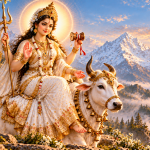
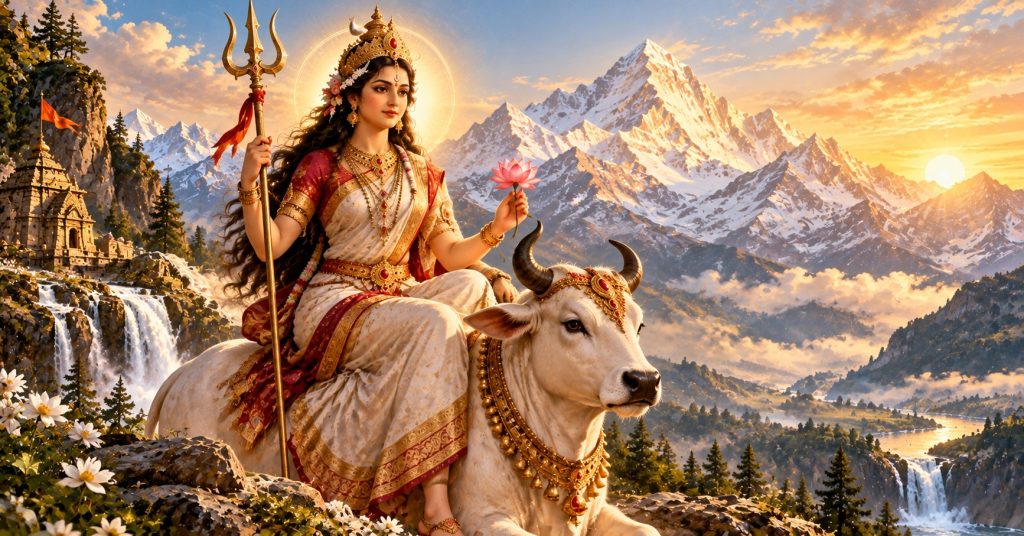
Shailaputri is shown seated on a white bull, which gives her the name Vrisharudha, she who rides the bull. In her right hand she holds a trident and in her left a lotus, and a crescent moon rests on her brow. Devotional manuals open her worship with a verse that salutes her in just these terms: the one who wears the half moon on her crown, who rides the bull, carries the trident and is glorious as the daughter of the mountain.
Commentators have read each emblem with care. The Sanskrit word vrisha means both bull and dharma, and in the Puranas dharma itself takes the form of a bull standing on four legs in the first age and on fewer as the ages decline. The bull is also the mount of Shiva, and in seating Shailaputri upon it the tradition shows the Goddess resting on righteousness. The trident is read as the three gunas held under her command, or as the three times, past, present and future, gathered in one hand. The lotus rises from mud and opens in light, and it stands for purity that is born within the world and remains in it. The crescent moon is an emblem of Shiva and of the cycle of waxing and waning, and Navratri itself begins in the bright fortnight, when the moon starts to grow.
The Root and the Beginning of the Path
Popular tradition associates each of the nine forms with a centre of the subtle body described in yoga, and Shailaputri is linked with the first of them, the Muladhara. The name joins mula, root, with adhara, support. The Muladhara is placed at the base of the spine, its element is earth, its sense is smell, and in the Tantric texts that describe the chakras, such as the Sat-Chakra-Nirupana of Purnananda, it appears as a four-petalled lotus around a square, the figure of earth. The Devi Mahatmya itself does not describe this scheme, and different traditions assign the later forms to the centres in different ways, so the association is best held as one reading among several.
Its meaning for the first night is nonetheless clear. In yogic accounts the subtle energy begins its ascent from the root, and a path that rises needs a ground from which to rise. Shailaputri is the name given to that ground: steadiness of body and mind, the sense of being held by the earth before any search for what lies beyond it begins.
Ghatasthapana: The Seed and the Pot
The ritual of the first morning belongs to her. During the muhurat given in the local panchang, a clean place in the home is prepared, soil is spread in a shallow vessel, and barley is sown and watered. A kalasha filled with water and topped with mango leaves and a coconut is set upon the earth, and a lamp is lit that many households keep burning through the nine nights.
The kalasha is understood as the universe in small. The water recalls the waters from which creation rose, the leaves stand for living nature, and the coconut is read, depending on the commentator, as the head of the Goddess or as the fullness of the world. The barley sprouts over the nine days, and the green shoots standing in the vessel at the end are the visible sign that the worship has taken root. In this ritual Shailaputri is the soil beneath the pot, and a festival that begins its greatest nights by sowing seed has placed the first act of the Goddess in the ground.
The Spiritual Significance of Shailaputri
The first teaching of Shailaputri concerns where a spiritual life begins. The Upanishadic and yogic traditions speak of ascent, of the mind rising toward what is subtle and luminous, and Shailaputri stands at the point from which that rising starts. Her mountain is a picture of the mind that has found its centre, one that receives storm and sunlight alike and keeps its place. The Bhagavad Gita describes the person of steady wisdom, the sthitaprajna, in the closing verses of its second chapter (2.54 to 2.72) in just these terms, and the first night of Navratri can be read as an invitation to begin there.
The second teaching lies in her return from Sati. A Goddess who gives up one body and takes another shows that the power worshipped in these nights depends on no single form, and that loss, which seems to end everything, becomes in her story a change of dwelling. For the devotee, grief and endings are placed inside the pattern of the Goddess herself.
The third teaching belongs to her place at the head of the nine. The Navadurga move from Shailaputri’s birth through austerity, courage, creation, motherhood, righteous anger, the meeting with fear and time, purification and fulfilment, and this order has often been read as the stages of an inner journey that begins with a grounded life and ends in realisation. Shailaputri is the first stage because the later ones depend on it, and the tradition counts gratitude toward the earth that bears us, in the form of the soil, the mountains and the waters, as the first act of worship.
The last teaching is a gentle one. Devotees call the Goddess Maa on all nine nights, and Shailaputri is the form in which that word first acquires a home, a father’s house and a mother’s courtyard. The festival carries from her the intimacy of a family, and it is in this form that many people feel most plainly that the Goddess is a mother and a daughter at once.
Seen Through the Natural World
Alongside its spiritual reading, the first night of Navratri rests on features of the natural world that can be observed, and a few of them are worth setting beside the tradition’s own account. Sharad Navratri falls as the monsoon withdraws, a few weeks after the autumn equinox. In the Ayurvedic reading this is a ritu sandhi, the junction of two seasons, when the body adjusts to changes in temperature, humidity and daylight, and the Ayurvedic texts recommend that diet be changed gradually at such boundaries (Charaka Samhita, Sutrasthana 6; Ashtanga Hridaya, Sutrasthana 3). Lighter food and fasting during Navratri follow that counsel in practice, whether or not the household names it.
The Himalaya is the source of the great northern rivers, and its snow and glaciers feed the Ganga, the Yamuna, the Indus and the Brahmaputra systems. The range also forces the moist winds of the summer monsoon to rise and release their rain, and it holds back the cold air of Central Asia. A tradition that called the mountain the father of the Goddess was describing a power whose effect on the life of the subcontinent can be measured. Testing seed by sprouting is likewise an old agricultural practice, and the household that sows barley on the first morning is watching the same sign that farmers have long watched.
The subtle-body scheme of the chakras belongs to the yogic tradition and has not been established by scientific measurement, and this article has presented it as the tradition’s own account. The two kinds of statement have been kept apart here, observations of the natural world on one side and the tradition’s readings on the other, so that each reader may hold them at the level that suits them.
The Beginning That Holds the Rest
The nine nights will carry the Goddess through many forms, and each of them needs a place in which to happen. The austerity of Brahmacharini, the courage of Chandraghanta, the creative radiance of Kushmanda and the rest take place on the earth that Shailaputri makes holy by being born into it. Sati’s fire was followed by Parvati’s birth, and the story gives the devotee the assurance the barley gives: what has been laid in the ground will come up.
By the ninth night the barley will stand tall and green beside the lamp. For now it is a handful of seeds under a layer of earth, and the daughter of the mountain stands behind it, steady as the range in which she was born. Tomorrow the series follows her out of her father’s house and into the forest, where she becomes Brahmacharini.
Sources and Further Reading
Primary texts
- Rigveda 10.121.4 (hymn to Hiranyagarbha)
- Atharvaveda 12.1 (Prithvi Sukta)
- Kena Upanishad (the appearance of Uma Haimavati)
- Bhagavad Gita 2.54 to 2.72 and 10.25
- Kalidasa, Kumarasambhava, cantos 1 and 5
- Shiva Purana, Rudra Samhita (Sati Khanda and Parvati Khanda)
- Devi Bhagavata Purana, Book 7
- Devi Kavacha, recited with the Devi Mahatmya
- Purnananda, Sat-Chakra-Nirupana
- Charaka Samhita, Sutrasthana 6; Vagbhata, Ashtanga Hridaya, Sutrasthana 3
Translations and studies
- Wendy Doniger, The Rig Veda: An Anthology (Penguin Classics)
- Ralph T. H. Griffith, The Hymns of the Atharvaveda (1895)
- Swami Gambhirananda, Eight Upanishads (Advaita Ashrama)
- Swami Gambhirananda, Bhagavad Gita with the Commentary of Shankaracharya (Advaita Ashrama)
- David Smith, The Birth of Kumara (Clay Sanskrit Library)
- J. L. Shastri (ed.), The Siva Purana (Motilal Banarsidass)
- Swami Vijnanananda, The Srimad Devi Bhagavatam (Sacred Books of the Hindus)
- Arthur Avalon (John Woodroffe), The Serpent Power (1919)
- P. V. Sharma, Caraka Samhita (Chaukhambha Orientalia)
- K. R. Srikantha Murthy, Vagbhata’s Ashtanga Hridayam (Chowkhamba Krishnadas Academy)
- David Kinsley, Hindu Goddesses (University of California Press, 1986)
- Thomas B. Coburn, Devi Mahatmya: The Crystallization of the Goddess Tradition (Motilal Banarsidass, 1984)