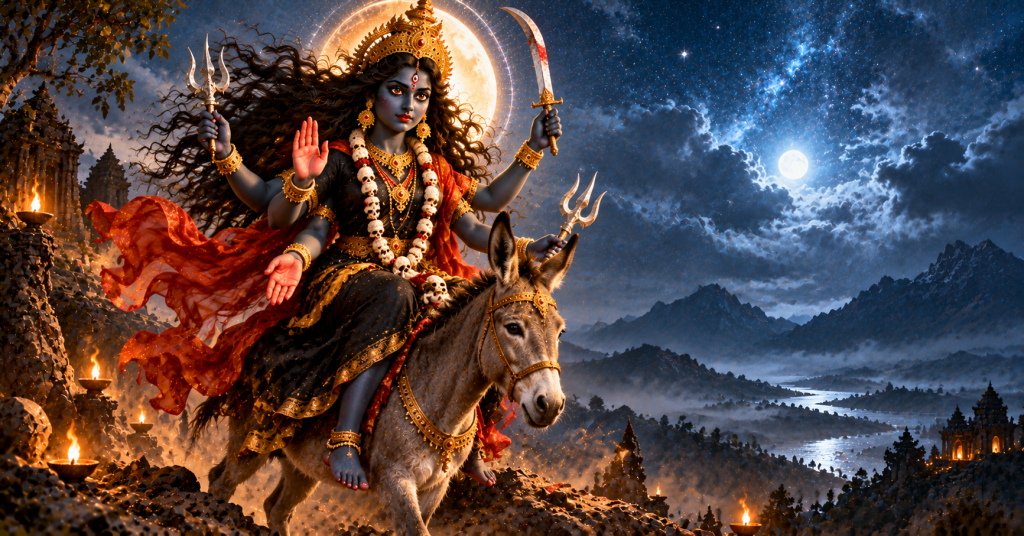
The seventh night of Navratri is the darkest of the nine. The Goddess worshipped on it has a complexion black as the sky between the stars, hair loose and wild, three round eyes that flash like lightning and a garland that shines like a thunderbolt, and she rides a donkey. Her name is Kalaratri, the night of time, and the Devi Kavacha places her seventh among the Navadurga: saptamam Kalaratriti. Many who see her image for the first time find it frightening, and the tradition is aware of this. It also gives her a second name, Shubhankari, she who does good, and it shows two of her hands raised to dispel fear and to grant boons. This article follows her name, her appearances in the great texts, her form, and the Indian understanding of time and darkness that she gathers into a single figure.
The Name and Its Meaning
Kala in Sanskrit means time, and also black, and also death, so that time, darkness and ending share a single word. Ratri is night. Kalaratri is therefore the night of time, the dark night in which the days of a world come to their close. The earliest of her appearances is the Ratri Sukta (Rigveda 10.127), met in the first article, where night is addressed as a goddess who spreads over the world with many eyes and guards those who sleep.
In the Devi Mahatmya, Brahma, praising Yoganidra from the lotus of Vishnu’s navel, calls her Kalaratri, Maharatri and the dreadful Moharatri, the night of delusion (1.79). The same hymn goes on to call her Shri, Ishvari, Hri and Buddhi (1.80), and the tradition takes this as the central lesson of the seventh day, that the dark night and the radiant intelligence are named together in one breath.
Her Appearances in the Texts
The Devi Mahatmya’s other great dark figure is Kali, who springs from the brow of Ambika in the seventh chapter when the demon generals Chanda and Munda advance, and who is called Chamunda after she slays them. In the eighth chapter, in the battle with Raktabija, whose every drop of blood becomes a new demon, Kali drinks the blood as it falls so that no more can be born, and the Goddess wins. The tradition identifies Kalaratri with this fierce form.
In the Mahabharata, in the Sauptika Parva, a dark figure called Kalaratri is seen during Ashvatthama’s night attack on the sleeping camp of the Pandavas, noose in hand, leading away the dead. The epic gives her the same role of night as the ender of what has run its course.
Her Form
Kalaratri is shown with a dark complexion and unbound hair. Her three eyes are round like the universe and shoot light like lightning, and her breath is said to carry flames. She has four arms. The upper right is raised in the gesture that dispels fear and the lower right grants boons, while the upper left holds an iron hook, or in some images a thunderbolt, and the lower left holds a sword. She rides a donkey. The donkey is the patient carrier of burdens that others turn away from, and commentators read in it the Goddess’s willingness to come in the humblest form to those who are most weighed down. The terrible aspect and the blessing hands are drawn together, and the tradition says that the devotee who reaches her finds the gift waiting in the dread. Commentators read the hook as what draws out the root of fear and the sword as what cuts attachment to what time takes away. This is why she is also called Shubhankari.
Popular tradition associates her with the Sahasrara chakra at the crown of the head, whose name means thousand-petalled and which is linked with the dissolution of the self into the highest reality, although some schemes give the crown to the ninth form and assign the dark night to another centre. As on earlier days, the chakra scheme is one reading among several.
Time in Indian Thought
The Indian tradition has thought about time with unusual depth. The Atharvaveda (19.53) describes Time as a horse with seven reins and a thousand eyes, ageless and rich in seed, which carries all the worlds, and the next hymn (19.54) says that from Time arose the waters, Brahman, tapas and the directions. The Maitri Upanishad (6.15) says that Time ripens all beings in the great Self, and that the one who knows that in which Time itself is ripened is a knower of the Veda.
In the eleventh chapter of the Bhagavad Gita, when Arjuna asks to see the form of the Lord, Krishna answers kalo ‘smi, I am Time, grown vast, the destroyer of worlds (11.32), and Arjuna, seeing the form, shakes with terror and asks to be shown the gentle form again. The eighth chapter describes the day and night of Brahma, each lasting a thousand ages, and says that at the fall of that night all beings dissolve into the unmanifest and at its dawn go forth again (8.17 to 8.19). Kalaratri is the Goddess of that night, and she is the Time that Krishna names as himself.
The Shakta tradition takes the word further. Mahakala, the great Time, is a name of Shiva, and Kali, the feminine form of the same word, is Time as the Mother. The image of Kali standing over the still form of Shiva is commonly read as Shakti, the active power of Time, standing over the stillness that rests beneath all change. The reading places the Goddess of the dark night at the point where movement and rest meet, and it explains why the tradition addresses her with awe and with affection together.
Kalaratri in Worship
The seventh day, Saptami, begins the great nights of Durga worship in Bengal and eastern India. On this morning the Nabapatrika, a bundle of nine plants, is bathed in a river or pond, dressed in a sari and set beside the image of the Goddess, where it is often called the Kola Bou. The nine plants are the banana, the colocasia, the turmeric, the jayanti, the bel, the pomegranate, the ashoka, the arum and the rice plant, and each is said to hold one aspect of Durga, the colocasia being assigned to Kali. In the Bengali rite the Goddess is first invoked in the plants of the field and the garden, and the image receives her presence afterwards. In many homes elsewhere the seventh night is kept with vigil, recitation of the Devi Mahatmya and the lighting of lamps through the dark hours.
The Spiritual Significance of Kalaratri
The first teaching of Kalaratri concerns fear. Arjuna’s terror in the Gita and the first impression of Kalaratri’s image belong together, and the tradition answers both in the same way, by showing that the dreadful form and the gracious one are the same. The hymn of Brahma names the dark night and the radiant intelligence in a single breath, and the raised hand of the Goddess offers the assurance that fear loosens when the terrible is recognised as the Mother’s own face.
The second teaching concerns impermanence. Time in the texts is a power that consumes and a power that ripens, and both actions belong to it. What the night ends, it also prepares, as the dark of the soil prepares the seed. Kalaratri carries the teaching that nothing in this world is exempt from time and that this is no cause for despair, since time is a name of the Goddess herself.
The third teaching is in the Gita’s verse on night (2.69), which says that what is night for all beings is the time of waking for the one who has mastered the self. Darkness for the ordinary mind is the place where the sage sees. Commentators read Kalaratri’s darkness as the stage of unknowing that comes before understanding, the place from which the inner light is known. The Mandukya Upanishad’s account of deep sleep, a state without objects that lies before the silent fourth, belongs to the same thought.
The fourth teaching is the position of the day. Katyayani’s sword was drawn on the sixth night, and the radiance of Mahagauri and the fulfilment of Siddhidatri follow on the eighth and ninth. The seventh night stands between, and the tradition does not shorten it. A life of practice includes a dark stretch before understanding comes, and the Goddess who presides over that stretch is the same Goddess who presides over the rest.
Seen Through the Natural World
Darkness has a physical account that anyone can test. When a person enters a dark room, the eye takes about twenty to thirty minutes to reach most of its sensitivity to dim light, because the rod cells of the retina slowly recover, and what looked at first like blank black resolves gradually into shapes. The tradition’s picture of darkness as the place where sight changes its character has a counterpart in this ordinary experience.
Night is also the time of sleep, an active state in which the brain consolidates memory and the body repairs itself, and sleep guidelines recommend that adults have at least seven hours. Seeds, like the barley in the vessel on the altar, germinate in the dark of the soil, and many animals do their work by night. Fear of the dark is very common in children and in many adults and is generally regarded as a normal response to the reduced ability to see. The gesture of Kalaratri, one hand raised to dispel fear, addresses this ordinary feeling directly. After the moon has set, the autumn sky shows what the city’s light usually hides. The Pleiades, met on the fifth night, climb high, and Orion rises before dawn.
Time’s work is visible in the landscape as well. The Himalaya, the Goddess’s father in the first days of this series, is still being raised by the collision of the Indian plate with the rest of Asia at a few millimetres a year, and it is worn down at the same time by ice, rain and rivers. The mountain is the product of both raising and wearing, the double face that the tradition gives to Time. As on earlier days, the chakra scheme remains the tradition’s own account and has not been established by measurement.
The Night Before the Light
On the seventh night, after the moon has set near midnight, the sky over the courtyard is as dark as it will be in the whole festival, and the lamp on the altar is the smallest light in the house. The barley beneath it has come up in the dark of the vessel and stands green in the lamplight. Kalaratri is shown with her hand raised, and the whole of her darkness is held within that gesture. Tomorrow, on Ashtami, the series turns to Mahagauri, the Goddess whose name is the whiteness that follows the dark.
Sources and Further Reading
Primary texts
- Rigveda 10.127 (Ratri Sukta)
- Atharvaveda 19.53 and 19.54 (hymns to Time)
- Maitri Upanishad 6.15; Mandukya Upanishad
- Bhagavad Gita 2.69, 8.17 to 8.19 and 11.32
- Devi Mahatmya, chapters 1, 7 and 8; Devi Kavacha
- Mahabharata, Sauptika Parva
Translations and studies
- Wendy Doniger, The Rig Veda: An Anthology (Penguin Classics)
- Ralph T. H. Griffith, The Hymns of the Atharvaveda (1895)
- Patrick Olivelle, Upanisads (Oxford World’s Classics, 1996)
- Swami Gambhirananda, Bhagavad Gita with the Commentary of Shankaracharya (Advaita Ashrama)
- Kisari Mohan Ganguli, The Mahabharata of Krishna-Dwaipayana Vyasa (1883 to 1896)
- Thomas B. Coburn, Devi Mahatmya: The Crystallization of the Goddess Tradition (Motilal Banarsidass, 1984)
- David Kinsley, Hindu Goddesses (University of California Press, 1986)