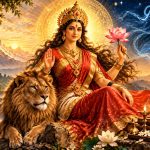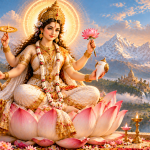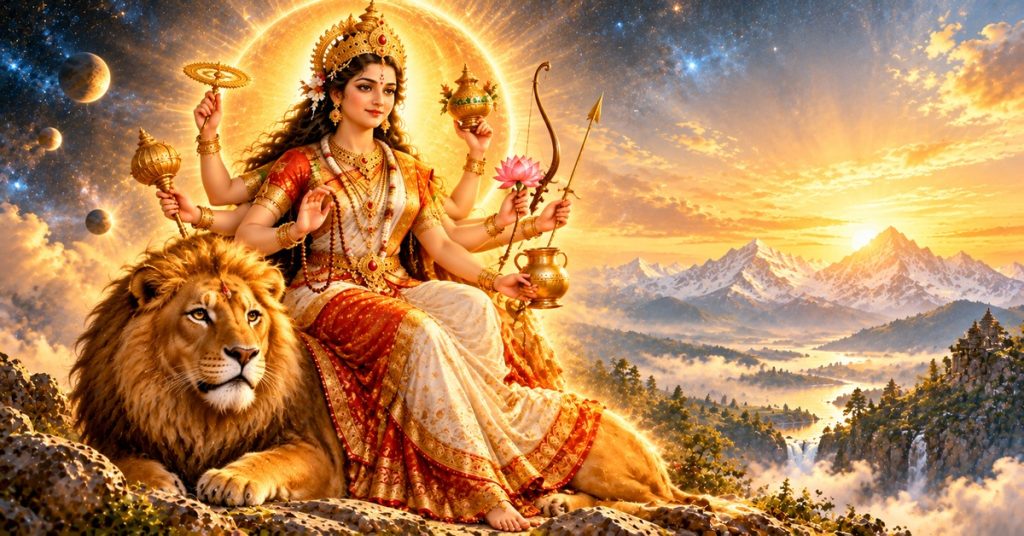
The fourth day of Navratri belongs to the Goddess who is said to have made the universe with a smile. Before there was light, according to the tradition that has grown around her, there was only darkness, with no sun, no earth and no sky, and Kushmanda smiled in that darkness, and the warmth of the smile gave form to the cosmic egg from which the worlds came. She is the fourth of the Navadurga, named in the Devi Kavacha: kushmandeti chaturthakam. She is shown with eight arms, a lion beneath her and a radiance like the sun’s, and she is said to dwell within the sun itself. Shailaputri gave the ground, Brahmacharini the discipline and Chandraghanta the courage to remain, and Kushmanda gives the act for which these prepare, which is creation. This article follows her name, her place in the Indian accounts of the beginning of the world, her form, and what the tradition has drawn from the idea of a universe that begins in a smile.
The Name
The name is usually explained as three words joined: ku, a little, ushma, warmth or energy, and anda, the egg. Kushmanda is the one who, with a little warmth, brought forth the egg of the universe. The same word is the Sanskrit name of the ash gourd and the pumpkin, large fruits that hold many seeds, and the tradition has long played on the double meaning, since the Goddess who holds the cosmic egg is also the Goddess of the full gourd. In the Yajurvedic tradition a set of mantras called the Kushmandas is recited in rites of purification, so that the name has a Vedic echo beyond its place in Navratri.
The word ushma also connects her with the second day. The One born through tapas in Rigveda 10.129.3 and the Goddess of tapas on the second night belong to the same family of images as the gentle heat of Kushmanda, the warmth from which things come into being.
The Egg Before the Worlds
The cosmic egg is one of the oldest images of creation in Indian thought. The hymn to Hiranyagarbha (Rigveda 10.121.1) says that the golden embryo arose in the beginning and was the one lord of all that is born. The Chandogya Upanishad (3.19) describes the universe before form as a single existent that grew into an egg, lay for a year, and then split, one half of silver and the other of gold, the silver becoming the earth and the gold the sky. The Manusmriti (1.8 to 1.13) tells of a golden egg formed in the waters from the seed of the self-existent one, from which Brahma was born, and the Puranas take the egg as the unit of their cosmology, so that the Brahmanda Purana carries it in its name, Brahmanda meaning the egg of Brahma.
The Nasadiya hymn (Rigveda 10.129) stands apart from these images. It asks who truly knows from where this creation came, and it closes by suggesting that even the one who watches from the highest heaven may or may not know. The tradition has always held both together, the confident image and the open question.
Where the Goddess Stands in the Story
These accounts place the egg as the product of Brahman’s desire or seed. The Shakta texts place the Goddess behind the whole sequence. In the first chapter of the Devi Mahatmya, Brahma, praying to Yoganidra from the lotus of Vishnu’s navel, addresses her as the one by whom the world is created, supported and withdrawn. The third book of the Devi Bhagavata Purana teaches that the three gods of creation, preservation and dissolution are themselves born of her power. Kushmanda is the popular and devotional form of this teaching: the Goddess smiling in the dark and the universe beginning to be.
A Goddess Who Smiles
The smile is no ornament in this story. The names of the Lalita Sahasranama sing of the gentle smile of the Goddess, and the Devi Mahatmya shows her laughing even in battle, in the third chapter, as she faces Mahishasura. The tradition reads this laughter as the sign of power that works without strain. Kushmanda gathers both images into one: creation as an act of ease, done by one for whom the making of a universe is a matter of a little warmth.
Her Form
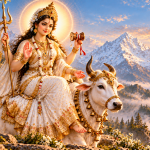
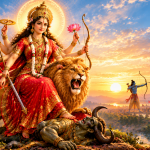
Kushmanda is called Ashtabhuja Devi, the Goddess of eight arms. In her hands she holds a water pot, a bow, an arrow, a lotus, a jar of nectar, a discus, a mace and a rosary, and she rides a lion. Her complexion is radiant like the sun’s, and tradition says that she lives in the interior of the solar orbit, where no other being could endure, and that her light shines into every direction. The emblems are read in order. The water pot holds the water of life, the bow and arrow give direction, the lotus is unfolding, the nectar is sustaining life, the discus is the turning of time, the mace is strength, and the rosary is the discipline through which, in the tradition’s words, powers and treasures are granted to those who repeat the name.
Popular tradition associates her with the Anahata chakra at the heart, whose name means the unstruck sound. The connection with the previous day is instructive. Chandraghanta’s bell is a struck sound that calls attention, and Anahata is the sound that sounds without being struck, the hum of existence heard when the mind is still. As on earlier days, the chakra scheme is one reading among several.
The Spiritual Significance of Kushmanda
The first teaching of Kushmanda is that the world begins in joy. The Taittiriya Upanishad (3.6) says that beings are born from bliss, live by bliss and return into bliss, and the Brahma Sutra (2.1.33) speaks of creation as the play of the Lord, undertaken without need. Kushmanda’s smile is the devotional image of those teachings. The Goddess who makes the world does so out of fullness, and a world that comes from a smile has a claim on the affection of those who live in it.
The second teaching is dependence on a source of light. Kushmanda dwells in the sun, and Indian worship has always acknowledged the sun as the visible face of the source of life, from the Gayatri (Rigveda 3.62.10), which asks that the radiance of Savitr inspire the mind, to the daily offering of water to the rising sun. The Goddess of the fourth day reminds the devotee that the powers by which the body lives and the mind knows are received from a source beyond oneself.
The third teaching is that creation can begin small. The word ku means a little, and the Goddess brings forth the whole of existence through a little warmth. In the order of the days, the fourth night may be read as the point at which the strength gathered on the first three begins to turn toward making, whether that is a prayer, a piece of work or an act of kindness, and the tradition values the slight and sincere beginning.
The fourth teaching lies in the gourd. Where animal sacrifice was practised in Shakta worship, many communities place a gourd on the altar in its place, and the Goddess whose name is the gourd receives it. Devotees and commentators read this as a movement of the tradition toward non-violence, a recognition that the Mother of all living things does not require the life of one of them.
Seen Through the Natural World
Almost all life on earth depends on sunlight. Plants capture its energy through photosynthesis, animals eat plants or one another, and the food an ordinary household cooks is stored sunlight in another form. The sun itself, a star about four and a half billion years old, shines by turning hydrogen into helium in its core. A tradition that placed the Goddess of creation in the sun is describing, in the language of devotion, a dependence that natural science describes in the language of energy.
Modern cosmology describes the universe as having expanded from an extremely hot and dense state about thirteen point eight billion years ago, and the image of heat at the beginning has an evident likeness to the warmth of the Rigveda’s tapas and of Kushmanda’s ushma. The likeness is a poetic one. The Sanskrit texts are metaphysical and devotional and make no predictions that can be tested, while the scientific account rests on observation and calculation, so the two are best read as different kinds of statement that happen to share an image.
The ash gourd and the pumpkin, both called kushmanda, are large fruits that hold many seeds within a single protective rind, and the sealed shell that contains the whole of a future plant is one of the plainest natural pictures of the cosmic egg. Seedlings, like the barley sprouting in the vessel on the household altar, bend toward light as they grow, which is the plant’s response to the direction of the sun. The chakra scheme remains the tradition’s own account and has not been established by measurement.
The Lamp and the Seedlings
On the fourth night the lamp burns steadily in the darkened room, a small sun of its own, and the barley beside it has grown tall enough to lean toward the flame. Kushmanda is shown with a smile, and the old story says that a smile was all the universe required to begin. Tomorrow the series turns to the Goddess who holds a child in her lap, with Skandamata, the mother of Kartikeya.
Sources and Further Reading
Primary texts
- Rigveda 10.121.1 (Hiranyagarbha Sukta), 10.129 (Nasadiya Sukta) and 3.62.10 (Gayatri)
- Chandogya Upanishad 3.19; Taittiriya Upanishad 3.6
- Brahma Sutra 2.1.33
- Manusmriti 1.8 to 1.13
- Devi Mahatmya, chapters 1 and 3; Devi Kavacha
- Devi Bhagavata Purana, Book 3
- Lalita Sahasranama, Brahmanda Purana
Translations and studies
- Wendy Doniger, The Rig Veda: An Anthology (Penguin Classics)
- Patrick Olivelle, The Early Upanishads (Oxford University Press)
- Patrick Olivelle, The Law Code of Manu (Oxford World’s Classics, 2004)
- Swami Gambhirananda, Eight Upanishads (Advaita Ashrama)
- Swami Gambhirananda, Brahma Sutra Bhashya of Shankaracharya (Advaita Ashrama)
- Swami Vijnanananda, The Srimad Devi Bhagavatam (Sacred Books of the Hindus)
- Thomas B. Coburn, Devi Mahatmya: The Crystallization of the Goddess Tradition (Motilal Banarsidass, 1984)
- David Kinsley, Hindu Goddesses (University of California Press, 1986)
- Steven Weinberg, The First Three Minutes (Basic Books, 1977)