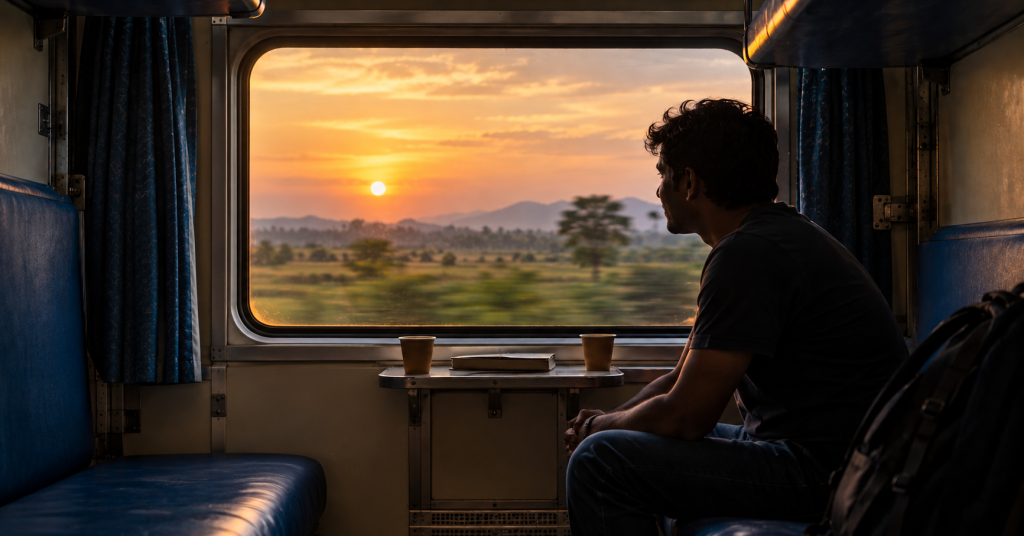
As the ticket checker came to me and reconfirmed my name, I noticed a young man watching me from the berth across. Once the checker moved on, I let my face fall back into one of the books I had carried along for the long journey. I continued reading, though I could still feel him looking.
“Are you an author, sir?” he asked, after a while, moving closer to sit beside me. “I have seen the names of some of your books, and I went through your social media too.” Being recognised is a good thing, mostly, but the moment one starts placing popularity above peace, it turns into something heavier to carry. Whenever I travel, I choose the plainest clothes I own, since there is rarely anyone on these journeys I need to convince of anything.
I am still not entirely sure what made him open up the way he did, his life, his plans, and eventually, the concerns he had clearly been carrying somewhere deep for a long time. He spoke of a career he had chosen more out of family expectation than desire, a marriage he was still learning how to inhabit, and a restlessness he could not name even to himself. As I answered each thing he asked, I watched his eyes widen slightly, again and again. They were, in truth, questions offered back to him in a different shape, the kind that let a person reach their own answer rather than borrow someone else’s. I have found, over many years of these conversations, that most people already carry the answer they are looking for. What they lack is someone willing to sit across from them long enough for that answer to surface on its own.
A few hours later, his wife appeared and reminded him that his station was approaching. He rose slowly, began gathering his luggage, and as the train pulled in, he said goodbye and walked toward the door. It was only then that I noticed something unusual. We had never exchanged phone numbers. I had not even asked his name. He had not asked mine either.
This is not how these journeys usually end for me. If I were to go through the contacts saved on my phone, a great many of them would be people I first met exactly this way, on a train, mid conversation, somewhere between one station and another. Some of those meetings happened more than twenty five years ago, and the people from them are still close friends today, a few of them closer than that. I still remember the names of stations where such friendships began, the particular light coming through a train window, the small kindnesses exchanged over shared food, the addresses written by hand on torn pieces of paper before either of us owned a mobile phone. But this time, nothing. No name, no number, no promise to stay in touch. It was only afterward that a philosophy I had recently come across returned to me, one I had read but never truly felt settle into me until that moment. I have heard it called the Last Meeting Theory.
The theory holds a difficult truth. We never encounter the same thing twice, not even moments apart. Think of a river. I look at the water and say, this is the Ganga, or this is the Kaveri, and by the time the sentence has left my mouth, the water I named has already moved on, replaced by water that has never touched that stretch of riverbed before. The name stays. The river, in the only sense that actually matters, does not. This is not a poetic exaggeration. It is what a river actually is, a name we give to something that is never the same thing twice, moving continuously out from under the very word we use to hold it still. A philosopher in ancient Greece once said something close to this, that no one steps into the same river twice, since new waters are always flowing toward him. Long before that, our own sages spoke of anicca, the truth that nothing holds its form for even one full breath, that permanence itself is the illusion, not the exception.
Everything we think we return to carries this same betrayal. A flower noticed on a morning walk, admired in passing, may not exist by the time the same path is walked again, the plant itself gone, the ground beneath it changed, nothing left to mark where it once stood. Even a photograph, which we imagine holds a moment still, only holds the light that fell on a face that no longer exists in that exact arrangement, since the person in it has aged, however slightly, in every second since the shutter closed. We rarely think of any of this as loss, because we were never asked to say goodbye to it. It simply was, and then, at some point we did not witness, it was not.
Apply this to a person, and something in the chest tightens, the way it does with any truth we would rather not have named so plainly. Every person we meet, we meet exactly once, in the fullest sense of that word. The version of them sitting across from us on a particular afternoon, in a particular mood, carrying a particular set of concerns they may never carry again in that combination, will not exist in that form the next time we see them, if there is a next time at all. We meet people again, certainly, the same name, the same face, often the same affection. But we never meet the same meeting twice. Every conversation, however ordinary it feels, carries the possibility that it is the only one of its kind we will ever have with that person, whether or not we ever see them again in body.
This truth does not confine itself to strangers on trains. It lives inside the people we see every day, the ones we assume, wrongly, will always be available to us in exactly the shape we left them. A parent answering the phone this evening is not the same parent who answered it a year ago, a little more tired now, a little more given to repeating themselves, a year closer to an ending none of us like to name aloud. A child running through the house at this particular age, with this particular laugh and these particular questions about the world, will be gone within months, replaced by an older child who has already forgotten the exact way they once said certain words. We assume familiarity protects us from this, that because we will see these people again tomorrow, today’s version of them does not matter as urgently as a stranger glimpsed once on a journey. The truth runs the other way. It is precisely because we assume endless further meetings with the people closest to us that we so rarely give any single one of those meetings our full attention, and it is precisely the stranger, met once and never again, who sometimes receives the fuller version of our presence, simply because we knew, without needing a theory to tell us, that this was all the time we would ever have.
I did not truly understand this until that afternoon on the train, watching a stranger walk toward a door, realising only as it closed behind him that I would very likely never see him again, not because life had conspired to keep us apart, but because neither of us had done the ordinary thing people do to ensure otherwise. There was no tragedy in it. There was, suddenly, a window into something true of every meeting, whether we notice it or not, one that most of us pass through a thousand times in a lifetime without ever pausing long enough to look through it properly.
As the train continued its journey, I began watching the people who boarded and got off at each stop differently. I smiled at them. I let whatever love I could offer in a glance actually reach them, because I would very likely never see any of them again in this lifetime.
The train stopped at the station early in the morning. A few people were still asleep on the benches along the platform. Others were already walking briskly toward the exit. As I walked toward the gate myself, I tried to hold on to their faces a moment longer than usual. These were strangers I would likely never see again. Without either of us knowing it in advance, this had been our last meeting.
If we looked at every person, every place, every ordinary thing around us, as though we were seeing it for the last time, something in us would change completely. We would stop hurrying past what we barely notice now. We would begin looking at everything, and everyone, with all the love we have. Let it be the most bleoved one in front of you!
_____________________________________________________________________
In short: A chance conversation with a stranger on a train, one where neither exchanged a name or a number, becomes the entry point into a philosophy the author calls the Last Meeting Theory. Drawing on the impermanence of a river, a flower, even a photograph, and echoing both Heraclitus and the Buddhist concept of anicca, the piece argues that every meeting with another person, however familiar, may be the only one of its kind, since the version of them present in that moment will never exist in quite that form again. It extends this beyond strangers to parents and children, the people we wrongly assume will always be available to us unchanged, and closes with a simple shift: looking at everyone and everything as though it were being seen for the last time.