
I was genuinely excited for this journey, the first long distance train trip I had made in years. There was a particular nostalgia in it too, a return to the era when the train, not the flight, was how a real journey felt. And this time the destination sharpened that excitement further. I was travelling to the state where I was born, decades ago, a place I had not returned to by rail in a very long time.
The train was scheduled for 5.05 in the evening. I reached the station by 4, only to learn it had been delayed by five hours, now expected at 10.05. Rather than sit at the station for six hours, I took a taxi back home and returned around 9.30, giving myself enough time to settle before boarding. It was only after I was back at the station that I heard the next announcement. The train would now arrive at 1.15 in the morning. I was carrying heavy luggage, and the idea of going home a second time and coming back again for a third made no sense. So I sat, at the station, for the hours that followed, and waited for a train that kept moving further away from the time I had planned my entire evening around. Since the day I booked, I have received a number of emails and messages from Indian Railway asking me if I need extra services, meals etc. I wonder why couldn’t they just send a message when the train was recheduled.
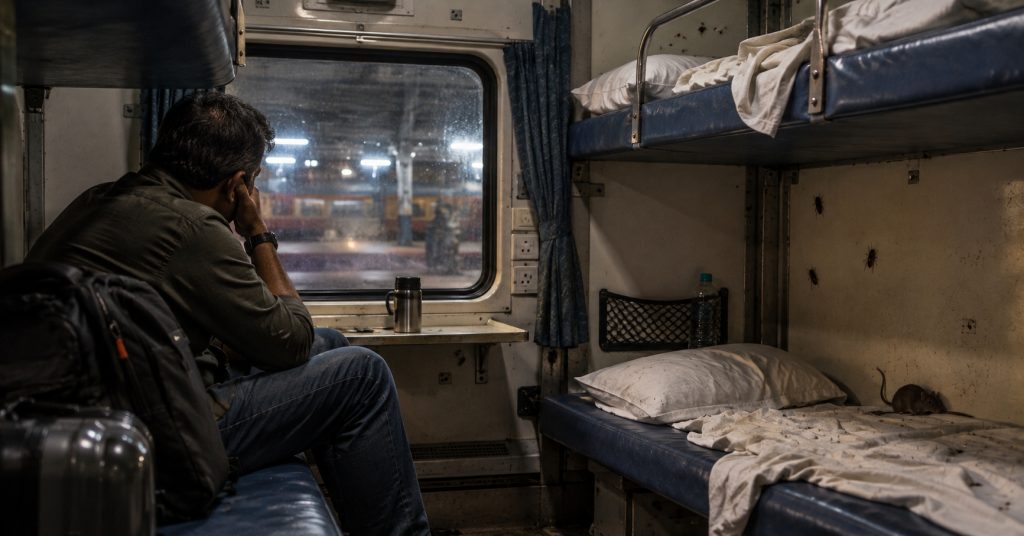
When it finally arrived and stopped, cleaning staff came aboard for a few minutes, going through motions that looked more like a performance of cleaning than the act itself. The compartment doors opened to very few passengers in Second AC. What greeted me inside was, without exaggeration, one of the worst coaches I have travelled in. Small insects, cockroach-like, moved along the berths and walls with no particular urgency, as though they, too, had come to expect this coach as their own. At some point during the journey, a mouse appeared, unhurried, crossing the floor of a coach I had paid a premium fare to travel in. This was Second AC, one of the higher tiers of Indian Railways travel, leaving aside Vande Bharat and its separate category entirely. I found myself wondering, seriously, what condition the sleeper and general compartments further down the same train must have been in, if this was what greeted a paying AC passenger. The coach itself, I noticed, was split down the middle, First AC on one side, Second AC on the other, sharing the same tired structure.
I do not fully know how I managed to sleep that night, given how far behind schedule the train already was and continued to fall. Tea, or anything resembling regular service, was rare, noticeably more so than on other trains I have taken. Through the night and into the following day, I watched the train pull into station after station, not to let passengers on or off, but simply to wait, stationary, while other trains were given priority to pass.
By early afternoon the next day, a middle aged co-passenger began walking the length of the compartment in visible panic. It emerged that his bag, containing his laptop, his essential documents, his cards, and the keys to his own home, had gone missing. He had been running a high fever through the journey and had fallen asleep with the bag kept close beside him, the way any exhausted, unwell traveller reasonably would. I remembered the train’s last stop, and a few passengers moving through the compartment around that time. Watching him search, increasingly certain of what had happened, was difficult to witness. I found myself quietly checking my own belongings, making sure everything I had brought was still where I had left it. No police official came to the compartment, not once, in the hours that followed. The entire episode ended exactly where these things usually end in this country, a complaint lodged over the telephone, filed into a system that, by every indication, would take it nowhere.
After roughly thirty six hours from departure to arrival, a journey that should have taken a fraction of that time, I reached Kakinada. The compartment, by then, was almost entirely empty.
I have read, like most Indians have, a great deal about the transformation supposedly underway in Indian Railways, the new trains, the modernised stations, the promise of a railway system finally catching up to the country it serves. I am not asking for that transformation to happen overnight. No reasonable person expects an institution this large to change in a season. But there is a difference between not yet having achieved excellence and failing, repeatedly, at the most basic things a paying passenger is owed. A clean coach without insects and rodents is not an aspiration. It is a baseline. What I experienced falls well short of even that baseline, in a class of travel positioned as one of the more comfortable options available.
Consider, then, what the general compartments carry, the ones I did not travel in but could only imagine after seeing my own. Passengers packed in with barely room to breathe, let alone sit comfortably for a journey of any real length. Toilets in those compartments that, by every account I have heard from others who have endured them, are conditions that would turn most stomachs on sight. If this is what a Second AC passenger is handed, I do not need much imagination to guess at what a general compartment traveller, who is very often the passenger with the least means to absorb such treatment, is left to endure.
And then there is security, or rather, its complete absence. A man loses his laptop, his cards, the very keys to his home, on a moving train he paid to travel on safely, and not a single official appears to even acknowledge it in person. The response is a phone number and a complaint that vanishes into a system with no accountability attached to it. Forget the bag. If a passenger loses something far more serious than belongings on that train, the response, I suspect, would look identical, a complaint registered, and nothing that follows it.
We have all heard the railway’s standard line by now, the inconvenience is regretted. I would like to ask, plainly, who is regretting what, exactly. Who compensates me for the taxi rides back and forth to a station that kept moving its own departure time by the hour. Who accounts for the time lost, an entire extra day and more of a finite life that no government, however efficient it eventually becomes, can ever hand back to a person once it is spent. I paid a real fare for this journey, priced as a premium class of travel. What, precisely, did that fare purchase. If it was not comfort, not safety, not punctuality, and not even basic cleanliness, I am left asking a simple question the railway owes every passenger an honest answer to: was this a fare, or simply a donation, handed over in exchange for nothing resembling the service it was meant to buy.
I stepped off the train at Kakinada in the early hours of the morning, the platform still half asleep, the air carrying that particular stillness only a very early morning arrival has. Thirty six hours after I had first reached the station in Mysore, filled with the excitement of a journey home, I was finally standing in the state where my life had begun, tired in a way that had very little to do with the actual distance travelled, and everything to do with everything that stood between the two points on the map.
In short: A long-awaited train journey from Mysore to Kakinada, meant to revive the nostalgia of travel by rail, turned into a 36-hour ordeal. A nine-hour delay, a filthy Second AC coach with cockroaches and a mouse, near-absent food service, and a fellow passenger whose laptop and house keys were stolen with no police response at all, only a phone complaint that led nowhere. The piece argues that despite years of railway PR about modernisation, the most basic passenger expectations, cleanliness, security, and punctuality, remain unmet, and asks plainly what a premium fare is actually paying for if not these.





Unfortunately, this is not what one would expect in our era – in any developed country of the world. These journeys, though they could be indeed memorabe, turn into a mere ordeal that could have been avoided if the basics had been applied…