
As I was returning home after all the tests, the sound of the instruments in the hospital was still echoing in my ears, faint but persistent, the way a struck bell keeps ringing long after the hand has left it. A strange sense of silence had begun conquering me, settling somewhere beneath the noise of the traffic and the ordinary business of the evening. This was not the first time, it was the second, and the doctor’s words had followed me out of that room and into the car and now into this quiet, the plain clinical sentence that my heart had begun to fail, that years of unwatched hypertension had gone on to leave something structural, something changed in the architecture of the thing that had kept me alive without complaint for so long.
I was not afraid of dying. I want to say that plainly, because it surprised me too, how calm that thought sat inside me, almost as though some part of me had already made its peace with the idea long before the tests confirmed anything. What frightened me, in the silence of that drive home and in the weeks that followed, was a much smaller and much larger question at once. What happens to my three little girls if I am not here to stand between them and the world. Their mother will be there for them, I have no doubt of that. But a father is a father, and what he gives a daughter cannot be replaced by anyone else, however capable they are.
Life, until then, had been a long negotiation with struggle. I had built things, dismantled things, moved cities, started again more times than I could count without a certain tiredness entering the counting itself. And through all of it, one thing had remained undone. I had never managed to build a home, a shelter on the earth that my daughters could call theirs regardless of where I was or was not.
So I began, with far less money saved than the work would ever need, carried mostly by the kind of urgency that makes a man pour a foundation before he has finished the arithmetic. Kerala, close to where I had grown up, seemed the obvious place, and for a while the walls of that house rose the way walls do, slowly, stone by stone, each one a kind of promise. Then, one by one, difficulties arrived that I will not recount here in detail, only to say that they were persistent enough, and strange enough in their timing, that I eventually stopped. I left that foundation standing half formed in the earth like a sentence I had begun and could not finish. When I moved from Kerala to Mysore to begin again from nothing, I asked my mother to have even that foundation removed. I did not want a half built thing marking the place where an idea of home had failed. I wanted, if I was starting from zero, to start from an honest zero. With what my uncle gave me, I started my journey holding tight my little girls with some strange faith in the universe.
But the question that had sent me looking in the first place had not gone anywhere. My daughters still needed a home, wherever life eventually settled me, and so on my next visit to Kerala I began again, this time looking to buy rather than build, since building had already cost me more than money once. A house with land attached, I thought, would save both time and heartbreak. What I found instead was an education in something I had not expected to learn.
The first house belonged to a woman now living in Mangalore. Her father had built it for her, brick by careful brick, with the patience of a man who wanted his daughter’s whole future held safe inside walls he had raised himself, imagining perhaps her children playing in its rooms one day. He had died of a sudden cardiac arrest, and his daughter, settled elsewhere, wanted now only to be rid of the place. The house stood there, complete and empty, waiting for a buyer to give it a use its own family no longer wanted.
The second house belonged to a man who had worked at a college nearby. He had spent his entire life’s savings building it, and only a few years after its completion, he too had passed away. His family had returned to the southern part of Kerala, and now, years later, they were trying, without much urgency or hope, to sell a house none of them had any wish to return to.
The third house carried a story heavier than the first two combined. A man from a little further away had bought the land the moment his marriage was fixed, and by the time the wedding took place, the house stood ready with every comfort he could give his bride. Those were, by every account, happy days, the kind that make a whole village quietly envious of a young couple’s fortune. He had gone to work in the Gulf, taken his wife with him, and then, for the ordinary bureaucratic reason of a visa process, sent her home ahead of him. Within a week of her return, she had left with another man. He remarried eventually, but the house he had built with such hope stood closed, and he now lived far away, in the place of his work, a man visibly diminished by a betrayal he had never fully set down.
Three houses. Three men who had built, or bought, or dreamed toward the same purpose I was reaching for, and three houses that had ended up empty, unwanted, or shut against the very lives they were meant to hold. I remember sitting with that for days, feeling something close to despair. If this was where the effort led, again and again, then what exactly was I building toward. Whom was I building the house for, if a house could stand perfect and still be abandoned by the very love it was built from. I let the dream go quiet inside me. I stopped looking.
It was one of my relatives who would not let the matter rest. He called one day, almost apologetically, to say there was another place I should see before I gave up entirely. I went, mostly so as not to disappoint him, without any real expectation.
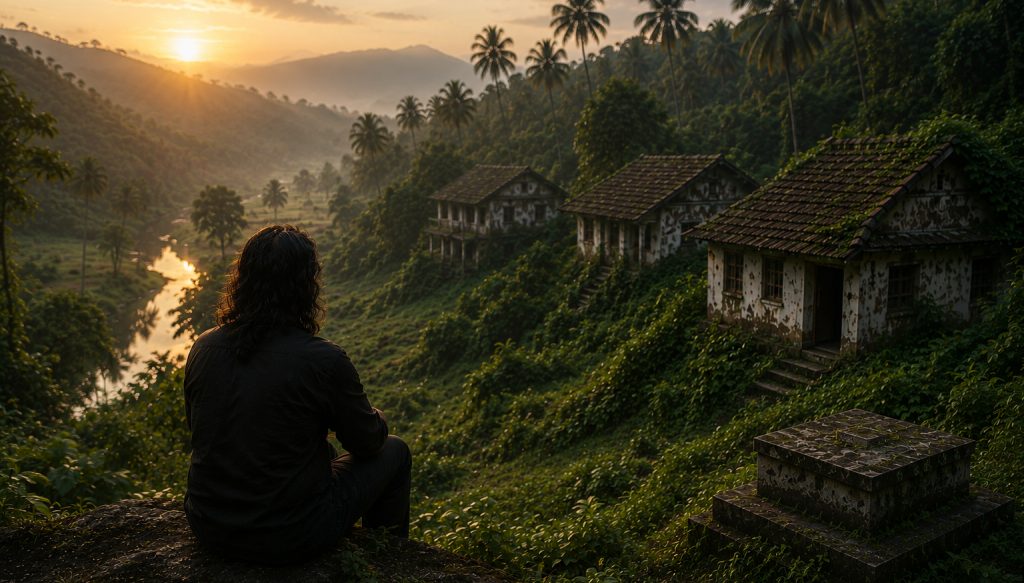
The road there left the main highway and its familiar dryness behind, and turned instead onto a narrower path that seemed to lead into a different climate altogether. The land opened into a valley, cool and green in a way that felt almost private, arecanut and coconut groves stretching in every direction, a slender tributary moving quietly through it, and a lake holding the sky’s colour without complaint. There was almost no one there. Only three old houses stood in that entire stretch of green, and something about their stillness made me ask.
The agent told me their story as though it were an old, familiar sadness he had grown used to repeating. A father had built all three houses, one for each of his three daughters, imagining them settled and returning, imagining grandchildren perhaps, imagining a valley full of the sound of a family he had raised with everything he had. All three daughters had married and moved away, each into a life of her own, none of them ever wishing to return to this valley, however beautiful it was. The father and mother had eventually passed away, and the houses had simply stood there since, going slowly to ruin, waiting for daughters who were not coming back, offered now for sale at whatever price a buyer would give.
I noticed, some distance from the houses, a small concrete structure I did not recognise, and when I asked, the agent said, simply, that it was the tomb of the father and the mother, and I do not think I can describe fully what moved through me in that moment, a man who had built three houses with his own hands, each one an act of pure, exhausting love, arriving in the end at the one structure that still belonged entirely to him, the one built to hold his own remains, and I found myself asking where they were now, those daughters, and where those dreams had gone to wait.
I think of that valley often. The grief in it is real, a father’s years of labour standing empty under the sun, and yet somewhere underneath that grief a kind of clarity has settled into me as well. A house, however carefully built, however lovingly furnished, cannot by itself carry forward what a parent hopes to give a child. Walls do not teach a person how to meet loss without breaking. Land does not teach a daughter how to recognise a good marriage from a hollow one, or a son how to survive betrayal without disappearing into a life half lived. What I have to give my daughters, I understand now, is a mind and a heart capable of building a life anywhere, out of anything, water finding its own way through even the most stubborn ground, and that matters far more than four walls waiting somewhere for them to arrive.
An education that opens doors rather than closes them. Values that hold steady when the ground beneath them shifts. A way of seeing the world that lets them recognise, early enough to matter, the difference between what looks like love and what actually is. If I can give them that, then it will not matter whether the roof over their heads was built by my hands or found by their own, because they will already carry, inside themselves, the only home that no one can ever leave empty.
My home is still a dream, and I would not mind if it remains one, for I have made up my mind to leave this place leaving nothing behind. All I would need would be a place where I am burned to ash, and even that space, after the ritual is done, would no longer be mine. Why build walls when the world itself has none. There is a road that begins at every threshold and does not announce where it ends, and I have come to think that the only inheritance worth leaving my daughters is the courage to walk it without asking.
The poet says –
The Road goes ever on and on
Down from the door where it began.
Now far ahead the Road has gone,
And I must follow, if I can,
Pursuing it with eager feet,
Until it joins some larger way
Where many paths and errands meet.
And whither then? I cannot say.
Preeth Padmanabhan Nambiar




A profound and valuable insight for anyone to realize how our lives are best lived with an awareness that life on earth is but a span within parenthesis in eternity.
Thank you, dear Sister!