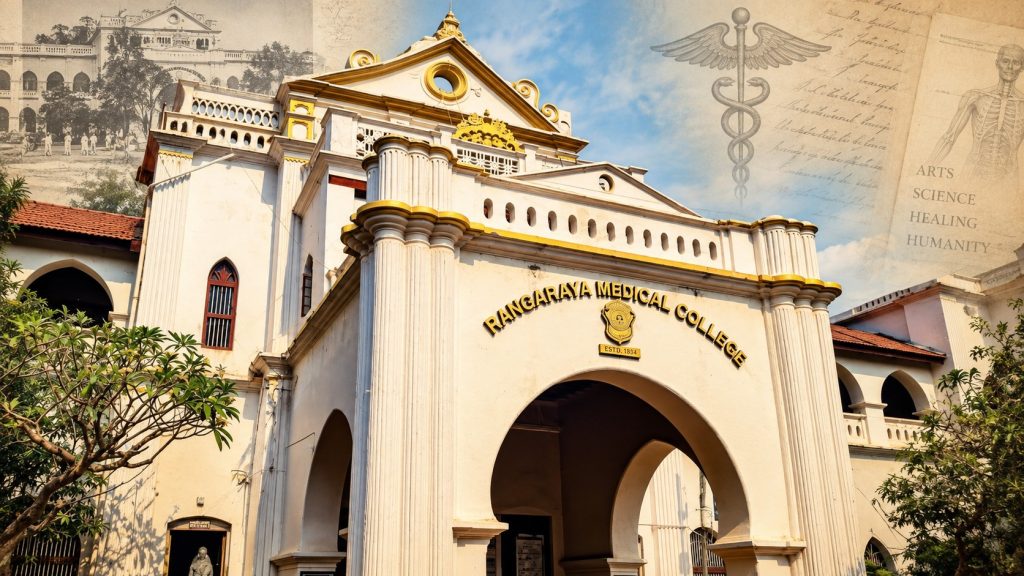
Beyond the bustle of Kakinada’s evening traffic, I came upon a building that seemed to hold its ground with a kind of authority, old, weathered by decades, yet unmistakably dignified against the newer structures crowding the road around it. I was walking with Dr. Chandrashekhar, an MD student at the college, who had offered to show me around the campus. Until that walk, I had no real sense of the history sitting inside those walls, only a vague awareness that the institution had been there for a long time, the way most of us know a landmark exists without ever asking how it came to be.
It was already evening, well past the hours one would expect any real activity, and yet a number of people stood outside the hospital gates in scattered groups, waiting, talking quietly among themselves, in no apparent hurry to be anywhere else. Something about that stillness, an old building holding a crowd of strangers even after its working hours had ended, stayed with me long enough that I went looking into its history once I was back home, curious to understand what this place had meant to the region before it meant anything to me.
Beginning that search, I assumed, the way most people would, that its history followed the predictable path of India’s legacy institutions, a wealthy king handing over a parcel of land, a government cutting a ribbon, or a single wealthy physician erecting a monument to his own name. What I found instead was something far more complex and worth telling properly, a story that deserves to be carried forward to the generations of students and patients who will walk these same corridors long after I have.
The genesis of RMC is an intricate mosaic of post-independence ambition, an unprecedented linguistic compromise in naming, an orphanage that moonlighted as a medical campus, and an intellectual lineage that stretches all the way to Netaji Subhas Chandra Bose’s inner circle. To uncover the founding of Rangaraya Medical College is to explore a masterclass in community-led, private-sector resourcefulness that transformed coastal Andhra Pradesh for good.
The Problem of the Missing Physicians
To understand why RMC was built, one must look at the geography of the late 1950s. The newly carved state of Andhra Pradesh was grappling with a massive deficit of healthcare professionals. While elite medical colleges existed in cities like Visakhapatnam and Guntur, the fertile, densely populated Godavari districts lacked a dedicated medical training ground.
The idea to plug this gap did not originate in a bureaucratic office in New Delhi or Hyderabad. It was conceived by local visionaries who realised that if they waited for the state to build a medical college, a generation of students would lose out.
The initial spark came in 1955 from Dr. Mallavarapu Venkata Krishna Rao, a former Education Minister in the cabinet of Chakravarti Rajagopalachari during the era of the composite Madras State. Dr. Krishna Rao had the political foresight to know what it took to build an institution, but he needed structural and military-grade execution. He found his partner in Colonel Dr. Datla Satyanarayana Raju, known as Dr. D.S. Raju, a medical figure who had served as the personal doctor to Netaji Subhas Chandra Bose during the Indian National Army trials and later became the Deputy Minister of Defence and Health under Jawaharlal Nehru.
Together, these two men decided that if the government could not immediately fund a public medical college in Kakinada, they would rally the public to build a private one.
April 2, 1958: The Historic Meeting at Pithapuram Road
The dream officially shifted from concept to reality on April 2, 1958. A meeting was convened in Kakinada at the residence of a prominent local citizen, Dr. Lakkaraju Subbarao. The gathering included Sri Neelam Sanjiva Reddy, then the Chief Minister of Andhra Pradesh.
The organisers faced a real hurdle. They had no land and no buildings to house a medical college, an enterprise that requires extensive laboratory and classroom space.
Stepping into this gap was the Maharajah of Pithapuram. In an act of philanthropy, he gave his consent to hand over an orphanage building complex he was running on Pithapuram Road. A space originally built to shelter and care for vulnerable children became the incubator for the region’s future doctors.
To formalise the community support gathering around them, the founders registered the Kakinada Medical Education Society on April 16, 1958. Its mandate was clear and ambitious in equal measure, open a fully functioning private medical college by July of that same year.
The Name: A Portrait of Gratitude
Perhaps the most striking element of RMC’s history is its name. In the mid-20th century, if a private citizen funded a college, the institution typically bore their exact name. RMC broke that convention through a gesture of gratitude from the Kakinada Medical Education Society.
As the society scrambled for seed capital, it received financial support from regional families, including Sri P.S. Raju, the Zamindar of Goteru. The larger breakthrough came from an industrialist from Tanuku, Sri Mullapudi Harischandra Prasad, representing the Sri Mullapudi Venkata Rayudu Memorial Educational Trust, who donated five lakh rupees, an extraordinary sum at the time.
Rather than allow the college to be named after him, Prasad deflected the honour. In response, the society crafted a portmanteau name that honoured Prasad’s own family lineage, drawing “Ranga” from his late brother-in-law, Sri Pendyala Sriramachandra Venkata Krishna Rangarao, the Zamindar of Dommeru, and “Raya” from his grandfather, Sri Mullapudi Venkatarayudu.
By fusing the memory of the brother-in-law and the grandfather, the society named the institution Rangaraya Medical College, a rare instance in Indian academic history of a college named not after the person who wrote the cheque, but as a multi-generational tribute to a donor’s family roots.
Overcoming the Lack of a Hospital
While the orphanage building was modified to host classrooms, anatomy halls, and basic laboratories, a medical college is functionally incomplete without a teaching hospital of real capacity. Building one from scratch would have taken years the society did not have.
The founders turned to the existing District Headquarters Hospital in Kakinada, a facility with its own history rooted in British colonial-era public health infrastructure. On October 14, 1959, after negotiation with the state, the Government of Andhra Pradesh officially notified the Kakinada District Headquarters Hospital as the formal teaching hospital attached to Rangaraya Medical College, bridging a privately funded college with a publicly managed clinical space, and giving students access to a wide and varied patient base from the outset.
The Haldane Connection
As RMC found its footing through the 1960s, it began attracting attention from unexpected quarters. Among the more remarkable chapters in its history involves the British evolutionary biologist and geneticist J.B.S. Haldane, a polymath who renounced his British citizenship to become an Indian citizen and spent his final years working in the country.
Haldane developed a real respect for the grassroots medical movement taking shape in Kakinada. Before his passing in late 1964, he made his final request known, donating his body to the Pathology Department of Rangaraya Medical College for research and medical education. Haldane, who had famously written a poem on his own terminal illness, treating even his mortality as a final teaching tool, gave a regional medical college in coastal Andhra a striking form of validation, the mortal remains of one of the twentieth century’s most significant scientific minds.
The Shift to a State Institution
By the late 1970s, the financial burden of running a leading medical institution on private donations and subsidised fees had become unsustainable for the Kakinada Medical Education Society. To preserve the quality of education and allow the hospital infrastructure to scale with a growing population, the Government of Andhra Pradesh stepped in. In 1981, the state officially took over RMC, completing its transition from a private, society-run experiment into a premier government medical college.
A Legacy Carved in Community
Great institutions are rarely the work of a single force, and Rangaraya Medical College makes that case as clearly as any I have come across. It exists because an INA-connected physician, a former minister, a local landlord, an industrialist, and a Maharajah sat together in a living room on a spring afternoon and decided that the youth of the Godavari districts deserved better than what they had. The name on its façade does not represent a single ego. It represents a community’s way of saying thank you to a donor who asked for nothing in return, a piece of Kakinada’s own golden age of philanthropy, still standing, still treating patients, decades after the men who built it have passed on.
Walking out through those same gates that evening, I carried all of this history with me into the city outside. While returning, the streets of Kakinada were well lit. Beside the smell of the open drainage, people were already preparing to go to bed. I do not know how they manage to fall asleep so easily amid it all. Perhaps the chaos has simply become part of their life, absorbed so completely into the rhythm of the place that it no longer registers as chaos at all, only as home.
__________________________________________________
In short: A quiet, weathered building near Kakinada’s evening traffic and a crowd of people waiting outside its gates after hours sent the author looking into the history of Rangaraya Medical College. What emerged was a remarkable story of post-independence community effort: an INA veteran physician, a former minister, a Maharajah who donated an orphanage building, and an industrialist who refused to have the college named after himself, choosing instead to honor his late brother-in-law and grandfather through its name. The piece traces the college’s journey from a privately funded 1958 experiment to a state-run institution, including its unlikely connection to British scientist J.B.S. Haldane, who donated his body to its Pathology Department. It stands as a record meant to carry this history forward for generations of students and patients still to come.