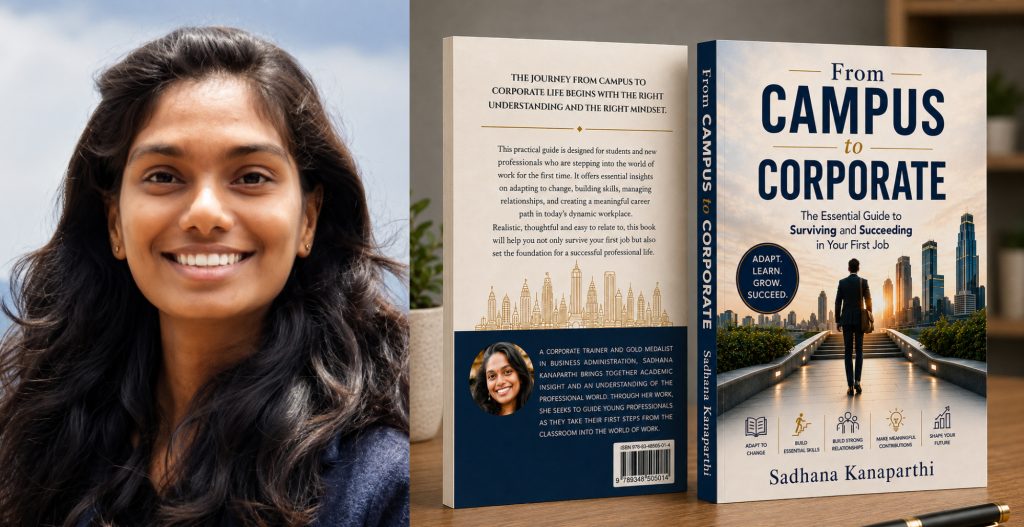
There are books that tell young people how to build a career, and there are books that speak more honestly about what it feels like to begin one. From Campus to Corporate: The Essential Guide to Surviving and Succeeding in Your First Job by Sadhana Kanaparthi belongs to the second category. It is a book concerned not merely with employment, but with the difficult and often overlooked transition from being a student to becoming a professional.
This transition deserves far more attention than it usually receives. Education prepares young people to acquire knowledge, pass examinations, earn qualifications and compete for opportunities. Yet the moment a graduate enters an organisation, many of the rules change. Knowledge remains important, but it is no longer sufficient. The new professional must learn how to communicate, collaborate, respond to authority, manage expectations, handle uncertainty, accept responsibility and function within a network of human relationships. These lessons are often acquired through experience, and experience can sometimes be an unforgiving teacher.
Sadhana Kanaparthi understands this reality well. Her own academic and professional background gives the book a useful foundation. A Gold Medallist in PGDM in Finance and Business Analytics from the Kirloskar Institute of Advanced Management Studies, with professional experience in organisations including Infosys, Odessa Technologies and Wipro Technologies, she writes from a position that combines academic achievement with experience of the contemporary workplace. Her perspective is particularly relevant because the book does not approach the young professional merely as someone who needs technical competence. It recognises the person behind the designation, the individual who is still learning how to understand work, relationships, ambition, responsibility and self.
One of the strengths of From Campus to Corporate is its recognition that the first job is itself an education. This may sound obvious, but it is a point worth making because young graduates frequently enter professional life with an expectation that education is largely complete. They have obtained the degree, crossed the examinations and secured the job. What they discover soon enough is that another form of learning has begun. The questions are different now. There may be no textbook chapter explaining how to deal with an impatient manager, no examination rubric for responding to criticism and no classroom exercise that adequately prepares one for the consequences of missing an important deadline.
The book approaches these realities without presenting them as reasons for anxiety. Instead, it encourages readers to see them as part of professional growth. This is an important distinction. A young person who makes a mistake at work may immediately interpret that mistake as evidence of inadequacy. Sadhana’s approach encourages a different understanding. Mistakes, difficult conversations, unfamiliar responsibilities and uncomfortable situations can become sources of professional maturity when they are examined honestly and used as opportunities to learn.
The progression of the book is also thoughtful. It begins with the transition itself and gradually moves into the practical realities of working life. The early chapters address the loss of the familiar structures of student life, the significance and limitations of a degree, the first ninety days and the language of the workplace. These are appropriate starting points because they deal with the psychological and practical adjustment that takes place when a young person enters an organisation for the first time.
The discussion then moves naturally into relationships. Working with people is one of the most important and least predictable aspects of professional life. We do not choose our colleagues in the way we choose our friends, and we do not always share their personalities, habits, priorities or ways of thinking. The chapters dealing with workplace relationships and management recognise that professional maturity includes learning to work effectively with people who may be very different from us.
I particularly appreciate the attention given to the experience of being managed. Much career literature concentrates on leadership, as though the natural progression of every professional should be towards managing others. Yet before becoming a leader, most people spend considerable time being managed. Learning to receive feedback, understand expectations, exercise judgement and work within organisational structures is an important professional skill in its own right. The book treats this experience as part of learning rather than as a limitation on independence.
Another valuable aspect is its treatment of mistakes. There is a tendency in professional culture to celebrate success while treating failure as something to conceal. For someone beginning a career, this can create an unhealthy fear of getting things wrong. The book takes a more realistic position. Mistakes are inevitable, but the manner in which one responds to them can reveal character and determine whether the experience becomes useful. Taking responsibility, understanding what went wrong and making sure that the same lesson does not have to be learned twice are important parts of professional development.
The book also expands its focus beyond immediate workplace survival. Chapters on time, pressure, money, work-life boundaries, office politics and career growth acknowledge that a career is not lived in isolation from the rest of life. A salary brings independence, but it also introduces responsibility. A demanding job may provide growth, but it can also begin to occupy more of a person’s life than intended. Career advancement can bring recognition, but it can also raise questions about whether the direction being pursued is actually meaningful.
This broader perspective makes the book more than a manual for the first few months of employment. It gradually becomes a guide to thinking about professional life itself. The later chapters on career decisions, networking, professional presence and leadership are particularly relevant because they encourage readers to look beyond the immediate job description. A career is not simply a sequence of promotions. It is shaped by relationships, reputation, learning, judgement and the choices one makes when the next step is not obvious.
There is also something valuable in the book’s refusal to promise a perfect career path. Young professionals are often pressured to have everything figured out very early. They are expected to know what they want, where they will be in five years and which opportunities they should accept or reject. Reality is considerably less orderly. Careers develop through unexpected opportunities, changes in interests, new responsibilities and circumstances that cannot always be predicted. The book allows room for this uncertainty while encouraging readers to remain attentive to what their experiences are teaching them.
From an educational perspective, I find this particularly meaningful. Institutions can provide knowledge and qualifications, but education should ultimately prepare individuals to participate thoughtfully in the world around them. The transition from campus to corporate life is one of the places where this broader purpose of education becomes visible. A young graduate needs more than employability. They need judgement, resilience, communication skills, self-awareness and the ability to continue learning.
From Campus to Corporate contributes to that conversation in a practical way. It does not attempt to turn professional life into a set of rigid instructions. Instead, it encourages readers to observe, reflect and gradually develop their own understanding of work. That makes the book particularly suitable for students approaching graduation, recent graduates beginning their first jobs and young professionals who are still trying to understand the culture and expectations of the workplace.
The book is also timely because the nature of professional life continues to change. Technology is transforming workplaces, organisations are becoming increasingly interconnected and young professionals are entering careers in which continuous learning is no longer optional. Yet beneath these changes, certain human questions remain remarkably constant. How do we work with others? How do we respond when we fail? How do we build trust? How do we balance ambition with well-being? How do we know when it is time to change direction? These questions remain relevant regardless of industry or job title.
What Sadhana Kanaparthi offers is therefore not simply a guide to getting through one’s first job. She offers a way of looking at those early years as an important period of formation. The first workplace becomes another classroom, although one without a fixed syllabus. Its lessons come through responsibility, relationships, mistakes, pressure, opportunity and reflection.
For young readers standing at the threshold of professional life, this book can serve as a useful companion. It may not eliminate the uncertainty that accompanies the first job, nor should it. Some things can only be understood by living through them. What a good guide can do is help us recognise those experiences when they arrive and approach them with a little more preparation.
That is the real value of From Campus to Corporate. It reminds us that entering the workplace is not the end of education. It is the beginning of another, more personal form of learning. A degree may open the door, but what happens after that depends on how willing we are to observe, adapt, take responsibility and continue growing.
Sadhana Kanaparthi’s book deserves to be read not only by those about to begin their first jobs, but also by educators, mentors and professionals who have the opportunity to guide young people through this important transition. If we want our graduates to become capable professionals, we must teach them not only how to enter the workplace, but also how to understand it.
From Campus to Corporate makes a meaningful contribution to that effort. It is a practical, thoughtful and timely book for anyone standing at the beginning of a professional journey and wondering what comes after the classroom.
Prof. Irene Doura Kavadia
About Prof. Irene Doura-Kavadia
 Prof. Irene Doura-Kavadia is a Greek educationist, linguist, author, poet and cultural advocate based in Athens. She holds advanced qualifications in Comparative and Computational Linguistics and has worked as a language educator, translator, writer and academic. She is the Secretary-General of the Writers Capital International Foundation and Editor-in-Chief of Writers International Edition, where she contributes to international literary and cultural dialogue. A prolific author whose work spans poetry, fiction, essays and educational writing, Irene has published numerous books and participated in literary and cultural initiatives across countries. Her work is deeply connected with education, language, literature, cultural diversity and the promotion of understanding among people and cultures.