On the tenth morning the lamp lit nine days ago is allowed to finish, the barley in the vessel stands tall and green, and the household that began the festival with a handful of seed and a pot of water comes to its last day. Vijayadashami takes its name from vijaya, victory, and dashami, the tenth lunar day, and it is kept in nearly every part of India under one of its many names, among them Dussehra and Dasara. This final article gathers what the nine nights have shown. It looks at the stories of victory that the day holds, reads the nine forms of the Goddess together, considers what victory means in the Indian tradition, and follows the customs of the day to their close. The question with which the series began, who the Goddess is, ends here as an answer given in the shape of a festival.
The Name and the Day
Dussehra is usually explained as dashahara, the removal of ten, whether of the ten heads of Ravana or of ten faults of the mind, and the name Vijayadashami holds the same event as victory. The day is held to be auspicious for beginnings. It carries a further name, Aparajita, the Unconquered, under which the Goddess is worshipped in many places and a blue-flowered creeper of the same name is offered to her. In Kerala children are initiated into writing on this day in the rite of Vidyarambham, tracing their first letters in rice or sand, and in many other regions people begin study, a craft or a venture on the day, since it is held that what is begun at the time of victory carries the quality of the day with it.
Three Stories of Victory
Three stories of victory are told on this day, and each belongs to a different text.
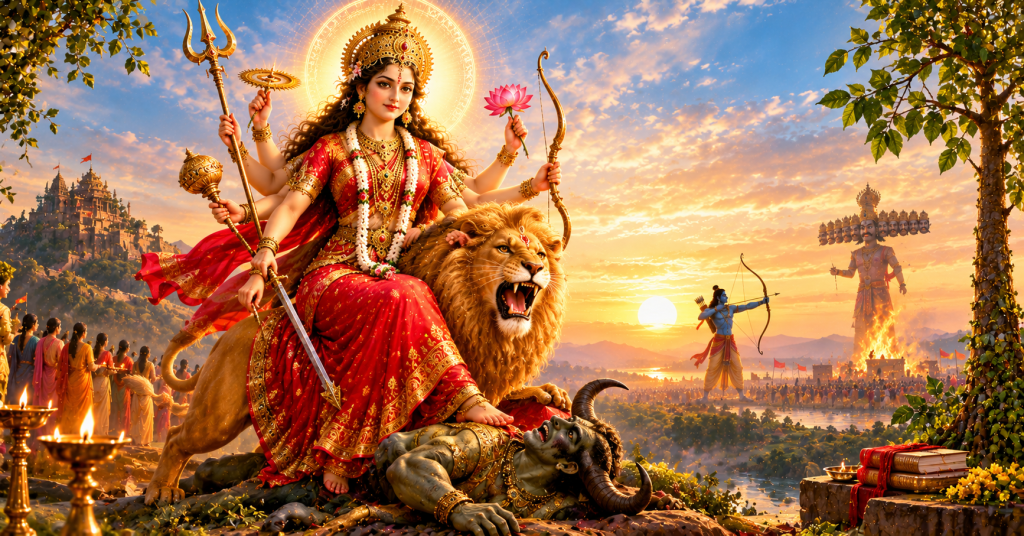
The first is the Goddess’s. According to popular tradition, Katyayani, worshipped by the sage Katyayana for three days, slew Mahishasura on the tenth. The account in the Devi Mahatmya (chapters 2 to 4), met in the sixth article, is the earliest full telling of the battle, and the gathered radiance of the gods that gives her form makes it a story of many powers made one.
The second is Rama’s. In the Ramayana of Valmiki the war against Ravana, who had carried off Sita, ends with Ravana’s fall in the Yuddha Kanda, and in North India the event is placed on this day, which is why effigies of Ravana, Kumbhakarna and Meghanada are burned at the close of the Ramlila performances. The link between Rama’s victory and the worship of the Goddess belongs to later texts. The Devi Bhagavata Purana (Book 3, chapters 26 to 30) tells that Rama, on the advice of Narada, kept the nine nights of Devi worship before the final battle, and the Bengali Krittivasi Ramayana tells of his untimely invocation of Durga in the autumn, the akal bodhan, from which the Bengali autumn worship takes part of its form.
The third is the Pandavas’. In the Virata Parva of the Mahabharata the Pandavas hide their weapons in a shami tree before entering the thirteenth year of their exile, in which they must live unrecognised, and when the year is complete Arjuna takes the Gandiva from the tree and rides out to defend King Virata’s cattle. In Maharashtra, Karnataka and nearby regions the day is marked by worship of the shami, or banni, tree and by the exchange of its leaves, or those of the apta tree, as tokens of gold.
The Nine Forms Read Together
The nine forms of this series are gathered below, with the day, the emblems the tradition reads, the teaching taken from each and the popular chakra association. As the earlier articles said, the chakra scheme is one reading among several, and it is least consistent for the last three days.
| Day | Form | Emblems | Central teaching | Popular chakra association |
|---|---|---|---|---|
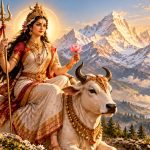
| 1, Pratipada | Shailaputri | White bull, trident, lotus, crescent moon | Steadiness and the ground of practice | Muladhara |
| 2, Dwitiya | Brahmacharini | Rosary, water pot, white garment, bare feet | Tapas, the cost of what is deeply wanted | Svadhishthana |
| 3, Tritiya | Chandraghanta | Bell-shaped crescent, ten weapons, tiger | Fearlessness with a settled mind | Manipura |
| 4, Chaturthi | Kushmanda | Eight arms, nectar jar, lotus, rosary, lion | Creation as joy, and dependence on light | Anahata |
| 5, Panchami | Skandamata | Child on the lap, lotuses, lion | Power that shows itself as care | Vishuddha |
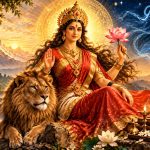
| 6, Shashthi | Katyayani | Sword, lotus, lion | Gathered strength and righteous anger | Ajna |
| 7, Saptami | Kalaratri | Hook, sword, raised hand, donkey | Facing fear and time | Sahasrara in most schemes |
| 8, Ashtami | Mahagauri | White bull, trident, drum | Purity after effort, the dark and the fair as one | Crown or lunar centre, varying |
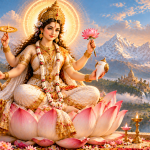
| 9, Navami | Siddhidatri | Mace, discus, lotus, conch | Fulfilment and union | Sahasrara in some schemes |
The order carries its own meaning. The first three forms prepare the person: the ground in Shailaputri, the discipline in Brahmacharini and the courage to remain in Chandraghanta. The next three act in the world, as Kushmanda creates, Skandamata nurtures and Katyayani defends. The last three complete, as Kalaratri dissolves what time has finished, Mahagauri purifies what remains and Siddhidatri fulfils. The sequence can be read as the course of one inner life, and the Devi Kavacha names the forms in this order.
In many regions the nine nights are also divided into three groups of three, devoted in turn to Durga, Lakshmi and Saraswati, a popular arrangement that lies over the Navadurga and is not found in the Kavacha. The colours assigned to each day, which many households follow, vary by region and by year and belong to popular practice.
What Victory Means
The tradition has asked what victory is as carefully as it has asked about time or purity. Its first answer is that victory belongs to truth. Satyam eva jayate nanritam, says the Mundaka Upanishad (3.1.6): truth alone conquers, and falsehood does not. Its second answer is that victory has conditions. The Bhagavad Gita closes with Sanjaya’s judgement (18.78) that where Krishna, the master of yoga, and Arjuna, the bearer of the bow, are present, there are prosperity, victory, well-being and firm conduct, and commentators read the pair as wisdom and action joined. Its third answer is that the great battle is within. The Gita (6.5 to 6.6) says that a person should lift himself by himself, that the self is the friend of the self and also its enemy, and that to the one who has conquered himself the self is a friend, and the sixteenth chapter (16.21) names desire, anger and greed as the three gates to ruin. The Dhammapada (103), in the neighbouring Buddhist tradition, says that the one who conquers himself is a greater conqueror than one who conquers a thousand in battle.
The three stories of the day carry the same layers. Mahishasura, as the sixth article described, is read as the arrogance of power that rests on a belief in its own immunity. Ravana, whose ten heads are commonly read as the ten faculties of sense and action or as ten faults of the mind, is learned in the Vedas and mighty in rule, brought low by desire for what was not his. The Pandavas’ victory follows a year of concealment, a discipline of its own. In each case victory follows long preparation and is won on the side of dharma, and the tradition takes care to show its limits. After Ravana’s fall, in the passage on his funeral in the Yuddha Kanda, Rama tells Vibhishana that enmity ends with death and that Ravana is now as dear to him as to his brother, and he orders the rites to be performed. The victory the day celebrates does not call for contempt toward the defeated.
How the Day Is Kept
The customs of the day take many forms. In northern India the Ramlila performances of the preceding days end with the burning of the effigies of Ravana, Kumbhakarna and Meghanada, a spectacle watched by whole towns. In Bengal and eastern India the day closes the Durga Puja, when married women apply vermilion to the Goddess and to one another in the rite of Sindoor Khela, and the images are carried in procession to the river or pond and given to the water in the rite called Visarjan. In Karnataka the great procession of Mysuru, the Jamboo Savari, takes place on this day, and in Himachal Pradesh the Kullu Dussehra begins on it and continues for a week. In Maharashtra families cross the boundary of the village or the home in the rite of Simollanghan and then exchange the leaves of the apta tree. In many homes the barley seedlings from the vessel are taken out and shared, in some regions tucked behind the ear as a blessing, and the lamp is allowed to burn to its end.
What the Nine Nights Teach
The first teaching is that the Goddess is one. The Devi Mahatmya gives her this line in its tenth chapter, when the goddesses who fought beside her withdraw into her body and she asks who else there is in the world, and the nine forms of this series are the faces of a single power, met first as the ground beneath the foot and last as fulfilment. The Devi Sukta of the first article placed her beneath the gods as their support, and the close of the festival returns to that picture.
The second teaching is that she is within the world and beyond it. She is the power in the seed and the voice in the hymn, the night that watches over sleepers and the light that follows it, and she is also the supreme reality of the Upanishads, which is the meaning of the first article’s account of Shakti as Prakriti and Brahman together. The nine nights show the same Goddess at each end of that range.
The third teaching is that victory has an outer face and an inner one, and the tradition keeps both. The demon of the story has a counterpart in the mind, and the festival gives the devotee nine nights of practice, in fasting, recitation and attention at a household altar, in which the inner contest is carried on.
The fourth teaching is in the parting. The Goddess is welcomed on the first night and given to the water on the tenth, and in Bengal the farewell ends with the cry that she will come again next year, asche bochor abar hobe. The rite carries the thought that the Goddess is present through the cycle of the seasons and returns as the seed returns, and that the form given to the water has gone back to the formless of which the Devi Sukta spoke.
Seen Through the Natural World
The tenth day falls in the season of clear skies after the monsoon, when the autumn harvest begins across much of the country, and the moon stands about four-fifths lit, about a week from the full moon of Sharad Purnima. The shami tree of the Mahabharata story is a real tree, Prosopis cineraria, a native of the dry plains of western India and Rajasthan, where it is the state tree. It survives drought through deep roots, fixes nitrogen in the soil as a legume, and gives fodder, firewood and the pods eaten as sangri, which makes it a tree that sustains life where little else does. It is a fitting place for a story to keep a hidden strength. The apta leaves of Maharashtra come from another tree, Bauhinia racemosa, whose paired leaves are exchanged as gold.
The inner victory the tradition describes has a measurable counterpart. A long study that followed about a thousand children in New Zealand from birth into their thirties found that those with better self-control in childhood had better health, higher incomes and fewer criminal convictions as adults, even when family background was taken into account (Moffitt and colleagues, 2011). The study cannot say that the festival’s disciplines produce such control, and it does show that the capacity the tradition calls self-conquest matters over a lifetime. The immersion of the images has an environmental side as well, and many communities now use clay and natural colours for the images and artificial ponds for immersion, so that the water that receives the Goddess is kept clean. As in the earlier articles, the chakra scheme remains the tradition’s own account and has not been established by measurement.
The Lamp, the Water and the Grain
In Bengal the Goddess is carried to the river at dusk with drums and the cry that she will return, the oil in the lamp is nearly spent, and the barley from the vessel is passing from hand to hand through the household. Outside, the fields have begun to turn gold, and the shami tree stands in the dry light as it stood for the Pandavas. The nine nights are over. The Goddess who was met first as a mountain and last as fulfilment is in the water, in the grain and in the hands that hold it.
Sources and Further Reading
Primary texts
- Rigveda 10.125 (Devi Sukta)
- Mundaka Upanishad 3.1.6
- Bhagavad Gita 6.5 to 6.6, 16.21 and 18.78
- Devi Mahatmya, chapters 2 to 4 and 10; Devi Kavacha
- Devi Bhagavata Purana, Book 3 (chapters 26 to 30)
- Ramayana of Valmiki, Yuddha Kanda; Krittivasi Ramayana
- Mahabharata, Virata Parva
- Dhammapada 103
Translations and studies
- Wendy Doniger, The Rig Veda: An Anthology (Penguin Classics)
- Patrick Olivelle, Upanisads (Oxford World’s Classics, 1996)
- Swami Gambhirananda, Bhagavad Gita with the Commentary of Shankaracharya (Advaita Ashrama)
- Robert P. Goldman and others (trans.), The Ramayana of Valmiki: An Epic of Ancient India (Princeton University Press)
- J. A. B. van Buitenen (trans.), The Mahabharata, Volume 3: The Book of the Virata and the Book of the Effort (University of Chicago Press, 1978)
- Acharya Buddharakkhita, The Dhammapada: The Path of Wisdom (Buddhist Publication Society)
- Swami Vijnanananda, The Srimad Devi Bhagavatam (Sacred Books of the Hindus)
- Terrie E. Moffitt and others, “A gradient of childhood self-control predicts health, wealth, and public safety,” Proceedings of the National Academy of Sciences 108 (2011)
- Thomas B. Coburn, Devi Mahatmya: The Crystallization of the Goddess Tradition (Motilal Banarsidass, 1984)
- David Kinsley, Hindu Goddesses (University of California Press, 1986)