A Critical Review by Prof. Irene Doura Kavadia
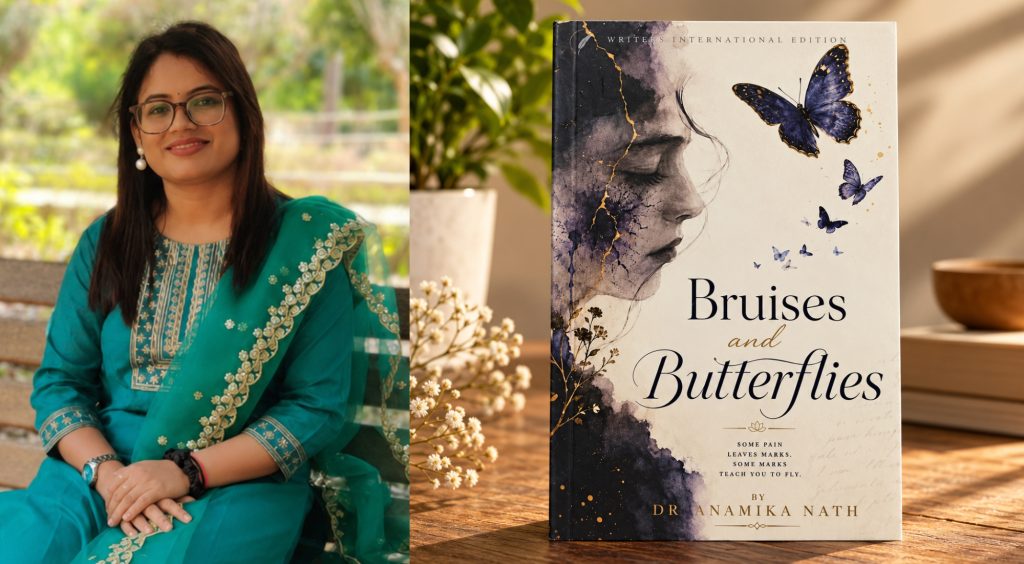
In Bruises and Butterflies, Dr Anamika brings together the intimate and the public, the remembered and the forgotten, the physical body and the emotional histories it carries. The collection asks readers to pay attention to experiences that often escape notice: a mother’s silence, the discomfort of being misunderstood, the memory held by an old kitchen, the violence concealed beneath familiar social conventions, and the uneasy relationship between identity and belonging. These subjects are approached without excessive sentimentality. The poems seek to understand how people live with what has happened to them, how memory shapes the present, and how tenderness survives alongside injury.
Dr Anamika’s professional background in forensic medicine offers an important context for reading this collection, although it does not fully explain its literary character. Her poems frequently examine the body as a site of evidence, but they also recognise that human experience cannot be reduced to what can be observed, measured, or documented. A body carries its history in ways that may not be visible. A family can inherit grief without possessing the language to describe it. A community can remember injustice even when public discourse attempts to move beyond it. Throughout the collection, the act of looking becomes inseparable from the responsibility to understand what is being seen.
Beyond the Language of Recovery
The title Bruises and Butterflies establishes the central tension of the book. Bruises suggest injury, vulnerability, and the persistence of an encounter after the encounter itself has ended. Butterflies suggest transformation, but they need not be read as symbols of uncomplicated renewal. Dr Anamika does not present suffering as a necessary stage on the way to a more beautiful or complete self. Nor does she insist that every wound must lead to recovery.
The preface makes this position clear. The poems are concerned with the coexistence of damage and tenderness, rather than with recovery as a triumphant conclusion. This is a significant distinction. Literature about pain can sometimes become too eager to offer consolation, as though the meaning of suffering depends upon the lessons eventually extracted from it. Dr Anamika is more cautious. Her poems recognise that some experiences remain unresolved, and that acknowledging them may itself be a meaningful act.
The collection moves through hospitals, railway platforms, family kitchens, memories of childhood, landscapes, and encounters with death. These settings are not arranged into a simple narrative of personal development. Instead, they form a network of experiences through which the speaker considers what it means to inhabit a body, belong to a place, and remain connected to others. The result is a collection that understands vulnerability not as an exceptional condition but as part of ordinary human existence.
The Social Body and the Question of Belonging
One of the collection’s strongest concerns is the relationship between individual experience and the structures that determine who is accepted, heard, or understood. In “Women’s Compartment,” the railway carriage becomes a space of shared physical presence. Coconut oil, wet dupattas, fried peanuts, bangles, and a sleeping child establish an atmosphere that is recognisably Indian and immediately tangible. The women may not know one another’s names, yet their proximity creates a temporary form of solidarity. The observation that names are unnecessary when weight is already shared suggests that human connection can precede familiarity or explanation.
The poem does not idealise this solidarity. The women remain strangers, and their meeting is temporary. Yet the speaker leaves with something acquired through the encounter: a sense of strength that has passed from one person to another without requiring formal recognition. In a collection preoccupied with isolation and the difficulties of communication, this moment offers a grounded understanding of community.
“Instruction Manual to Fit in a City That Mispronounces You” approaches belonging from a different direction. Its instructional structure exposes the small humiliations through which cultural exclusion is maintained. A mispronounced name, an assumed identity, a joke about physical features, or a question about where someone truly belongs may appear insignificant in isolation. Repeated over time, however, such encounters place the burden of accommodation upon the person who is already being treated as an outsider.
The poem’s reference to mountains surviving mispronunciation gives geographical identity a quiet persistence. A name may be altered by another person’s speech, but the person and the history behind that name do not disappear. “Othering” extends this concern into the social realities of regional identity, language, caste, and the question of who is considered sufficiently Indian. These poems are important because they connect personal discomfort to wider systems of exclusion. They ask readers to consider not only the intention behind an apparently casual remark but also the cumulative effect of being repeatedly positioned outside the boundaries of belonging.
Inheritance: The Past Carried Through Ordinary Things
Memory in this collection is rarely presented as an abstract mental activity. It resides in objects, gestures, food, domestic spaces, and phrases that have passed from one generation to another. “Oiling Hair on Sunday Mornings” recalls the grandmother’s hands and the familiar ritual of applying coconut oil. The poem draws its emotional force from the ordinary nature of the act. Affection is expressed through touch and repetition, through something done so regularly that its significance may become apparent only when the person who performed it is no longer present.
In “How to Translate a Heart Attack in My Mother Tongue,” language becomes a means of examining inherited silence. The poem places medical crisis alongside the limitations of familial expression, allowing the reader to see how pain may be understood physically while remaining difficult to articulate emotionally. The reference to Partition adds a historical dimension to this difficulty. The inability to speak openly about suffering is not treated simply as a personal failing; it is connected to histories of displacement and the habits of restraint that can persist across generations. The grandmother’s death, associated with unfinished sentences, becomes an image of what remains unspoken when a life ends.
This is among the collection’s most compelling areas of inquiry. Inheritance is not confined to possessions, customs, or stories deliberately passed down. It also includes silences, fears, and ways of responding to hardship that become so familiar they are mistaken for natural behaviour.
The domestic poems extend this argument through the material world. “Shape of an Old Kitchen” recalls a space shaped by rain, family routines, and the mother’s voice. “The First Plastic Chair” considers what is lost when convenience replaces objects that have accumulated personal histories. “Power Cut, 1995” and “When Kids Did Not Have Watches” revisit a time when darkness, hunger, shadows, and shared routines governed daily life more directly than clocks and devices. These poems are not simply nostalgic. They examine the relationship between material change and the ways people experience time, family, and place.
The Female Body as Lived Experience
The female body occupies a central position in Bruises and Butterflies, but Dr Anamika resists treating it as a single, stable category. It is a site of social expectation, reproductive experience, desire, exhaustion, and self-questioning. In “I Do and I Do Not Want a Body,” the contradictions of bodily existence become particularly evident. The body may be loved, needed, and inhabited, yet it can also become a source of alienation. The experience of motherhood, including the physical consequences of childbirth and the demands of care, complicates any simple celebration of the maternal role.
The poem’s willingness to acknowledge ambivalence is important. Women are often expected to speak of motherhood through established languages of fulfilment and sacrifice. Experiences that do not fit those expectations may be difficult to express without fear of judgement. By allowing contradictory feelings to coexist, Dr Anamika makes room for a more complex account of the body and its demands.
“On the Plasticity of Women and Gold” examines the ways women are shaped by social expectations, while “The Virginity of a Village” brings questions of female sexuality and purity into the landscape of collective identity. The latter is particularly revealing because the village becomes associated with a female body whose supposed purity is defended through social conventions that may conceal violence or contradiction. The poem invites scrutiny of the moral language through which communities regulate women while preserving their own reputations.
These poems do not offer a single theory of womanhood. Their strength lies in showing how the female body is simultaneously personal and political, experienced from within and interpreted by others. The tension between these positions remains unresolved, as it often does in life.
Forensic Medicine and the Poetry of Evidence
The collection’s engagement with death and forensic observation provides some of its most distinctive material. In “The Autopsy of Silence,” the language of examination is turned towards a relationship damaged by neglect. Silence is not treated as an empty space but as something that accumulates consequences. A relationship may deteriorate through the repeated absence of attention, explanation, or response. The metaphor of autopsy asks what can be learned from examining a loss after the possibility of intervention has passed.
“Monsoon Doesn’t Wash Away Blood” moves from the intimate to the public. Rain, which is often associated with cleansing and renewal, cannot erase the evidence of violence or guarantee justice. The poem considers the distance between public slogans and the realities they claim to address. Words may disappear, public attention may shift, and familiar routines may resume, while the consequences of violence remain with those who have experienced it.
Here, Dr Anamika’s medical background offers a productive point of contact with her poetic practice. Forensic medicine seeks evidence that can withstand scrutiny. Poetry, by contrast, often works through ambiguity, association, and emotional implication. The two approaches are not identical, but the collection allows them to inform one another. The forensic gaze insists that suffering should not be overlooked; the poetic imagination recognises that evidence alone cannot account for the whole of a human life.
This relationship gives the collection an ethical dimension. To witness is not simply to observe. It also means resisting the temptation to reduce another person’s experience to a convenient explanation or a passing spectacle.
Time, Landscape, and the Self
In the later sections, the collection broadens its attention to love, departure, landscape, and the instability of personal identity. Poems such as “Nothing Was Lost,” “Finding Love,” “When You Are Leaving,” and “What We Practice Becomes Love” consider the ways relationships are shaped through ordinary actions and repeated choices. Love is not presented only as an intense emotion. It is also a practice, sustained or diminished by the conduct of daily life.
The poems concerned with rivers, trees, gardens, and ecological memory extend the idea of witnessing beyond the human body. In “The River and the Names” and “The Trees Will Remember Us Gently,” the natural world becomes a repository of histories that human beings may neglect or fail to preserve. This does not mean that landscape is merely a decorative backdrop for human feeling. Rather, it offers a different scale of time, one against which human ambitions, losses, and acts of destruction can be reconsidered.
“Unremembering Anamika” turns the question of memory towards the self. The possibility of forgetting is approached in relation to mortality and the desire to remain attentive to the present. “The Algorithm Forgets My Face” introduces a contemporary concern: the reduction of identity to data. A technological system may record or recognise a face without understanding the experiences, relationships, and histories that give that face meaning. The inability of a system to recognise the person fully becomes, paradoxically, a source of relief. The poem questions the assumption that visibility and recognition are always desirable, particularly when the observer lacks the capacity to understand what is being observed.
These poems return to a concern that runs throughout the book: a human being is always more than the evidence available to another person.
Form, Language, and the Discipline of Attention
Dr Anamika generally favours free verse, using the flexibility of the form to move between observation, recollection, and reflection. Her strongest poems rely on precise sensory details rather than elaborate ornament. The smell of a railway carriage, the touch of oil on hair, the shape of a chair, or the presence of a familiar food can carry an emotional history without requiring lengthy explanation.
“The Physical State of Pumpkin Seeds” is a good example of her ability to find significance in an ordinary object. The poem considers preparation, patience, and transformation through the language of food. Its concern with becoming solid without becoming hard offers an image of resilience that does not depend upon emotional invulnerability. Survival, in this understanding, involves adaptation without the complete loss of tenderness.
The collection also benefits from its attention to language and cultural specificity. Bengali expressions, regional memories, and familiar domestic practices are allowed to retain their particularity. They are not always translated into universal statements, and this is a strength. The reader is invited to enter a particular world rather than encounter a generalised version of experience.
There are moments when a poem explains an idea that its imagery has already communicated. In such instances, greater trust in silence or implication might have strengthened the effect. This is a question of poetic economy rather than a fundamental weakness. The collection is at its most persuasive when it allows an image to remain active in the reader’s mind without immediately interpreting it.
Conclusion
Bruises and Butterflies is a collection concerned with the relationship between injury and attention. It moves from the body to the family, from the family to society, and from individual memory to the wider histories carried by language and landscape. Its subjects are diverse, but they are connected by a consistent question: what does it mean to recognise another life without simplifying its experience?
Dr Anamika does not suggest that attention can reverse loss, eliminate injustice, or resolve every contradiction. Her poems are more measured than that. They ask readers to look carefully at what is present, including the evidence of pain that familiar routines and social conventions can make easy to overlook.
The collection’s lasting value lies in this refusal to treat suffering as either spectacle or a problem that literature must solve. Its people remain complicated, its memories incomplete, and its questions open. The tenderness it offers is therefore not a promise that everything will be repaired. It is a way of remaining attentive to life, even when repair is uncertain.
For Dr Anamika, poetry becomes a means of registering what might otherwise go unnoticed: the body that remembers, the family that cannot speak, the landscape that bears witness, and the individual who remains larger than any single account of who they are. In this sense, Bruises and Butterflies is not simply a collection about pain and change. It is an inquiry into the responsibilities of seeing, remembering, and bearing witness.
Prof. Irene Doura Kavadia
Editor-in-Chief
Writers International Edition