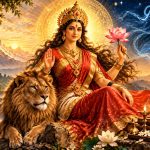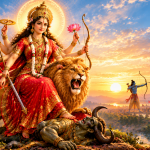
By the sixth night of Navratri the feeling of the festival has changed. The first three days laid ground, discipline and courage, the fourth brought creation and the fifth brought care, and on the sixth the Goddess takes up arms. Katyayani, the sixth of the Navadurga, named in the Devi Kavacha as shashtham Katyayani cha, is the form in which the tradition remembers the slaying of the buffalo demon Mahishasura. She is shown with a sword in her hand and a lion beneath her, and her face is calm. Her story rests on an idea that the tradition treats with great seriousness, that when the powers of many beings gather around one need, a strength appears that none of them held alone. This article follows her name, the story of her making, her form, and the tradition’s long reflection on anger, force and the inner adversary.
The Name and the Sage
Katyayani means the daughter of Katyayana, a sage of the family of Kata, and the name is older than the Puranic stories that explain it. The Taittiriya Aranyaka (10.1.7), in the section that forms the Narayana Upanishad, contains a verse that begins Katyayanaya vidmahe, which asks to know Katyayani, meditates on the maiden Kanyakumari and prays that Durga inspire the mind, and this verse is traditionally recited as the Durga Gayatri. The Devi Bhagavata Purana and other Puranas tell that the sage Katyayana practised tapas with the wish that the Goddess be born as his daughter, and that she granted the wish and took birth in his house, so that he was the first to worship her. Popular accounts add that he worshipped her for three days, from the seventh to the ninth, and that she slew the demon on the tenth, which is the origin of the tenth day’s name, Vijayadashami.
The Demon and the Boon
In the Puranic accounts Mahishasura had performed severe austerities and received from Brahma the boon that no man or god could kill him, and he made the boon the basis of a great contempt, believing that no woman could be a threat. He conquered heaven, drove out Indra and the gods, and took their places. The Devi Mahatmya begins this part of the story with the gods’ defeat. In the second chapter the gods go to Vishnu and Shiva and tell them what has happened. The two grow angry as they listen, and from their faces and from the bodies of the other gods a great radiance rises.
The Gathering of Light
The radiance gathers into a single blazing mass, and from it takes form a woman. The Devi Mahatmya (2.10 to 2.17) lists the sources of her body with care. Her face comes from Shiva’s radiance, her hair from Yama’s, her arms from Vishnu’s, her waist from Indra’s, her feet from Brahma’s, her three eyes from Agni’s, and so on through the gods of the moon, the sun, the winds, the waters and the earth. Each god then gives her a weapon of his own. Shiva gives a trident and Vishnu a discus, Varuna a conch, Agni a spear, Vayu a bow, and Indra a thunderbolt and a bell taken from his elephant Airavata. Brahma gives a rosary and a water pot, and Himavat, the king of mountains, gives her a lion to ride. Her body is made of the gods’ own substance and her hands are filled with their gifts.
A reader of this series will notice that several of the gifts recall earlier days of the festival. The mountain king who gave the lion is Shailaputri’s father, the rosary and water pot are the emblems of Brahmacharini, and the bell belongs to the name of Chandraghanta.
The Battle and the Hymn
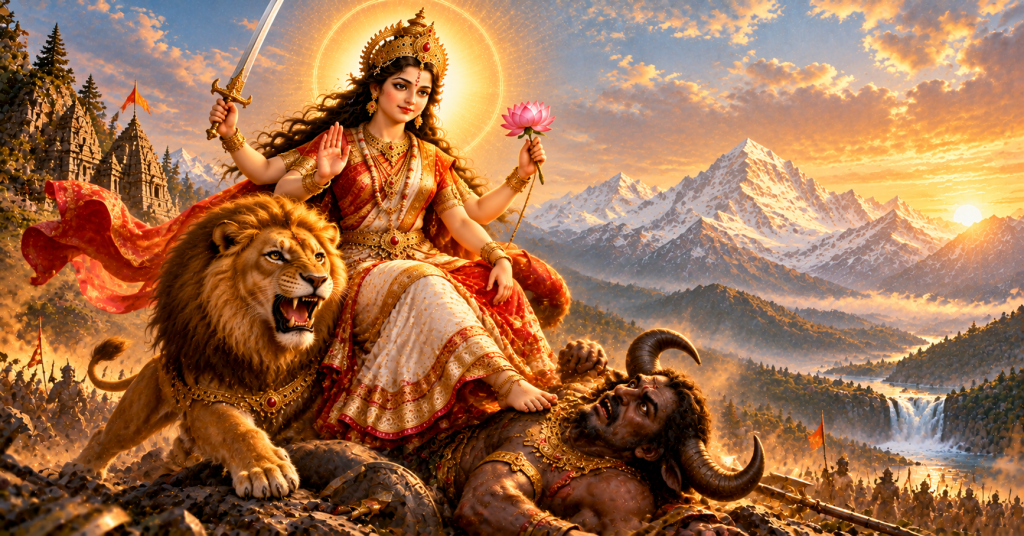
The battle occupies the next two chapters. Mahishasura sends his generals and then comes himself, and he changes form again and again, appearing as a buffalo, as a lion, as a man with a sword, as an elephant and as a buffalo once more. The Goddess drinks from a cup and laughs, telling him to roar while she drinks. She pins him beneath her foot and strikes with her spear, and when the demon half emerges from the buffalo’s body in his last form she cuts off his head (3.36 to 3.40).
The gods sing the hymn that follows in the fourth chapter. They salute her as the one who pervades the world by her own power and who gathered the strength of all the gods in one body, and they ask for her protection whenever they call on her. In this form she is called Mahishasuramardini, the one who crushed Mahishasura, and it is the form most often painted and sculpted in Indian art.
Her Form
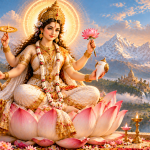
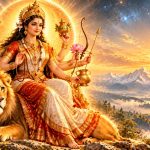
Katyayani is shown with a radiant golden complexion and four arms. The upper right hand is raised in the gesture that removes fear and the lower right grants boons, the upper left holds a sword and the lower left a lotus, and she rides a lion. The verse used in her worship describes her as bright with the shining sword, mounted on the noble lion and the destroyer of demons, and asks that she bestow what is auspicious. The sword is read as discrimination, the power that cuts through confusion, and the lotus beside it as the gentleness that remains in the hand that holds the blade.
Popular tradition associates her with the Ajna chakra, the centre between the eyebrows, whose name means command and which is linked with insight and discernment. The association fits the sword of discrimination. As on earlier days, the chakra scheme is one reading among several.
Katyayani in Worship
The Goddess of the sixth day has a long place in devotion beyond the battle. In the Bhagavata Purana (10.22) the young women of Vraja bathe in the Yamuna through the cold month, make an image of Katyayani from sand, and worship her with the prayer that Nanda’s son, Krishna, become their husband, addressing her as the great illusion, the great yogini and the mistress of all yoga. The tradition came to know her as the goddess to whom young women bring the wish for a good marriage, and unmarried women still keep the Katyayani vow. Readers of this series will recognise a thread from the second day, where Parvati sought a husband through tapas.
The Spiritual Significance of Katyayani
The first teaching is in the manner of her making. No single god could meet Mahishasura, and the Goddess comes into being when each of them lends a portion of radiance to a common form. The tradition reads this as a statement about the way strength against a great wrong is built, by the gathering of many partial powers into one shape, and the Devi Mahatmya repeats the point in its hymns, where she is praised as the unity of all divine energies.
The second teaching concerns anger. The Rigveda has a hymn to manyu, righteous wrath (10.83 and 10.84), which it treats as a divine power that gives strength and victory in battle, and the Devi Mahatmya begins the Goddess’s story with the anger of Vishnu and Shiva at the suffering of the gods. The Bhagavad Gita speaks differently. It lists anger among the traits that lead a person astray (16.4), traces a path from anger to confusion and the loss of reason (2.63), and names desire and anger as the two great enemies born of the passion-quality (3.37). The tradition holds both statements. Anger that arises from personal pride harms the one who feels it, and the wrath that rises on behalf of others, free of ego, is honoured as the force that protects. Katyayani’s calm face is the sign by which the two are told apart.
The third teaching concerns the adversary. Mahisha means buffalo, the heavy animal of dullness and inertia, and commentators read the demon as the arrogance of power that rests on a belief in its own immunity. His changes of form, lion, man, elephant and buffalo again, are read as the disguises that ego and ambition take when pressed, and the Goddess meets each of them in turn. His boon, which counted women as of no account, shows the arrogance in its plainest form, and the Goddess is the answer to it. The inner reading and the outer one stand side by side in the tradition, and neither requires the other to be set aside.
The fourth teaching is that resolve has a divine address. The sage who wished for the Goddess as his daughter and the young women who made her an image of sand each addressed Katyayani with a settled wish and kept a vow over days. The tradition presents her as the form in which sincere resolve receives its answer, and it places the taking up of arms after the preparation of the earlier days.
Seen Through the Natural World
The idea of radiances gathering into one has a familiar physical analogy. A magnifying lens takes sunlight that is scattered and harmless over a wide area and concentrates it to a point where dry grass can catch fire. The analogy illustrates the tradition’s point about the gathering of power, and it makes no claim about the origin of the Goddess.
Anger has been studied closely by psychologists. It is an arousal state that raises the heart rate and prepares the body for action, and it often arises in response to perceived injustice and can motivate people to address it. Research also finds that anger tends to narrow attention and to weaken careful reasoning when it is acted on at once, and that its effects on health are poorer when it is held for long periods. The Gita’s sequence from anger to confusion and the loss of discrimination (2.63) describes in older language what these studies describe in newer. A reading of Katyayani that fits both is one in which strong feeling is answered with a steady mind and the sword is used only after discernment.
The water buffalo, the animal in the demon’s name, was domesticated in South Asia several thousand years ago and remains one of the central working animals of Indian farming. It is enormously strong, and its strength serves a household only while it is yoked and guided, a plain image of the tradition’s view of power. The chakra scheme remains the tradition’s own account and has not been established by measurement.
The Sword Not Yet Raised
By the sixth night the barley in the vessel stands tall and green, and the moon, a little short of half full, is high in the south-west at dusk. The Goddess on the altar holds a sword that she has not yet raised, and her face is as calm as it was on the first day. Katyayani’s story ends in victory, and the tradition does not linger on the battlefield. It goes at once to the hymn of the gods, to the stillness that follows. Tomorrow the series turns from the sword to the night itself, with Kalaratri, the Goddess of the dark.
Sources and Further Reading
Primary texts
- Taittiriya Aranyaka 10.1.7 (Narayana Upanishad)
- Rigveda 10.83 and 10.84 (Manyu Sukta)
- Bhagavad Gita 2.63, 3.37 and 16.4
- Devi Mahatmya, chapters 2 to 4; Devi Kavacha
- Devi Bhagavata Purana, Book 5
- Bhagavata Purana 10.22
Translations and studies
- Wendy Doniger, The Rig Veda: An Anthology (Penguin Classics)
- Swami Gambhirananda, Bhagavad Gita with the Commentary of Shankaracharya (Advaita Ashrama)
- Swami Vijnanananda, The Srimad Devi Bhagavatam (Sacred Books of the Hindus)
- Thomas B. Coburn, Devi Mahatmya: The Crystallization of the Goddess Tradition (Motilal Banarsidass, 1984)
- Thomas B. Coburn, Encountering the Goddess (SUNY Press, 1991)
- Edwin F. Bryant, The Bhagavata Purana: Book X (Penguin Classics)
- David Kinsley, Hindu Goddesses (University of California Press, 1986)