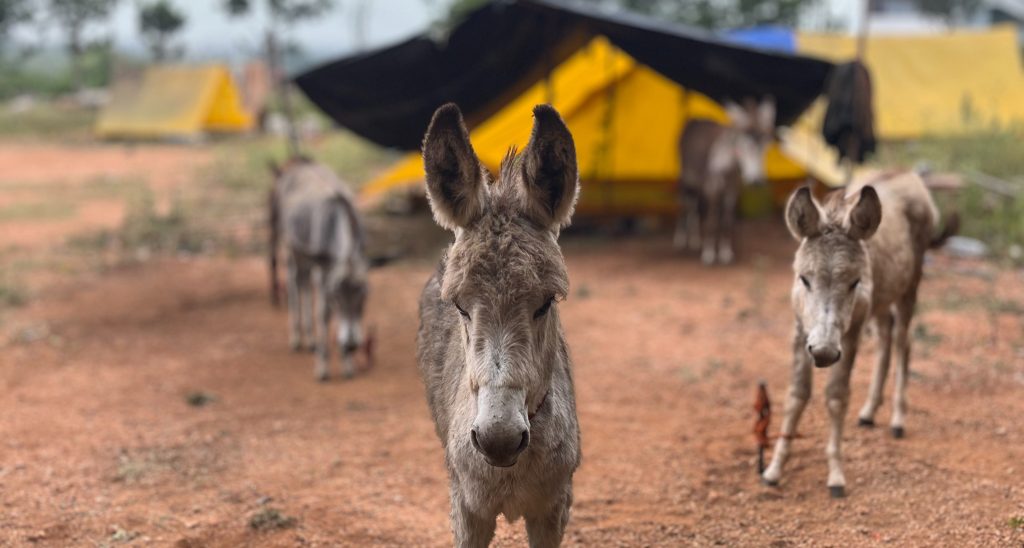
“Take a picture of this with your inner eyes,” I told my daughters, standing at the edge of the open ground where the nomads had pitched their tents for the past few weeks, a handful of canvas shelters leaning against the wind, smoke rising thin and grey from a fire someone had lit for the morning tea. “Frame it and keep it somewhere inside your mind, and whenever you feel like postponing your studies or wasting your time, look at it again.” They looked at the donkey I was pointing to, then at me, and burst into laughter, the easy laughter of children who assume their father has said something funny rather than something he means.
The women of the camp were already at their morning’s work, gathering dry twigs for the fire, cooking over it in blackened pots, tending to children who ran between the tents with the particular fearlessness of a childhood spent outdoors, and milking the donkeys that stood tethered along the length of the clearing. The milk goes quickly in the localities nearby, carried away each morning by buyers who have convinced themselves, on the strength of rumour more than evidence, that it holds something close to a miracle inside it, a promise of skin that will not age and a body that will not fail. I have never had the heart to ask whether the belief is true. It hardly matters to the donkeys, tied as they are to their small allotted patch of earth regardless of what their milk is imagined to cure.
It was one particular donkey that held my eyes longer than the rest that morning, one of its legs bound by a rope to a wooden stump driven into the ground, so that its whole world had shrunk to the exact radius that length of rope permitted, no further, no matter how far the good grass might have grown just beyond its reach. Every so often it lowered its head and searched, with a patience that had long ago stopped looking like suffering and started looking like habit, for another blade within the circle it was allowed. It did not strain against the rope. It did not seem, any longer, to notice that the rope was there at all, and that, more than anything else that morning, was what I could not stop looking at.
I turned back to my daughters, who were still laughing, still waiting for the joke they assumed was coming. “Do you know why I asked you to remember this?” I asked them, and before they could answer I told them myself, because some lessons are better given than discovered. “It is not because this is a donkey. It is because freedom is life’s greatest blessing, and it is also the easiest thing to lose without ever noticing the losing.” I watched their faces settle slowly into something more serious than the morning had asked of them yet. “If you do not study, if you do not work hard, if you do not build your own identity, one day someone else will decide the boundaries of your life for you, where you work, how you live, what choices remain open to you and which have quietly closed. The rope may not be visible. It will still be there, and you will still learn its length the same way that donkey has, by reaching for something and finding, again and again, exactly how far you are permitted to go.”
I think often, watching my own daughters grow, of how many ropes we accept in a lifetime without ever calling them by that name, a job taken not from ambition but from fear of the gap in the resume, a marriage entered not from love but from the exhaustion of resisting what a family has already decided, a silence kept in rooms where speaking might have cost something. None of these arrive wearing the shape of a rope. They arrive dressed as practicality, as duty, as the reasonable thing a reasonable person does, and by the time a person notices the radius of their own life, the noticing itself has often become too costly to act on. The donkey does not strain because straining has taught it, over years, that the rope always wins. I wonder sometimes how many of us have simply had the same lesson taught to us more gently, and for that reason, learned it even more completely.
“The purpose of education is not merely to earn a degree,” I told them, and I meant it as the truest thing I could offer them that morning, more than any warning about marks or careers. “It is to ensure that you remain free, that the boundaries of your life are drawn by your own hand and not measured out by someone else’s convenience. Work hard while you have the opportunity in front of you, because the opportunity itself does not wait, and build a life in which your decisions, even the difficult ones, even the ones that cost you something, remain entirely your own to make.”
My daughters had stopped laughing by then, and something in their silence told me the picture had been taken, whether they knew it yet or not, filed away somewhere behind their eyes to be returned to on some later morning when the studying felt harder than the sleeping in. From a distance came the horn of the school bus, ordinary and insistent, pulling the morning back into its usual shape, and I kissed them goodbye as they climbed aboard, watching them find their seats and press their faces to the window to wave until the bus rounded the bend and the trees took it from view.
Preeth Padmanabhan Nambiar
Summary: A father watches a tethered donkey outside a nomadic camp and uses the image to teach his daughters about the invisible ropes that limit a life without financial independence, education, or self built identity. The article explores how freedom, though rarely named directly, is shaped early through discipline, hard work, and the courage to make one’s own decisions, drawing a parallel between the donkey’s rope and the quiet constraints many adults accept without ever recognising them as such.