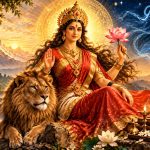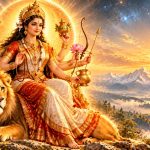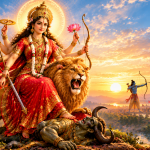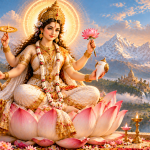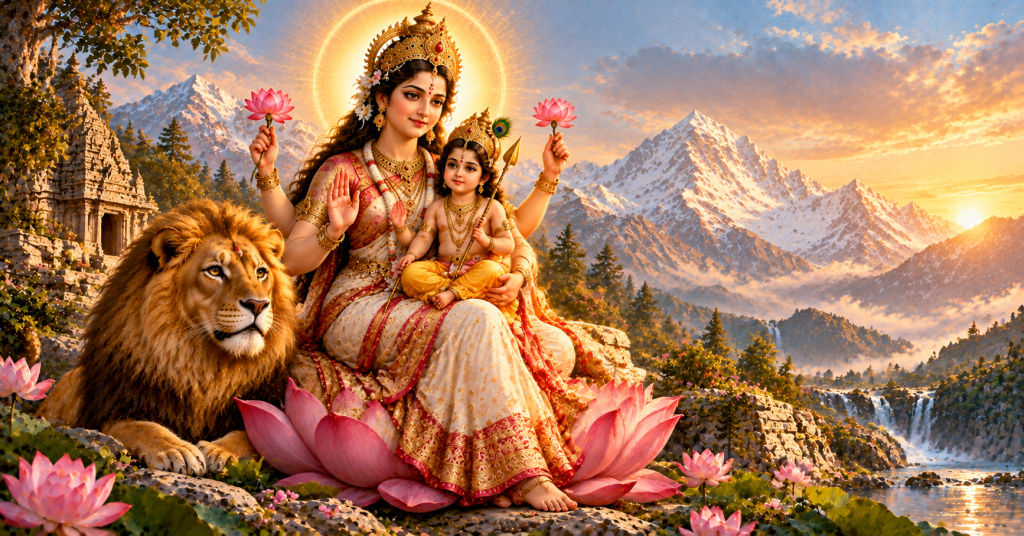
On the fifth night of Navratri the Goddess is shown with a child on her lap. Seated on a lotus with a lion beside her, she holds the infant Skanda in the crook of one arm, and the tradition names her for him: Skandamata, the mother of Skanda. The Devi Kavacha places her fifth among the Navadurga, panchamam Skandamateti. She is the only one of the nine shown with a child, and she is among the gentlest of them, although her son is the commander of the armies of the gods. Kushmanda brought the universe into being, and Skandamata is the Goddess who holds what has been made and gives it care. This article follows her son’s birth, her form, the long Indian reverence for the mother, and what the tradition has found in a Goddess whose power shows itself in nurturing.
The Name and Her Son
The Skanda to whom she is mother is known by many names. He is Kartikeya, nursed by the Krittikas, Kumara, the youth, Guha, the one in the cave, Shanmukha, the six-faced, Subrahmanya, and in the Tamil country Murugan, the beloved god of the Tamil people for more than two thousand years. The name Skanda comes from the root skand, to leap or to spill, which the Puranic story takes up in its account of his birth. Skandamata is the Goddess in her relation to this son, and the tradition has made that relation the whole of her identity on this day. She is named by the child she holds.
The Birth of the Commander
The story of the birth begins in a crisis. The demon Taraka had won from Brahma the boon that only a son of Shiva could kill him, and Shiva, as the earlier articles have told, was absorbed in meditation and had lost his first wife. The gods needed a child of Shiva and Parvati, and the whole of the preceding story, Parvati’s tapas, the burning of Kama and the wedding, can be read as preparation for that child.
After the marriage, according to the Shiva Purana (Rudra Samhita, Kumara Khanda), the seed of Shiva proved too fierce for Agni, the god of fire, who had been asked to carry it, and it passed to the river Ganga, who set it down in a thicket of reeds, the Sharavana. There the child took form, and the six Krittikas, the women of the Pleiades, nursed him, so that he grew six faces in order to feed from all six at once. The Mahabharata (Vana Parva, in the Markandeya Samasya Parva) tells the story with variations, and the Skanda Purana, the largest of the Puranas, devotes much of its length to his life. In several accounts Parvati embraces the six children when she comes to see them, and they become one body with six heads, whom the tradition knows as Kartikeya. Made commander of the divine army, he defeated Taraka and restored the order of the world.
Her Form
Skandamata is shown seated on a lotus, which gives her the name Padmasana Devi, the Goddess of the lotus seat. She has four arms. Two hold lotuses, one holds the infant Skanda, and one is raised in blessing, and a lion rests beside her. Her complexion is a shining white. The verse used in her worship describes her seated on the lion throne with lotuses in her two hands, and asks that the glorious Skandamata always be the giver of what is auspicious. The lotus is read as purity that grows from mud, the lion as the strength that guards the child, and the infant as the future she holds against her heart. The strongest animal sits beside the most vulnerable being, and the Goddess belongs to both.
Popular tradition associates her with the Vishuddha chakra at the throat, whose name means very pure and which is linked with space and with speech. The link with speech suits a mother, who gives a child its first words, and the idea reaches back to Vak of the Devi Sukta, met in the first article. As on earlier days, the chakra scheme is one reading among several.
The Child Who Teaches
The child in the Goddess’s lap is more than a warrior. In the Chandogya Upanishad (7.26.2) the sage Sanatkumara, who shows Narada the far shore of darkness, is called by the name Skanda, and the tradition has long taken this as an early sign of a wisdom-giving Skanda. In Tamil devotion Murugan is the teacher, and a well-loved story at the temple of Swamimalai tells how he explained the meaning of Om to his own father, Shiva. In the Skanda tradition the child is both warrior and teacher, and the mother who raised him has given the world strength and understanding in one person.
The Mother in Indian Thought
Indian thought has given the mother an exalted place from its earliest texts. The Taittiriya Upanishad (1.11.2), in the teacher’s farewell instruction to the departing student, opens with the words matri devo bhava, be one for whom the mother is a god, and places the father, the teacher and the guest after her. The Manusmriti (2.145) says that the mother outweighs the father by a thousand times in honour. In the Mahabharata, in the passage known as the Yaksha Prashna, the spirit asks what is heavier than the earth, and Yudhishthira answers that it is the mother.
The Devi Mahatmya carries the same reverence into the divine order. In the hymn of the eleventh chapter the gods tell the Goddess that all branches of knowledge are her aspects and that all women in all the worlds are her forms (11.6). The tradition’s honour for the mother is therefore an honour for the Goddess in one of her most familiar appearances.
The Spiritual Significance of Skandamata
The first teaching of Skandamata is that the highest power can show itself as care. The Goddess who is able to defeat demons chooses on this night to be seen with a child, and the tradition reads this as a statement that protection and tenderness belong to one source. The Devi Mahatmya calls the Goddess the mother of the world, and Skandamata is the form in which that title is seen at its closest.
The second teaching is the meaning of fruition. Everything of the previous days, the ground, the discipline, the courage and the creative beginning, reaches in Skandamata a child who will protect the world. The order of the days carries the thought that a life of steadiness and effort finds its purpose when it nourishes others.
The third teaching is that the child is reached through the mother. Devotees worship Skandamata and receive Skanda’s grace together with hers, which the tradition expresses by saying that the one who worships her worships both. The Goddess is the way to what she holds, and the thought is a common one in Indian devotion, in which the mother is the first guide to the divine.
The fourth teaching guards against a narrow reading. The tradition’s reverence for motherhood does not confine the feminine to it. Brahmacharini, honoured three days earlier, was a woman who gave years to tapas, and the Goddess of the nine nights is warrior, ascetic, creator and mother in turn. Skandamata shows one face of a power that has many, and a mother is honoured as a person who holds the whole of that range.
Seen Through the Natural World
Motherhood is among the most observable facts of the natural world. Human infants are born more dependent than the young of almost any other animal and need adult care for many years, a long dependence that biologists count among the defining facts of human life. Breast milk is suited to the infant’s needs and carries antibodies from the mother, and the major health bodies recommend breastfeeding for the first months of life where it is possible. These facts give the tradition’s honour for the mother a basis that can be observed, and they sit beside a respect for all who raise children in other circumstances.
The six nurses of Skanda can be seen in the sky. The Krittikas are the Indian name for the Pleiades, the cluster of stars that rises in the late evening in October and stands high after midnight in the weeks that follow. Most people see six stars with the naked eye, and sharp-sighted observers see seven, and the tradition counts six Krittikas and gives their foster child six faces. The month of Kartika is named for the same stars, since its full moon stands near them. The chakra scheme remains the tradition’s own account and has not been established by measurement.
Six Stars Over the Lamp
On the fifth night, in many houses, a mother puts a child to sleep while the lamp burns by the altar, and late in the evening the six stars of the Krittikas rise in the east, the nurses of the child on the Goddess’s lap. Skandamata does not speak in the stories. She holds the child, and everything else in the day’s worship gathers around that gesture. Tomorrow the series turns from the mother to the warrior, with Katyayani, the daughter of a sage, who rides out against the buffalo demon.
Sources and Further Reading
Primary texts
- Chandogya Upanishad 7.26.2; Taittiriya Upanishad 1.11.2
- Manusmriti 2.145
- Mahabharata, Vana Parva (Markandeya Samasya Parva and Yaksha Prashna)
- Shiva Purana, Rudra Samhita (Kumara Khanda)
- Skanda Purana
- Devi Mahatmya, chapter 11; Devi Kavacha
- Nakkirar, Tirumurukarruppatai (Sangam literature)
Translations and studies
- Patrick Olivelle, The Early Upanishads (Oxford University Press)
- Patrick Olivelle, The Law Code of Manu (Oxford World’s Classics, 2004)
- J. A. B. van Buitenen (trans.), The Mahabharata (University of Chicago Press)
- J. L. Shastri (ed.), The Siva Purana (Motilal Banarsidass)
- G. V. Tagare (trans.), The Skanda Purana (Motilal Banarsidass)
- Fred W. Clothey, The Many Faces of Murukan (Mouton, 1978)
- Thomas B. Coburn, Devi Mahatmya: The Crystallization of the Goddess Tradition (Motilal Banarsidass, 1984)
- David Kinsley, Hindu Goddesses (University of California Press, 1986)