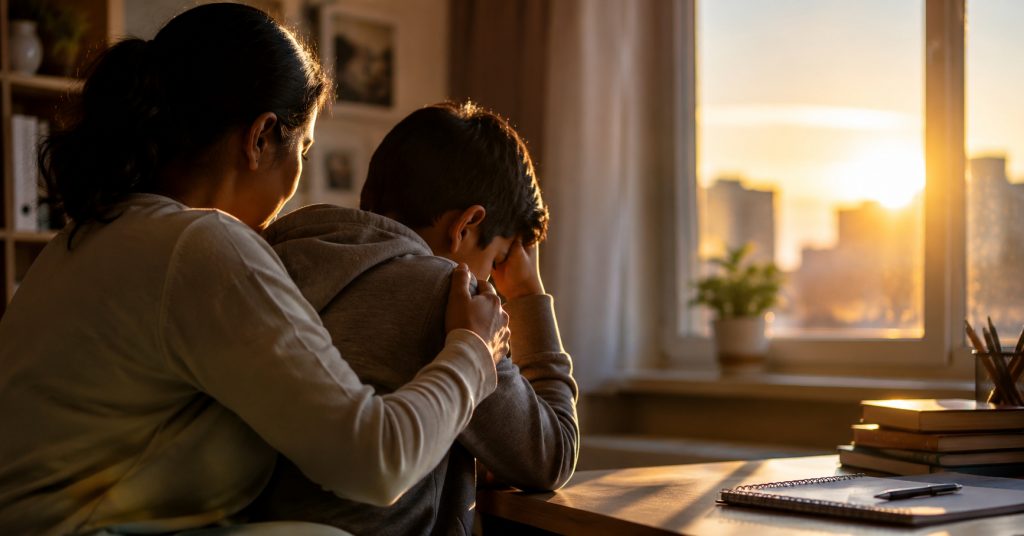
There is a number that should stop every parent in this country mid sentence. Every year, thousands of Indian students take their own lives, a majority of them still in school or college, most of them under the weight of an exam, a rank, or a comparison they were never taught how to carry. We talk about this loss in hushed, careful language, as though naming it too plainly might make it worse. But the silence has not protected anyone. It has only allowed the same pattern to repeat, year after year, exam season after exam season.
I want to say something that will sound uncomfortable to many parents reading this, myself included. When a child is pushed to the point where death feels like the only exit from a difficult moment, the failure is rarely the child’s. It is ours. Not the failure of love, because most parents love their children fiercely, but the failure of preparation. We have raised a generation of children who are extraordinarily equipped to chase success and almost entirely unequipped to survive its absence.
Earlier this year, a Supreme Court appointed task force examining student suicides in India reached a conclusion that deserves far more attention than it received. It described the crisis not as a mental health problem in isolation, but as a structural and institutional one, rooted in how our schools, our households, and our systems are built. That framing matters, because it moves the conversation away from a lazy and frankly cruel narrative, the idea that children today are simply weaker, softer, less resilient than the generations before them. That narrative is not just false. It is a convenient way for the adults in the room to avoid looking at their own part in this.
Think about what we actually teach a child from the age of six or seven. We teach them to read, to calculate, to memorise, to compete. We measure them constantly, through report cards, through rank lists, through the silent comparison every parent makes at a family gathering when someone else’s child scores higher. What we very rarely teach, in any structured or intentional way, is how to fail. How to sit with disappointment without believing it defines you. How to ask for help without believing it makes you weak. How to separate a bad result from a bad self.
A child who has never been allowed to fail at anything small will not know what to do the first time they fail at something big. And for an enormous number of Indian students, the first real experience of failure arrives all at once, in the form of a board exam, an entrance test, or a rank list, at precisely the age when their sense of identity is most fragile and least separable from their achievements. We spend eighteen years building a child’s entire self worth around performance, and then act astonished when a single bad performance feels, to that child, like the end of the world.
Part of this comes from how we as parents were raised ourselves. Many of us grew up in households where emotional conversations were rare, where a child’s sadness was met with distraction rather than discussion, where the phrase beta sab theek ho jayega was offered as comfort but rarely followed by an actual conversation about what was wrong. We inherited a way of parenting built on discipline and provision, and it served its purpose in a different India, facing different scarcities. But that model was never built to help a child process anxiety, comparison, heartbreak, or the specific, crushing pressure of a hundred million students competing for a small number of seats. We are still using an old map to navigate a world that has changed completely underneath our children’s feet.
None of this is said to assign blame to any individual parent who has lost a child. No parent sends their son or daughter to school in the morning imagining they will not see them again. Grief of that kind does not need an outside voice adding guilt to it, and I want to be careful not to do that here. What I am asking is something different, aimed not backward at individual tragedies but forward at the millions of households still raising children today. We have the chance, right now, to change how we prepare our children for a difficult life, before difficulty arrives.
That preparation has to start early, and it has to be deliberate. Children need to hear, repeatedly and without irony, that their worth is not contained in a mark sheet. They need parents who ask about their day before they ask about their score. They need to watch adults in their own home fail at something and recover from it, openly, so that failure stops looking like a catastrophe and starts looking like a normal Tuesday. They need permission to say I am struggling without immediately being handed a solution, a lecture, or a comparison to a cousin who is doing better.
Schools carry a share of this responsibility too, and to their credit, some have begun introducing counsellors and wellness periods. But a counsellor’s office that a child is too afraid to walk into, for fear of being seen as weak or unstable, does very little good. What actually helps is a culture, inside the classroom and inside the home, where struggling is treated as information rather than failure, where a teacher or a parent notices a withdrawn child not as an inconvenience but as a signal worth paying attention to.
There are also very real warning signs that parents can learn to watch for, and this knowledge should be as common as knowing basic first aid. A child pulling away from friends and activities they once enjoyed. Sudden changes in sleep or appetite. A drop in performance that comes with silence rather than the usual complaints. Talk, even indirect or joking talk, about being a burden or about things getting better after they are gone. These are not moments for lectures. They are moments to sit down, put away every device, and simply ask, gently and without judgement, how someone is actually doing.
If you or someone you know is struggling with thoughts like these, please reach out. Tele-MANAS, the government’s free 24 hour mental health helpline, can be reached at 14416, and the KIRAN helpline is available toll free at 1800-599-0019. These lines exist precisely for moments that feel unbearable, and reaching out to them is not a small or shameful thing. It can be the thing that buys a family more time.
I believe deeply in the strength of India’s children. I do not think for a moment that this generation is fragile. I think it is a generation carrying more comparison, more visibility, and more pressure per square inch than any generation before it, largely without the tools to metabolise any of it. That is not a flaw in them. It is a gap in what we, as parents, as schools, and as a society, have chosen to prioritise.
We can close that gap. It starts with something as simple as a parent choosing, tonight, to ask their child how they are feeling instead of how they scored, and actually waiting, in silence if needed, for the real answer.
Preeth Padmanabhan Nambiar
In short: India is losing thousands of students to suicide every year, and a 2026 Supreme Court-appointed task force has concluded the crisis is structural, not simply psychological. This piece argues the problem is not that today’s children are weaker, but that most have never been taught how to fail, how to sit with disappointment, or how to separate their self worth from their marks. Parents, many raised in households where emotional conversations were rare, often pass on the same silence. Real change starts small: asking a child how they feel before asking how they scored, normalising failure at home, watching for early warning signs, and knowing that help is a phone call away through Tele-MANAS (14416) and KIRAN (1800-599-0019).
If this piece has raised anything difficult for you personally, please know that support is available. Tele-MANAS: 14416 (24/7, free) | KIRAN: 1800-599-0019 (24/7, free)