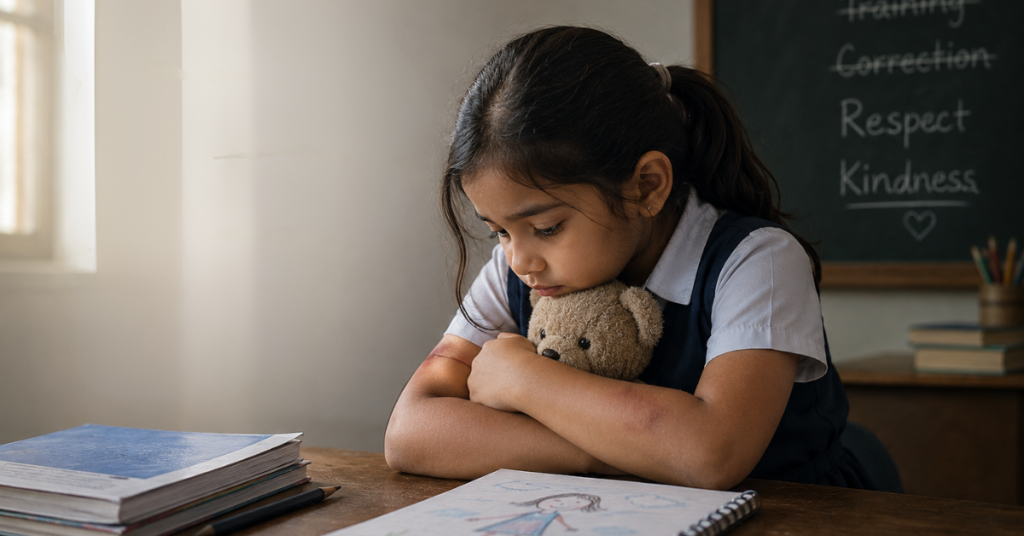
A few weeks ago, my five year old daughter came home from school looking unusually quiet. When I asked what had happened, she hesitated for a long time before she finally told me that her teacher had hit her. It was not the first time, she said, and she was not the only child it had happened to. I filed a complaint with the head of school who has been a good friend of mine too, and I was told the teacher had been warned. A week later, the principal called to tell me something else entirely. My daughter, she said, was very sensitive, and perhaps we as parents should work on training her to be less so.
I am an educationist myself, and a writer who has spent years working on questions of teaching and child development, and I have spent most of my working life believing that gentleness is not a weakness to be corrected in a child but a strength to be protected. So I sat with that conversation for a long time afterward, turning it over. A complaint about a teacher hitting children had somehow become a conversation about my daughter’s temperament. Nobody had told me what action had actually been taken against the teacher. Nobody had asked how my daughter was doing. What I was offered instead was a suggestion that the problem lay in how easily she felt pain, not in the fact that pain had been inflicted on her in the first place.
I have thought hard about whether I am reading too much into a single remark. But taken together with what my daughter told me weeks later, in an unrelated conversation, about believing that being hit would make her stronger, it started to look less like a stray comment and more like a quietly held belief. Somewhere in that school, and in a great many schools across this country, there is a conviction that physical pain builds character, that a child who cries after being struck is failing some test of toughness that a harder child would pass. It is an old belief, and it survives because it is rarely said aloud in those words. It hides instead behind gentler language. Discipline. Training. Correction. Being made stronger.
I want to be careful here, because sensitivity has become something of a loaded word. It gets used almost as an accusation now, as though a child who notices when something is wrong and says so is somehow deficient compared to one who has learned not to. But a child who registers pain and names it is not broken. She is paying attention. She trusts her own perception enough to report it, even when the person she is reporting it to has power over her. That is not fragility. If anything, it is a kind of honesty that a great many adults lose along the way, precisely because somewhere in their own childhood, somebody taught them that noticing pain and naming it was the wrong response. What actually gets built through repeated physical punishment is not resilience but a rehearsed silence. Children learn to stop reporting, not to stop hurting.
This is not a private grievance from one family in one school. Karnataka has spent this year confronting one account after another of what happens inside classrooms that operate outside real oversight. In July, a twelve year old boy named Guru Kiran collapsed and died during morning drills at a residential school on the outskirts of Bengaluru, and his family has alleged that the school’s physical training teacher assaulted him just before he went down, part of a pattern the boy’s classmates say was routine rather than exceptional. Around the same time, a daycare centre in the city came under investigation after videos surfaced showing toddlers confined in bathrooms and subjected to treatment that shocked even people who thought they had grown numb to this kind of news. These are not isolated cruelties by isolated adults. They are what happens when a culture of corporal punishment goes unexamined long enough that it becomes procedure rather than aberration.
None of this is new, and that may be the most damning part of it. Corporal punishment in schools has been prohibited under Indian law for more than a decade, under both the Right to Education Act and the Juvenile Justice Act, and yet case after case surfaces from every part of the country, in city schools and village ones, in elite institutions charging substantial fees and in modest government schools alike. What connects them is not geography or income. It is a shared, half spoken assumption that a certain amount of violence against children is not really violence at all, provided it comes wrapped in the language of discipline and provided the child survives it without visible injury. A bruise gets investigated. A child’s fear does not.
What troubles me most is how this assumption survives even after it is named. A parent complains, and a warning is issued, and that is treated as resolution. Nobody circles back to ask whether the behaviour has actually stopped, whether other children are safe, whether the teacher understands what was done wrong or merely resents having been reported. And when a parent persists, as I did, the conversation can quietly shift away from the adult who caused harm and toward the child who felt it, as though the correct outcome of abuse is a more tolerant child rather than a more accountable adult.
I do not think most people working in schools set out to hurt children. I think a great many of them inherited these methods from their own upbringing and have simply never been asked to examine them. But inheritance is not justification, and a profession built around the care of children carries a responsibility to interrogate its own habits rather than pass them along unchanged. A teacher’s authority in a classroom should rest on trust, not on the threat of pain. A principal’s job, when a parent raises a serious complaint, is to protect the child who was harmed, not to manage the parent who noticed.
My daughter is sensitive. I hope she stays that way. I hope she keeps noticing when something is wrong and keeps saying so, even when the room does not want to hear it. If there is a lesson in this for the adults who run our schools, it is a simple one. A child’s fear is not a flaw to be corrected. It is information. The question worth asking is never why a child felt something so strongly, but why an adult in a position of trust gave her a reason to.
Preeth Padmanabhan Nambiar
In short: When a kindergarten teacher was reported for hitting children, the school’s response was to call the complaining parent’s daughter “too sensitive” rather than hold the teacher accountable. This piece argues that a child’s sensitivity is not a defect to be trained out of her but a form of honesty, and connects one family’s experience to a wider, unresolved pattern of corporal punishment in Indian schools, including recent cases in Bengaluru, despite the practice being legally banned for over a decade.