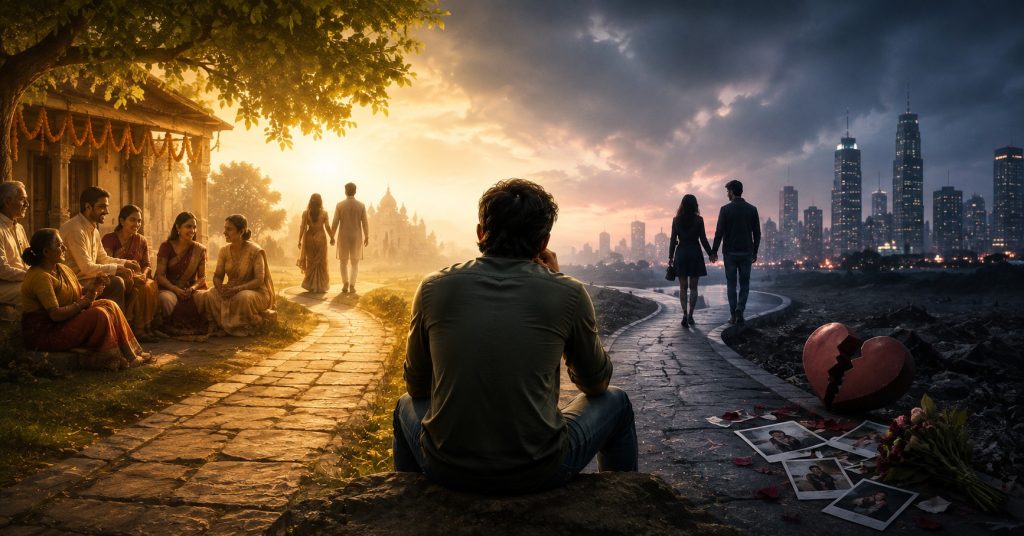
His fingers were trembling, his words breaking into fragments. From the eyes he was trying so hard to hide, I saw a few drops fall onto the table between us.
“Come on. Let’s get it fixed, dear. After all, we are men, and we have an innate ability to break anything, even if it is a huge rock.”
Holding his hands, I said this to reassure him, though it was not really a reassurance at all, but a promise to a dear friend.
This was not the first time something like this had happened to me. Perhaps because of the depth of certain connections in my life, or perhaps because people see a good listener in me, a number of people over the years have chosen to share their most difficult moments with me. Letting the mind empty itself is, in some ways, its own kind of solution. But I have also come to believe that my own life experiences have given me a certain authority to offer suggestions, ones that I believe have genuinely helped some of the people who have sat across from me. Most of these conversations, over the years, have circled back to the same subject, marital difficulty. And the friend in front of me that evening was, by his own admission, on the verge of ending his life because of a series of things that had happened to him in his marriage.
I have thought about that evening often since. His situation was not unusual. I have heard some version of it from enough people, in enough different households, to know it points to something structural, not personal, something about how we approach marriage in this country that leaves good, well meaning people quietly worn down by it, some of them to the very edge.
I want to begin with a claim that will sound strange to most readers, and perhaps uncomfortable to some. Marriage, in the way we practice and defend it today, is not a natural institution. Nature’s interest in a man and a woman is limited and specific. It wants reproduction, and beyond that, it is largely indifferent to what happens between two people. Lifelong monogamy, fidelity, the promise to build an entire existence around one other person until death, none of this comes from biology in any straightforward way. It comes from us, from the systems we built on top of biology once we realised that raising children and organising a society required more structure than instinct alone could provide.
Religions across the world stepped into that gap and gave marriage its rules. Fidelity, permanence, the specific roles assigned to husband and wife, all of these were introduced with real intentions behind them, the stability of families, the protection of children, and, not incidentally, the survival and continuity of the religion itself. These rules asked something difficult of human beings, that they commit their entire romantic and physical life to one person, in a way that does not come naturally or easily to most of us. This is rarely discussed openly, but the tension it creates is real, and I think it explains a great deal of the quiet suffering inside marriages that otherwise look stable from the outside.
In much of the Western world, the practice of marriage has moved, gradually and unevenly, toward something more rational. People increasingly live together before marrying, date for years, test compatibility in practical, everyday ways before making a lifelong commitment. In India, we have largely not followed that shift, even as much of our economic and social life has modernised around it. We still hold, for the most part, to older frameworks that were designed for a different kind of society, and I think this mismatch between an old system and a changed world is where a great deal of Indian marital distress actually begins.
Consider the two paths available to most people in India. In an arranged marriage, two individuals who are often near strangers to each other are brought together, largely through family will, into a lifelong partnership. This path is not without its strengths. It comes with structure, with families invested in the marriage’s success, and with an in-built support system that steps in when conflict arises, because the marriage was never just between two people, it was between two families who have every reason to want it to work. In a love marriage, the path is almost the reverse. Two people come together purely through emotional attraction, often without family involvement in the decision, and sometimes against the family’s explicit wishes. When trouble comes later, that same family, having been excluded from the choice, is often reluctant to step in, telling themselves and each other that it was the children’s decision to make and now theirs alone to bear.
I have watched this second path lead to real devastation, more often than most people are willing to admit publicly. Marriages built purely on emotion, without the practical scaffolding that arranged marriages often carry, can collapse with startling speed once the initial intensity fades. In the saddest cases I have come across, the collapse has been complete enough to end not just a marriage, but a life. This is not a small or occasional pattern. It is common enough that it deserves to be spoken about honestly, not hidden behind embarrassment or the assumption that love alone should have been sufficient protection.
Part of the problem, I think, lies in how courtship itself works. During the period when two people are falling in love, each is, consciously or not, presenting a curated version of themselves, competing to appear more patient, more understanding, more suited to the other than they may actually be in ordinary daily life. This is not usually dishonesty in any deliberate sense. It is simply what courtship does to people. But it means that by the time a couple marries, especially in a love marriage that has bypassed the practical vetting a family might otherwise provide, neither person has necessarily seen the other in the full, unglamorous texture of daily life, the tiredness, the financial stress, the small irritations that never show up during a romance but define an actual marriage.
An arranged marriage, for all its own real problems, is built on a kind of practicality from the outset, however imperfect. A love marriage is built on emotion, often without much practicality at all. Neither extreme, in my view, serves people particularly well on its own. What seems to actually work, where I have seen it work, is balance, arrangements that allow genuine time and honest interaction before a lifelong commitment is made, rather than either a stranger’s contract or an infatuation’s promise. Indian parents, I believe, need to begin treating a period of living together, or at minimum an extended and honest courtship, as a normal and practical part of marriage rather than something scandalous to be whispered about. If that full step feels too large a departure from tradition for many families, then at the very least, couples need to be given real time, protected from social pressure to rush, to understand each other practically rather than only emotionally, before they are asked to build an entire life together.
As is so often the case, the rise in failed marriages, and in the more traumatic incidents that sometimes follow them, comes back to the failure of an educational system, whether that is the education delivered through our academic institutions or the education quietly passed down through culture itself. When a culture or an educational system keeps producing the same painful outcomes, generation after generation, that repetition is not simply misfortune. It is a signal, one worth taking seriously, that the approach itself needs to be revisited. The government should seriously consider introducing this into our school curriculum, and educationists themselves need to press for it, rather than waiting for policy to catch up with a need that has already been visible for far too long.
This piece has focused on what happens before marriage, the mismatch between how we choose partners and what marriage actually asks of us afterward. What happens after the wedding, particularly after a child enters the picture, carries its own distinct set of pressures, ones I believe deserve their own space to be discussed properly. I will turn to that, and to what real change might look like, in the article that follows.
This is the first in a two part series. The second article continues this discussion, covering what happens after marriage and what a genuine solution could look like.
Please note: This piece reflects patterns observed specifically within Indian marriages and Indian family structures, and is written from that context.
__________________________________________________________
In short: A friend’s breakdown over his marriage becomes the starting point for a hard question: was marriage ever a natural human institution, or something built entirely by religion and society to hold families together? This piece traces how that gap between biology and tradition plays out differently in Indian arranged marriages, built on family practicality, and love marriages, built on emotion with little practical grounding, and argues both extremes leave people unprepared for what marriage actually demands. It closes with a call for India’s educational system, and its government, to start teaching the psychology of relationships before couples ever reach the altar. This is the first of a two part series.