Edwiga Vivianne: A New Voice at the Intersection of Literature, Philosophy, and Compassion
Romania’s literary sphere has long been a fertile ground for innovative thinkers and poetic voices, from the profound works of Mihai Eminescu to the avant-garde explorations of Tristan Tzara. It is a legacy woven from the threads of philosophical inquiry, linguistic beauty, and a cultural resilience that has borne witness to both triumphs and challenges. Today, as Romania’s literary tradition continues to evolve, it welcomes new voices who bring with them fresh perspectives and unique intellectual pursuits. Among these emerging figures is Edwiga Vivianne, a young scholar whose work and dedication seem almost a continuation of Romania’s storied heritage, yet marked by her distinct interweaving of literature, neuroscience, and compassionate action.
At only 26, Edwiga is already distinguishing herself in academia and beyond. A graduate of the Faculty of Letters at the University of Craiova, she has since deepened her expertise with a master’s degree in social sciences and is currently pursuing doctoral studies in philology at the esteemed Alexandru Piru Doctoral School. Here, Edwiga also serves as a teaching assistant, demonstrating both a commitment to academic growth and a passion for mentorship. Her research is nothing short of ambitious: she aims to construct a philosophical theory that integrates neuroscience into literary analysis, a forward-looking endeavor that promises to expand and challenge traditional approaches in both fields.
Her journey, however, extends far beyond the lecture halls and libraries. For the past five years, Edwiga has dedicated herself to volunteering as a teacher of Romanian and English for underprivileged children across the country. This selfless commitment reflects the warmth and empathy that balance her scholarly pursuits, embodying a belief that education should be a right, not a privilege, and that knowledge is most powerful when shared.
In addition to her academic and social work, Edwiga has established herself as a respected literary voice in Romania’s literary journals. Her poetry has appeared in prominent publications, including Banchetul, Bilete de Papagal, România Literară, and Mozaicul. She regularly participates in literary conferences, where her essays and articles add a distinct resonance to the discussions, often bridging the realms of creative thought and scholarly analysis. Her work has been published in esteemed scientific journals, such as Communication Interculturelle et Littérature and The Journal of Romanian Literary Studies (JRLS), reflecting both her intellectual rigor and her ability to connect across disciplines.
As Edwiga Vivianne continues her journey, she is contributing to a tradition that has long cherished literary innovation and philosophical depth. Her intellectual pursuits, community outreach, and poetic voice represent a new wave in Romanian literature, one that resonates with the past while boldly looking toward the future. In Edwiga, we see the promise of a young scholar whose work, grounded in compassion and ambition, honors the Romanian literary tradition while daring to explore uncharted territories of thought and expression.

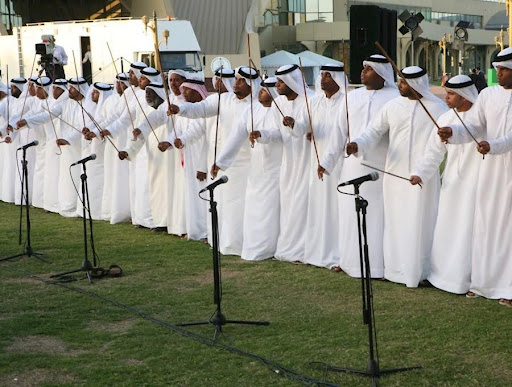 Al-Ayyala in United Arab Emirates culture exemplifies the ethos and gallantry of Bedouin life and reinforces the values of dignity and honour. Because it reflects the heritage and values of Emirati culture, the performance has become a symbol of national identity and union, and is an integral part of celebrations.
 In 2014, Al Ayyala was emblazoned on the UNESCO Representative List of the Intangible Cultural Heritage of Humanity, recognizing its significance as a cultural expression and its contribution to preserving Emirati traditions for future generations. It’s a symbol of the UAE’s values of unity, respect, loyalty, and bravery. It often serves as a cultural representation during national holidays, including UAE National Day, as well as at royal weddings and state ceremonies.
 The dance is performed predominantly by men and boys, arranged in two rows facing each other, with each dancer holding a thin bamboo stick called a “cane” (assa). The performers move in a synchronized, rhythmic pattern while chanting poetry or verses that reflect themes of courage, love, and history.
 Dance instructors teach students not only the physical movements but also the cultural significance behind them. Participating in an Ayala dance can be particularly passionate and fun for young learners, especially during school events like the Spring Dance Concert. This approach ensures that the traditional dance remains vibrant and relevant for future generations.
 Preetha Vikram is a passionate educator with over 25 years of experience working with children aged 3 to 12 years. An Abacus instructor, subject coordinator, poet, and author, Preetha was born in Kerala and grew up across various regions of North and South India. Despite facing early challenges, including the loss of her parents, she pursued her academic ambitions, earning a Master’s degree in English Language. From her formative years, Preetha displayed a strong work ethic, delving into teaching and writing at a young age. In 2015, she made a significant move to the UAE, working as an English Language Teacher at East Point Indian International School. She has since established herself both personally and professionally in the UAE. Currently, Preetha holds a Transitional Teacher’s license and serves as an Academic Resource Person at the Sri Narayani Teacher Training Center in Hyderabad, India, reflecting her dedication to education and lifelong learning.