Writers International Edition

Preeth Padmanabhan Nambiar

North vs South India: Understanding the Great Divide

South India and North India are two distinct regions of India that have a rich cultural and historical legacy. Although they share certain similarities, they are also vastly different from one another in terms of language, cuisine, dress, religion, customs, and traditions.

One of the most significant differences between South India and North India is the language. South India is home to four major Dravidian languages: Tamil, Telugu, Malayalam, and Kannada. In contrast, North India has a more significant diversity of languages, with Hindi, Punjabi, Bengali, and Gujarati being the most prominent ones. While Hindi is the official language of North India, each state in South India has its official language, reflecting the linguistic diversity of the region.

Another significant difference between the two regions is the cuisine. South Indian cuisine is known for its spicy and tangy flavors, which often include rice, lentils, and coconut. Idlis, dosas, vadas, and sambar are some of the most popular dishes in South India. In contrast, North Indian cuisine is characterized by its rich and creamy gravies, tandoori bread, and use of dairy products like ghee and paneer. Roti, naan, paratha, biryani, and butter chicken are some of the most famous North Indian dishes.

Religion is also a differentiating factor between the two regions. While Hinduism is the predominant religion in both regions, the form of worship and the customs associated with it differently. In South India, there is a more significant emphasis on temple worship and rituals, with Dravidian architecture being prevalent in the temples. In contrast, North India has a more significant Islamic influence, with many Mughal-era monuments like the Taj Mahal and Red Fort being located in the region.

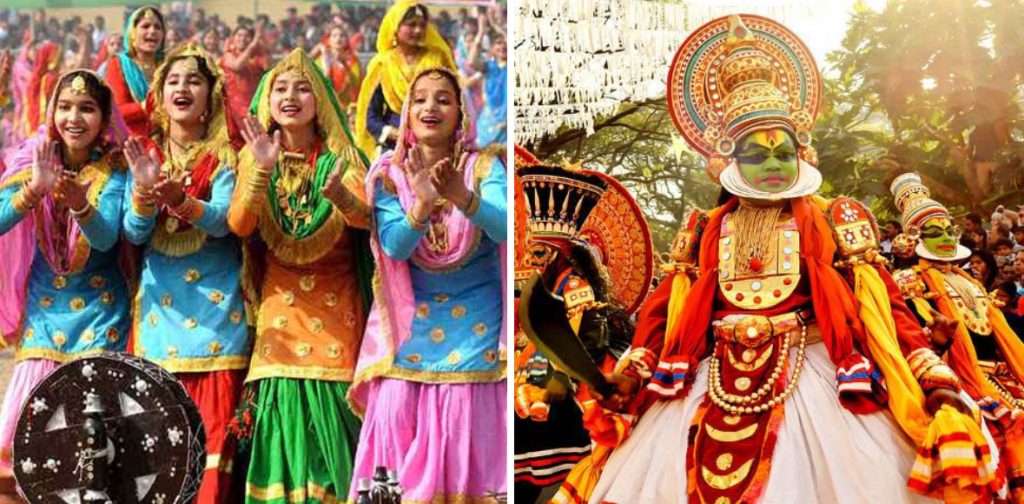
Dress is another aspect that sets the two regions apart. Traditional South Indian attire for men includes a dhoti, a veshti, or a lungi, while women usually wear a sari or a salwar kameez. In contrast, North Indian men wear kurta pajama, and women wear sarees or suits.

Customs and traditions also vary significantly between the two regions. For instance, South Indian weddings typically involve the exchange of garlands between the bride and groom, while North Indian weddings often include a baraat or a procession of the groom on a horse. Festivals like Onam, Pongal, and Vishu are celebrated with much fervor in South India, while Diwali, Holi, and Dussehra are celebrated with equal enthusiasm in North India.

In a nutshell, South India and North India are two distinct regions with unique identities, cultures, and traditions. While they share certain similarities, they also have significant differences that make them stand apart from each other. Understanding these differences can help promote greater appreciation and respect for the diverse cultural heritage of India.

North vs South India: Understanding the Great Divide Read More »

When Social Media Challenges Quality literature: Editorial

Social media is a giant neon sign that flashes continuously, ‘LOOK AT ME,’ while it saps our time and leaves us empty-handed. – Nir Eyal

Being in the Writers Capital Foundation and its subsidiaries, where we communicate with hundreds of writers from across the world, we have an opportunity to read a number of works on a daily basis and mostly through social media. While some of the works create strong impressions, some of the works not only fail to exhibit greater standards but also leave a shock on how social media interferes with quality in literary works.

In the age of social media, it has become increasingly common for writers to post their literary works on platforms such as Facebook, Twitter, and Instagram. While this may seem like a convenient way to share one’s writing with a wider audience, the reality is that the quality of literature is often lost in the pursuit of likes, shares, and comments.

Many writers post their work on social media simply for the dopamine boost of receiving validation from others. In doing so, they often sacrifice the time and effort necessary to produce high-quality writing. The result is an oversaturation of mediocre content, drowning out the truly exceptional works of literature.

Compounding this issue are the fake Facebook organizations that have sprung up, purporting to support and promote literary works. In reality, these organizations are often fronts for self-promotion or outright scams, preying on the hopes and dreams of aspiring writers.

The effects of social media on quality literature are significant. By prioritizing likes and shares over quality writing, we risk losing the very essence of what makes literature great – its ability to transport us to other worlds, to challenge our assumptions and beliefs, and to evoke strong emotions within us.

It is crucial that we take steps to combat this trend. We must encourage writers to prioritize the quality of their work over the immediate gratification of social media validation. We must also be vigilant in identifying and exposing fake literary organizations that seek to exploit the literary community.

At the same time, we should not dismiss social media entirely. When used responsibly and in conjunction with traditional literary channels, social media can be a powerful tool for promoting high-quality literature and engaging with readers in meaningful ways.

Social media can have negative effects on the quality of literature and the industry as a whole. The emphasis on quick, easily-digestible content can lead to a decrease in attention spans and a preference for shorter, simpler works. Additionally, the pressure to constantly produce content for social media can lead to a focus on quantity over quality, and the proliferation of fake organizations and online scams can further erode trust in the industry.

A writer may not be a great influencer, however, an influencer can intelligently act as a great writer with the so-called technologies of branding and communication skills. However, the fact is that ultimately, only quality works remain here and the rest will be eventually discarded.  Like that of the Sanskrit phrase ‘Satyameva Jayate’, which means “Truth alone triumphs,” only quality literary works would prevail in the ever-changing sphere of literature.

We must recognize the dangers that social media poses to quality literature, while also embracing its potential to support and elevate literary works. I eanestly believe that by striking a balance between the two, we can ensure that the literary community thrives in the digital age.

Preeth Padmanabhan Nambiar
Author-Poet, Educationist & Humanitarian
President & CEO, Writers Capital International Foundation
preethpadmanabhannambiar@gmail.com

When Social Media Challenges Quality literature: Editorial Read More »

Splendid Signature: Rhythmic Strokes of a Quill by Malakshmi Borthakur: A Review

Malakshmi Borthakur’s collection of poetry, Splendid Signature: Rhythmic Strokes of a Quill, is a noteworthy contribution to the domain of women’s writing. This collection of 50 poems deals with various themes such as individuality, love, mythology, economic deprivation, childhood, and social violence. Borthakur has a direct and simple style of writing that communicates the deep questions women face regarding their rights to equality, dignity, and independence.

The poems in this collection are an expression of the poet’s concerns with cultural, ideological, and value-related hurdles, which are problematic if not threatening. The language used in the poems is straightforward and easily understood, making the collection accessible to a wide audience.

The poetry collection captures the essence of hope and positive intervention through the struggles women face in contemporary society. The poet asserts that motherhood, family, and traditional norms are not the only concerns women face. The larger social expanse has its influence on women’s lives at both subtle and unsubtle levels.

The simplicity of Borthakur’s writing takes over in most poems, making the reader feel that all is not right with the world. Despite this, the poems also express a sense of fulfillment and hope in a few places, emphasizing positive intervention. The use of apparent clichés in some of the poems is done softly and easily, but there is a suggestion of a dramatic shift when we consider the title under which these lines are placed.

Borthakur’s concern with the travails of existing norms bearing upon sensitive sections in our midst is reflected in her exploration of the theme of love. The poet aims to project emotions as part of experience she visualizes in contemporary surroundings. The images of love in the collection are of a distinct character, not associated with the conventional relationship between a man and a woman.

The book also deals with questions of culture, where poetry is situated. The poet’s aim is to grasp the contentious truths of culture, ideology, and the folk tale, and build an account of distinct creativity. Borthakur’s poems are a form of feminism taking shape as the individual mind grapples with the nuances of complex living.

Splendid Signature: Rhythmic Strokes of a Quill is a valuable collection of poetry that explores the themes of women’s rights, culture, and feminism. Borthakur’s simple and direct style of writing makes this collection accessible to a wide audience. This collection of poems is an excellent addition to the literary domain and is highly recommended for readers who are interested in exploring women’s writing.

I wish you the author the very best in further contributing greatly to the ever-changing sphere of literature.

Preeth Padmanabhan Nambiar
Author-Poet, Educationist & Humanitarian
President & CEO, Writers Capital International Foundation
preethpadmanabhannambiar@gmail.com

Splendid Signature: Rhythmic Strokes of a Quill by Malakshmi Borthakur: A Review Read More »