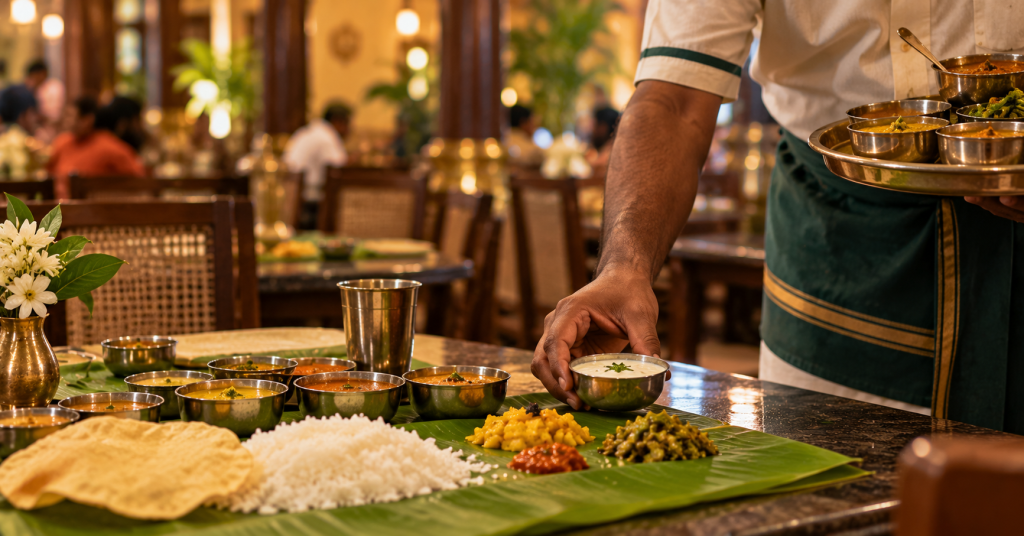
As we entered the restaurant, nearly every table was taken. It was lunchtime, and I had never seen a restaurant so full on an ordinary afternoon. The place served traditional Andhra food and had become famous for it, with celebrities among its visitors and videos of their meals travelling widely online. I was excited to be there, and glad to be with a friend from Andhra who is particular about hygiene, since the restaurant looked well kept. The people serving us were warm in a way that did not feel rehearsed, every one of them smiling, and I understood quickly why the place was so highly reviewed.
Each dish was served separately by a different person. When a man came with the raita, he said the word and placed it on my friend’s banana leaf in the same motion. She had already started to say no. A few drops lay on the leaf. Her anger was immediate and far larger than the cause. The man apologised several times in a low voice, and the apology made no difference to her. He went away, finally returned with a tissue, and wiped even the faint trace of raita from the leaf, bending over it while she went on looking at him with displeasure.
If it had been another kind of incident, I would have accepted it and moved on. My friend had every right to refuse the raita and ask for a fresh leaf. What I could not set aside was the manner. A man who stands in that room for hours so that his household can manage its month was being made to feel small over a few drops of curd. Somehow, even today, days after the incident, I could not stop thinking about it.
Empathy is often confused with sympathy. Sympathy is a feeling offered from a distance, a brief sadness about someone’s circumstances. Empathy asks us to come closer, to stand for a moment in the other person’s position and ask what the day looks like from there. From where the man with the bowl stood, the day looked like this: hours on his feet, a room that never stops calling, a smile he had to keep in place whatever the mood of the customers, a livelihood that depends on that smile, and a hundred chances every hour to make a mistake that a crowd will notice. A spoon moved a second too early. That was the whole offence.
The most important fact about that moment was that he could not answer. A server in a full restaurant has no room to defend himself. If he explains, he risks seeming rude. If he argues, he risks his job. So he apologises, again and again, and takes whatever is given. Anger moves downhill with very little effort, and it flows most freely toward people who cannot send any of it back. For this reason, the way we treat those who cannot answer us tells more about our character than the way we treat those who can. A person who is courteous to the manager and curt to the waiter has shown which of the two behaviours is real.
None of this is limited to restaurants. The same position is held by the delivery rider waiting at the gate in the heat, the security guard we do not greet, the domestic worker whose small mistake we remember for days, the driver, the sweeper, the clerk behind the counter, the attendant in a hospital corridor. Their work holds up the comfort of our days and is noticed only when something goes wrong, and then it is noticed loudly. Each of them has learned to absorb the irritation of strangers as part of the job. Most of us have never counted how much of it we have handed out.
It is worth asking why empathy fails us so often in these moments. Usually it is because we are absorbed in our own hunger, our own hurry, our own bad day, and the person in front of us shrinks into a function. He becomes the service rather than a human being delivering it. Once that happens, the mistake of a second feels like an insult, and the reaction grows to match. Nobody decides to be cruel. We stop seeing the person for a moment, and the cruelty follows without being invited.
Cruelty and kindness both travel. A man scolded in front of a full room at noon takes that scolding home in the evening. It enters his tiredness, his patience with his own children, the way he sleeps. The customer who raised her voice at the table will probably never know where it ended up. We tend to imagine our anger as an event that begins and finishes at the table. It does not finish. It moves on through the person who received it into rooms we will never see.
This is no argument against standards. Hygiene matters, and so does the right to refuse what we do not want. A customer can reject a dish, ask for a clean leaf, or complain to the manager in a firm voice. Firmness and cruelty are different things. A calm sentence, please change the leaf, would have settled the matter in seconds, and everyone in that restaurant would have complied. What makes the difference is whether the person on the other side is still a person while we make our point.
Part of the problem is the habit of believing that payment buys everything. When we pay for a meal, we are entitled to the food we ordered and to reasonable service. We are not entitled to diminish the dignity of the person bringing it. The bill settles the price of the meal. It does not settle what we owe each other as human beings, and no amount paid can purchase the right to humiliate.
Indian thought has held this view in its own language for a very long time. The Isha Upanishad says that the one who sees all beings in the Self, and the Self in all beings, no longer despises anyone. The Taittiriya Upanishad calls food itself Brahman. A tradition that regards food as sacred can hardly regard the hands that carry it to the table as unworthy of respect. The man with the bowl and the woman at the table shared the same life. The seats they occupied were different, and nothing more.
As an educationist, I have often wondered why our schools teach arithmetic, history and grammar with such seriousness and leave this entirely to chance. A child can complete twelve years of schooling without being taught how to speak to the person who brings the food, drives the bus or sweeps the corridor. Children learn it, if they learn it at all, by watching us. A child sitting at a restaurant table hears how a parent speaks to the waiter more clearly than any lesson delivered in a classroom. Empathy is taught at the table, in the car, at the gate, in the small tones of voice we use when we believe nothing important is happening.
It is easier to practise than it sounds. Look at the person who is serving us. Say thank you and mean it. Ask a name if the occasion allows. Pause for a breath before reacting to a mistake, and ask whether we would speak the same way to someone who had power over us. Remember a day when we sat in the other seat and were spoken to harshly, and recall what it did to the rest of that day. None of this takes money or time. Each one changes how the next person feels, and that effect travels the way anger does, from one person to the next.
Some people fear that this kind of gentleness is weakness, a loss of authority or standing. It is the opposite. Anyone can be gentle with those who have power over them. Gentleness toward someone who has none requires a steadier kind of strength, because nothing forces it and nobody will notice if it is missing.
I still think of the man with the tissue. He did not argue or explain that the drops were nothing. He apologised, wiped the leaf, and remained courteous to the end. He had every reason to be bitter, and he stayed gentle. I am not sure I could have done the same. That composure was a form of strength, and it taught me more about empathy than anything I have read.
After the payment, I asked whether there was another way I could give a tip to that particular man, since I had not carried any cash. Hesitantly, he showed me his QR code. I paid a small amount as a tip and walked out of the restaurant. I know that tiny sum could not erase the weight of the entire incident. All I wanted was a gentle smile on his face, and some ease for my own mind.
Perhaps, to treat with gentleness a person who serves us, who works to meet both ends, who stands before us with no means to answer, and who still meets our impatience with an apology, is one of the greatest signs of empathy.