
This article was never meant to be written. The two pieces before it said everything I had originally set out to say. But the response to those pieces, from readers who took away the idea that marriage itself should perhaps be avoided altogether, told me something important had gone unsaid. That was never my intention, and it is worth correcting directly rather than leaving it to sit there, misread.
There is a curious contradiction running through almost every corner of life. A person who has become famous spends the rest of their years chasing privacy, while someone unknown spends theirs chasing exactly the fame the famous one is trying to escape. A person with a stable job dreams of a long vacation away from it, while someone without work would give almost anything just to have that job to escape from. The wealthy quietly search for peace, and the people who have finally found peace often start searching for wealth. It should not surprise anyone, then, that the same contradiction plays out in marriage. The unmarried yearn for it, certain it holds something missing from their life, while a great many of the married spend real energy looking for a way out of the very thing they once yearned for.
I came across someone recently who had spent several years being told by almost everyone around her that she should never get married. She was not against the idea herself, not originally. But every married person she encountered seemed to arrive with the same complaint, the same warning, the same tired advice to stay away from it if she valued her peace. One of the loudest voices pushing this advice on her, tellingly, was a man who had married twice and was, by every visible account, living a genuinely happy life with his current wife and their children. He gave the advice freely, perhaps without even noticing the contradiction in his own life while he gave it. Over time, hearing this kind of warning again and again, often from people whose own lives quietly disproved it, left a mark on her that no argument could easily undo. I do not think she is unusual. I believe there are a great many people shaped this way, not by their own experience of marriage, but by absorbing everyone else’s disappointment with it, secondhand, year after year, until the idea of marriage itself began to feel like a warning rather than a possibility.
I wrote, in the pieces before this one, that love and marriage draw on different parts of us entirely. Falling in love calls on the right side of the brain, the emotional, intuitive, imaginative part of us that does not ask for evidence before it commits. Marriage, once the early intensity settles, calls instead on the left side, the logical, practical, sequencing part of us that has to actually plan a shared life, manage money, raise children, negotiate in laws, and keep a household running through the ordinary, unglamorous stretches most love songs never mention. A great deal of the suffering I described earlier comes from expecting the right side of the brain to keep doing a job that, at some point, only the left side is actually equipped to carry.
This is where I think practicality earns its place, not as the enemy of love, but as its necessary partner. A marriage that continues to run purely on feeling, long after the feeling that started it has naturally settled into something quieter, will struggle every single time reality asks something of it that emotion alone cannot supply. Budgets have to be planned. Disagreements have to be negotiated rather than simply felt through. Time has to be divided fairly between a spouse, children, parents, and one’s own sense of self, and no amount of love, on its own, tells you how to do that division well. Couples who bring genuine practicality into a marriage, who talk plainly about money, about boundaries with extended family, about how disagreements will actually be resolved rather than assuming love will somehow resolve them automatically, tend to build something sturdier than couples who rely on feeling alone to carry them through decades. Practicality is not the opposite of love inside a marriage. It is what allows love to survive long enough to become something deeper than the feeling it started as.
There is a particular kind of maturity that life only releases to us once we have actually lived through certain stages of it, not simply read about them or observed them in others. The maturity of a father or a mother cannot be reached by any number of years lived outside that role. The maturity that arrives with becoming a grandparent belongs only to those who have crossed into it. In the same way, I believe there is a maturity that marriage itself makes available, one that no amount of careful avoidance can substitute for. We are, I think, meant to move through each of life’s stages and meet it honestly, rather than skip past the ones that frighten us.
Even Adi Shankara, by most accounts the sharpest philosophical mind this land has produced, was not exempted from this. As the story is told in his traditional biographies, when he arrived at the Sarvajna Peetha, the seat reserved for those recognised as complete in all knowledge, he was challenged by Ubhaya Bharati, the scholar wife of the sage Mandana Mishra, whom he had just defeated in philosophical debate. She pointed out that Shankara, a renunciate who had left the world as a boy, could speak with total authority on the nature of the self and the illusion of the material world, but had no lived understanding whatsoever of grihastha life, of marriage, of the householder’s world he was being asked to be recognised as complete in. He could not answer her questions on that subject, not because his intellect had any limit, but because he had never actually lived it. Rather than dismiss the challenge, he asked for time, and by tradition, left his own body in a cave to inhabit the recently deceased body of a king, living for a period as a householder among his queens before returning to complete the debate and finally ascend the Sarvajna Peetha. Whatever one makes of the literal details of that story, its point has stayed with me. Even a mind capable of grasping the ultimate nature of reality was not considered complete until it had also lived, if only once, inside the ordinary, entangled, demanding experience of a shared domestic life.
I want to be clear about something, especially after two pieces that have looked honestly, and at times painfully, at where Indian marriages go wrong. Marriage itself is not bad. It is not a trap, and it is not, by nature, a battlefield. What I have described in the pieces before this one are the failures of preparation, of communication, of practicality, and of a culture and an education system that never taught us how to carry this particular kind of relationship well. None of that is an indictment of marriage as an institution. It is an indictment of how unprepared we so often are for it, which is a very different thing, and one that can actually be fixed. Avoiding marriage for fear of the suffering it might bring is no different from refusing to be born because the world contains suffering.
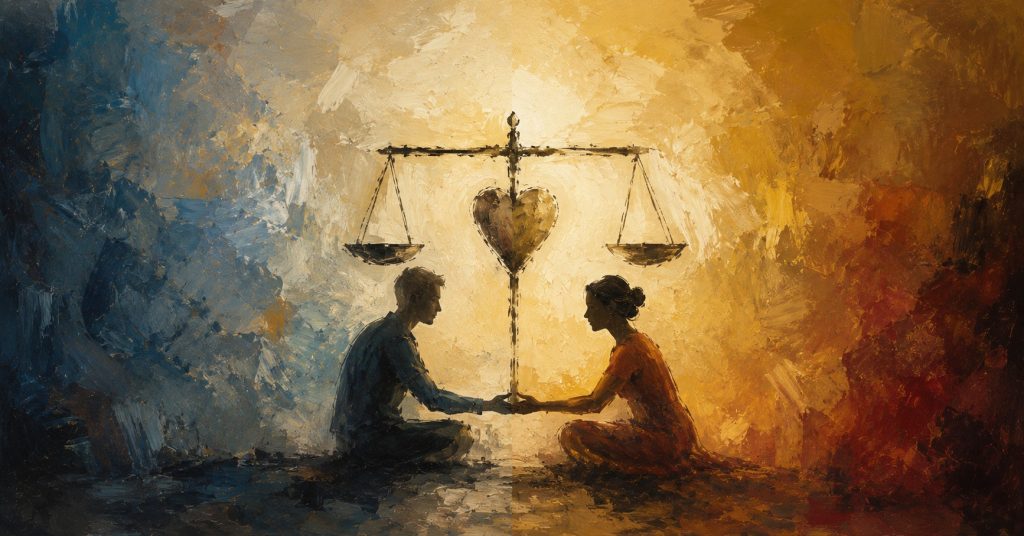
I think of Shiva and Shakti here, not as deities to be worshipped, but as two of the oldest philosophical principles this land ever produced, ideas that have outlasted every temple built around them. Shiva, in this reading, represents pure consciousness, stillness, the unmoving awareness beneath everything. Shakti represents pure energy, movement, the dynamic force that gives form and life to that stillness. As principles, neither is complete without the other. Consciousness without energy is inert, awareness with nothing to animate it. Energy without consciousness is directionless force, movement with nothing to give it shape or meaning. Together, as concepts, they are said to complete the whole of existence, much the way the Taoist idea of yin and yang describes two forces that only make sense, that only become whole, in relation to each other. Marriage, at its best, works on something close to this same principle. Not two people erasing themselves into one, but two distinct forces, each already whole on its own, choosing to move through life joined together, each making the other more complete than either was alone.
Perhaps that is the real correction needed, not a rejection of marriage, and not a naive return to marrying without preparation either, but a marriage built the way Shiva and Shakti are described together, consciousness and energy, stillness and movement, emotion and practicality, each given its rightful place rather than one being asked to do the work of both. Marriage was never the enemy. Our lack of preparation for it was. Live it, then, fully, and give it everything you honestly have to give. But there may come a point, after every real effort has been made, when you know with a clarity that no longer argues with itself that this particular joining of two forces was not meant to hold. When that moment arrives, speak it plainly to the one beside you, rather than letting it decay quietly into years of silence.
To part ways with honesty, after having truly lived it, is not a failure of the philosophy above. It is, in its own way, a final act of respect, for the marriage, for the person, and for the truth neither of you can keep unspoken forever.
Preeth Padmanabhan Nambiar
This piece reflects patterns observed specifically within Indian marriages and Indian family structures, and is written from that context. It is the third in a series.
In short: Written in response to readers who took the previous two articles as an argument against marriage, this piece makes the opposite case. Drawing on the contradiction of always wanting what we don’t have, the story of a woman warned against marriage by a happily remarried man, and the legend of Adi Shankara being made to live a householder’s life before he could be called complete, the piece argues that marriage offers a kind of maturity no amount of avoidance can substitute for. It closes with Shiva and Shakti, held here as philosophical principles rather than deities, as a model for what a complete partnership actually looks like. This is the third in a series.





Wondefully crafted