Writers International Edition

Fiction

THE TERRIBLE OLD MAN

It was the design of Angelo Ricci and Joe Czanek and Manuel Silva to call on the Terrible Old Man. This old man dwells all alone in a very ancient house on Water Street near the sea, and is reputed to be both exceedingly rich and exceedingly feeble; which forms a situation very attractive to men of the profession of Messrs. Ricci, Czanek, and Silva, for that profession was nothing less dignified than robbery.

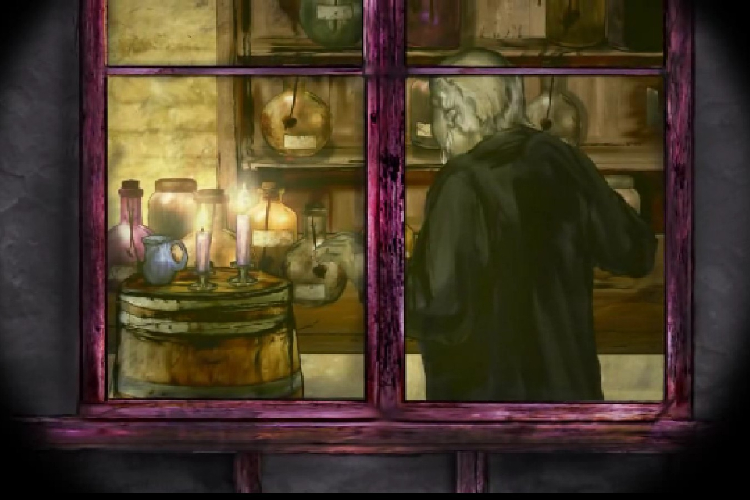
The inhabitants of Kingsport say and think many things about the Terrible Old Man which generally keep him safe from the attention of gentlemen like Mr. Ricci and his colleagues, despite the almost certain fact that he hides a fortune of indefinite magnitude somewhere about his musty and venerable abode. He is, in truth, a very strange person, believed to have been a captain of East India clipper ships in his day; so old that no one can remember when he was young, and so taciturn that few know his real name. Among the gnarled trees in the front yard of his aged and neglected place he maintains a strange collection of large stones, oddly grouped and painted so that they resemble the idols in some obscure Eastern temple. This collection frightens away most of the small boys who love to taunt the Terrible Old Man about his long white hair and beard, or to break the small-paned windows of his dwelling with wicked missiles; but there are other things which frighten the older and more curious folk who sometimes steal up to the house to peer in through the dusty panes. These folk say that on a table in a bare room on the ground floor are many peculiar bottles, in each a small piece of lead suspended pendulum-wise from a string. And they say that the Terrible Old Man talks to these bottles, addressing them by such names as Jack, Scar-Face, Long Tom, Spanish Joe, Peters, and Mate Ellis, and that whenever he speaks to a bottle the little lead pendulum within makes certain definite vibrations as if in answer.

Those who have watched the tall, lean, Terrible Old Man in these peculiar conversations, do not watch him again. But Angelo Ricci and Joe Czanek and Manuel Silva were not of Kingsport blood; they were of that new and heterogeneous alien stock which lies outside the charmed circle of New England life and traditions, and they saw in the Terrible Old Man merely a tottering, almost helpless grey-beard, who could not walk without the aid of his knotted cane, and whose thin, weak hands shook pitifully. They were really quite sorry in their way for the lonely, unpopular old fellow, whom everybody shunned, and at whom all the dogs barked singularly. But business is business, and to a robber whose soul is in his profession, there is a lure and a challenge about a very old and very feeble man who has no account at the bank, and who pays for his few necessities at the village store with Spanish gold and silver minted two centuries ago.

Messrs. Ricci, Czanek, and Silva selected the night of April 11th for their call. Mr. Ricci and Mr. Silva were to interview the poor old gentleman, whilst Mr. Czanek waited for them and their presumable metallic burden with a covered motor-car in Ship Street, by the gate in the tall rear wall of their hosts grounds. Desire to avoid needless explanations in case of unexpected police intrusions prompted these plans for a quiet and unostentatious departure.

As prearranged, the three adventurers started out separately in order to prevent any evil-minded suspicions afterward. Messrs. Ricci and Silva met in Water Street by the old man’s front gate, and although they did not like the way the moon shone down upon the painted stones through the budding branches of the gnarled trees, they had more important things to think about than mere idle superstition. They feared it might be unpleasant work making the Terrible Old Man loquacious concerning his hoarded gold and silver, for aged sea-captains are notably stubborn and perverse. Still, he was very old and very feeble, and there were two visitors. Messrs. Ricci and Silva were experienced in the art of making unwilling persons voluble, and the screams of a weak and exceptionally venerable man can be easily muffled. So they moved up to the one lighted window and heard the Terrible Old Man talking childishly to his bottles with pendulums. Then they donned masks and knocked politely at the weather-stained oaken door.

Waiting seemed very long to Mr. Czanek as he fidgeted restlessly in the covered motor-car by the Terrible Old Man’s back gate in Ship Street. He was more than ordinarily tender-hearted, and he did not like the hideous screams he had heard in the ancient house just after the hour appointed for the deed. Had he not told his colleagues to be as gentle as possible with the pathetic old sea-captain? Very nervously he watched that narrow oaken gate in the high and ivy-clad stone wall. Frequently he consulted his watch, and wondered at the delay. Had the old man died before revealing where his treasure was hidden, and had a thorough search become necessary? Mr. Czanek did not like to wait so long in the dark in such a place. Then he sensed a soft tread or tapping on the walk inside the gate, heard a gentle fumbling at the rusty latch, and saw the narrow, heavy door swing inward. And in the pallid glow of the single dim street-lamp he strained his eyes to see what his colleagues had brought out of that sinister house which loomed so close behind. But when he looked, he did not see what he had expected; for his colleagues were not there at all, but only the Terrible Old Man leaning quietly on his knotted cane and smiling hideously. Mr. Czanek had never before noticed the colour of that mans eyes; now he saw that they were yellow.

Little things make considerable excitement in little towns, which is the reason that Kingsport people talked all that spring and summer about the three unidentifiable bodies, horribly slashed as with many cutlasses, and horribly mangled as by the tread of many cruel boot-heels, which the tide washed in. And some people even spoke of things as trivial as the deserted motor-car found in Ship Street, or certain especially inhuman cries, probably of a stray animal or migratory bird, heard in the night by wakeful citizens. But in this idle village gossip the Terrible Old Man took no interest at all. He was by nature reserved, and when one is aged and feeble, one’s reserve is doubly strong. Besides, so ancient a sea-captain must have witnessed scores of things much more stirring in the far-off days of his unremembered youth.

THE TERRIBLE OLD MAN Read More »
THE STORY OF AN HOUR

Knowing that Mrs. Mallard was afflicted with a heart trouble, great care was taken to break to her as gently as possible the news of her husband’s death.

It was her sister Josephine who told her, in broken sentences; veiled hints that revealed in half concealing. Her husband’s friend Richards was there, too, near her. It was he who had been in the newspaper office when intelligence of the railroad disaster was received, with Brently Mallard’s name leading the list of “killed.” He had only taken the time to assure himself of its truth by a second telegram, and had hastened to forestall any less careful, less tender friend in bearing the sad message.

She did not hear the story as many women have heard the same, with a paralyzed inability to accept its significance. She wept at once, with sudden, wild abandonment, in her sister’s arms. When the storm of grief had spent itself she went away to her room alone. She would have no one follow her.

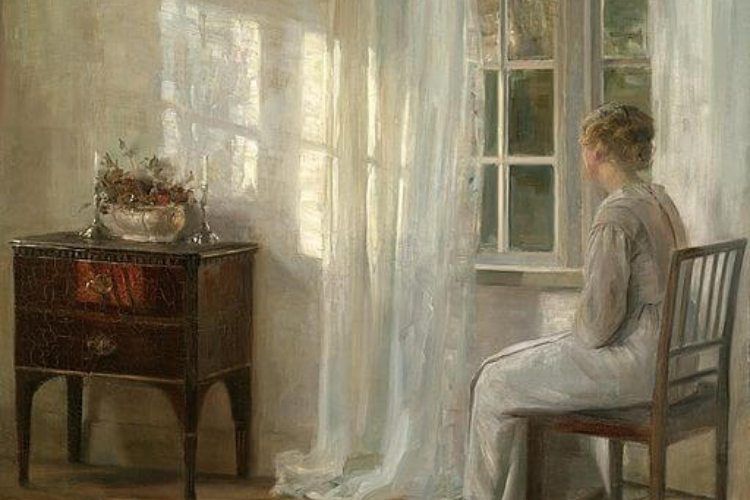
There stood, facing the open window, a comfortable, roomy armchair. Into this she sank, pressed down by a physical exhaustion that haunted her body and seemed to reach into her soul.

She could see in the open square before her house the tops of trees that were all aquiver with the new spring life. The delicious breath of rain was in the air. In the street below a peddler was crying his wares. The notes of a distant song which someone was singing reached her faintly, and countless sparrows were twittering in the eaves.

There were patches of blue sky showing here and there through the clouds that had met and piled one above the other in the west facing her window.

She sat with her head thrown back upon the cushion of the chair, quite motionless, except when a sob came up into her throat and shook her, as a child who has cried itself to sleep continues to sob in its dreams.

She was young, with a fair, calm face, whose lines bespoke repression and even a certain strength. But now there was a dull stare in her eyes, whose gaze was fixed away off yonder on one of those patches of blue sky. It was not a glance of reflection, but rather indicated a suspension of intelligent thought.

There was something coming to her and she was waiting for it, fearfully. What was it? She did not know; it was too subtle and elusive to name. But she felt it, creeping out of the sky, reaching toward her through the sounds, the scents, the color that filled the air.

Now her bosom rose and fell tumultuously. She was beginning to recognize this thing that was approaching to possess her, and she was striving to beat it back with her will–as powerless as her two white slender hands would have been. When she abandoned herself a little whispered word escaped her slightly parted lips. She said it over and over under the breath: “free, free, free!” The vacant stare and the look of terror that had followed it went from her eyes. They stayed keen and bright. Her pulses beat fast, and the coursing blood warmed and relaxed every inch of her body.

She did not stop to ask if it were or were not a monstrous joy that held her. A clear and exalted perception enabled her to dismiss the suggestion as trivial. She knew that she would weep again when she saw the kind, tender hands folded in death; the face that had never looked save with love upon her, fixed and gray and dead. But she saw beyond that bitter moment a long procession of years to come that would belong to her absolutely. And she opened and spread her arms out to them in welcome.

There would be no one to live for during those coming years; she would live for herself. There would be no powerful will bending hers in that blind persistence with which men and women believe they have a right to impose a private will upon a fellow-creature. A kind intention or a cruel intention made the act seem no less a crime as she looked upon it in that brief moment of illumination.

And yet she had loved him–sometimes. Often she had not. What did it matter! What could love, the unsolved mystery, count for in the face of this possession of self-assertion which she suddenly recognized as the strongest impulse of her being!

“Free! Body and soul free!” she kept whispering.

Josephine was kneeling before the closed door with her lips to the keyhole, imploring for admission. “Louise, open the door! I beg; open the door–you will make yourself ill. What are you doing, Louise? For heaven’s sake open the door.”

“Go away. I am not making myself ill.” No; she was drinking in a very elixir of life through that open window.

Her fancy was running riot along those days ahead of her. Spring days, and summer days, and all sorts of days that would be her own. She breathed a quick prayer that life might be long. It was only yesterday she had thought with a shudder that life might be long.

She arose at length and opened the door to her sister’s importunities. There was a feverish triumph in her eyes, and she carried herself unwittingly like a goddess of Victory. She clasped her sister’s waist, and together they descended the stairs. Richards stood waiting for them at the bottom.

Someone was opening the front door with a latchkey. It was Brently Mallard who entered, a little travel-stained, composedly carrying his grip-sack and umbrella. He had been far from the scene of the accident, and did not even know there had been one. He stood amazed at Josephine’s piercing cry; at Richards’ quick motion to screen him from the view of his wife.

When the doctors came they said she had died of heart disease–of the joy that kills.

THE STORY OF AN HOUR Read More »

SUBHA: SHORT STORY BY RABINDRANATH TAGORE

When the newborn girl was named Subhashini, who knew that she would turn out to be speech-impaired, or simply, dumb? Her elder sisters had been named Sukeshini (One with Lots of Hair) and Su-hasini (One with a Nice Smile). To rhyme with those names, this one was named Su-bhashini (One Who Can Speak Well or, Eloquent).Now everyone called her Su-bha for short.

The two elder sisters had been duly married off. But Subha was unmarried as yet, a silent load weighing upon her parent’s minds.

People do not generally remember that even when someone cannot speak, they can nevertheless hear and feel. So people openly expressed their worries about her, and discussed her right in front of her. From her very childhood Subha had come to understand that her birth was a curse upon her family. As a result she always tried to keep herself hidden from public view. It would be a relief if people forgot about me, she used to think. But she was always there in her parents thought – as a painful problem.

Subha’s mother was generally a little irritated with her, as though in some way she reflected some shortcoming or herself as a mother. But Subha’s father Banikanttha had a soft corner for her.

Subha had no power of speech, but she had two large, dark eyes with long lashes and lips that trembled at the slightest twinge of emotion. Dark eyes have their own power of expression.

The village in which Subha lived was named Chandipur. It was on the bank of a small river and Banikanttha’s house was right by the riverside. It was a prosperous household, with cowshed and mango grove, bamboo fencing and haystack.

Whenever Subha found the time, she used to come and sit by the riverside. Nature used to make up for her lack of speech. Nature spoke for her – in terms of the gurgle of the waves, the songs of the birds, the murmur of trees, the footfall and talk of people all around. All of it seemed in some way to be the speech that Subha could not make.

At mid-day when the boatmen had their meals, householders took their nap, and even birds fell silent, Subha used to sit under the trees and watch the world through her large, long-lashed eyes. Nature and Subha would be alone in each other’s mute company.

It is not as though Subha did not have a few friends of her own. There were two cows Sarvashi and Panguli who knew her very footsteps and responded lovingly to the way she folded her arms around them and rubbed her cheeks against their ears. Gazing at her affectionately, they licked her body. Every now and then Subha would go to the cowshed. The days she heard some bitter comment or reproach, she used to go there. Sensing something, they would come closer and rub their horns against her arms, as if to comfort her.

There was a goat and a kitten as well, which she petted. Then there was a creature of a higher order – Pratap – the youngest of the family of the Gosains. His main activity was fishing. One can spend a lot of time sitting by the waters with one’s fishing rod. That is what Pratap did, and that is how Subha and he often came to meet. Pratap felt good in people’s company. But for someone who is fishing, a silent friend is the best. So Pratap came to value Subha’s silent companionship. He began to call her ‘Su’ rather than Subha – the name by which everybody else called her.

Subha used to sit under the Tamarind tree and Pratap used to sit with his fishing rod. A paan was Pratap’s everyday quota and Subha made this betel-nut preparation herself and brought it along for him. She wished that Pratap would ask her for some special help. She wished for Pratap to see that she too could be of some use to the world.

But Pratap needed no help and never asked her to do anything for him. Then Subha used to pray to God for some magic powers that would give Pratap a big surprise and make him exclaim: “I never knew Subha had such abilities!”

Suppose, for instance, that Subha was a mermaid, coming up from the river’s depths, and leaving a jewel on the riverbank. Pratap then would dive in search for more, and come upon an underwater palace. Subha let her imagination go further. Pratap, she imagined, he would come upon the princess of that land under the river, and then find that it was none other than Subha!

But nothing so fantastic happened, and gradually Subha grew into a young woman as distinct from a girl. She felt the tide of youth flood her body. When it was full moon, she would often find herself open the door of her room and timidly step out. The moonlit night stretched silently before and Subha stood silently gazing at it.

Meanwhile Subha’s parents had realized that it was high time for their daughter to get married. Village people were gossiping. In fact, they were thinking of making Banikanttha a social outcast because he had not married off his daughter even though she had grown-up.

Banikanttha and his wife discussed the matter at length. Banikanttha was away from the village for a while. Then he came back and asked his family to go to Kolkata with him. Preparations for the journey began. Subha’s heart filled with a vague dread. Like a dumb animal she stayed by her parents’ side. Looking into their faces with her large eyes, she tried to understand something. But they never explained anything to her.

One afternoon, however, Pratap looked up from his fishing and said with a smile: “Subha, I heard that a match has been found for you and you are going away to get married. Don’t forget us, though!” Then he looked away again and concentrated on his fishing.

Subha looked at him like a stricken deer looking at the hunter. Silently she seemed to say: ‘What wrong did I do to you?’ She did not sit under the tree anymore. She went up and sat down at her father’s feet. Banikanttha had had his nap and was having a smoke. Subha looked into his face and began to cry. Banikanttha tried to comfort her but tears came to his own eyes as well.

The day of departure was fixed. Subha went to the cowshed to take leave of her childhood friends. She fed Sarvashi and Panguli herself, put her arms around their necks and gazed into their eyes with eyes full of unspoken words. Tears fell from her long-lashed eyes.

That night Subha left her room and went out to the moon washed river-bank. She fell upon the ground under the trees. Clutching at the earth, she tried to pray to Mother Nature not to let her go, but stretch out her hand like herself and clutch her to her breast.

On going to Kolkata, Banikanttha took up a temporary accommodation and presented Subha before a possible match for her.

His wife tied up Subha’s hair in golden ribbons, covered her up with ornaments, and obliterated her natural beauty as much as she could. Tears coursed down Subha’s cheeks. Her mother scolded her because that would make her eyes get swollen and ugly. But scolding could not make the tears stop.

The bridegroom himself, along with a friend, came to interview Subha. Subha kept on crying. But this enhanced her value to the bridegroom. It made him think: “The girl has a soft heart and one day that may of use to me.” After looking at Subha for a long time, he pronounced: “Not bad”. A suitable day was determined according to astrological calculations. Depositing their dumb daughter to an alien household, the parents went back to their village. They had met the requirements of social traditions.

The bridegroom was employed at a distance from Kolkata, in the central provinces. Immediately after the wedding, he took his bride there.

Within a week everyone got to understand that the newly wedded bride was speech-impaired, dumb. Nobody understood that it was not her fault. She had not deceived anyone. Her eyes had said everything but nobody had been able to understand it. Subha looked here and there. Wherever she looked, she found no one who could understand the language of the dumb. She could not see the familiar faces she had known since her birth. In the silent heart of the young girl, there rang out an inarticulate cry that no one but God could hear.

This time her husband used both his ears and eyes and chose a bride endowed with the power of speech.

SUBHA: SHORT STORY BY RABINDRANATH TAGORE Read More »