The Upanishads occupy a distinctive place in the intellectual and spiritual heritage of India. They represent a sustained inquiry into the nature of existence, consciousness, knowledge and the relationship between the individual self and the ultimate reality. Composed in an age when philosophical inquiry was closely connected with contemplative practice, these texts examine questions that continue to engage the human mind: What gives life its vitality? What lies behind perception and thought? What is the nature of the self? How should one live in the world while understanding the reality that extends beyond it?
Among the principal Upanishads, the Kenopanishad and the Ishopanishad offer two complementary approaches to these questions. The Kenopanishad investigates the source of consciousness and the limitations of ordinary knowledge. The Ishopanishad explores the presence of the divine in all existence and examines how this understanding should influence human conduct. Together, they provide a philosophical framework that connects self-knowledge with an understanding of the world.
The Kenopanishad: Discovering the Source Behind Consciousness
The Kenopanishad begins with a question that establishes the direction of its entire inquiry. The Sanskrit word Kena means ‘by whom’ or ‘by what’. The opening verse asks:
By whom is the mind directed towards its objects? By whose command does the vital breath function? At whose prompting does speech arise? What divine principle directs the eyes and ears?
These questions take the reader beyond the familiar functioning of the human faculties. The mind thinks, the eyes perceive, the ears hear and speech communicates. Yet the Upanishad asks what makes these functions possible in the first place. It directs attention towards the principle that enables every form of perception without itself becoming an ordinary object of perception.
The second verse introduces one of the most significant ideas in Indian philosophical thought: Brahman is the ear of the ear, the mind of the mind, the speech of speech and the life of life. The expression does not describe another physical organ or an additional mental faculty. It points towards the fundamental consciousness through which all faculties become capable of functioning.
This distinction has profound implications. Human beings generally identify knowledge with what the senses perceive and what the intellect can understand. The Kenopanishad questions the completeness of this approach. If the mind is itself directed by a deeper principle, can that principle be fully understood through the mind? If the senses depend upon something beyond their own operations, can that reality be grasped through sensory experience alone?
The Upanishad suggests that Brahman cannot be approached as an ordinary object of knowledge. It is not something that the intellect can possess or describe completely. Its teaching is expressed through a striking paradox: it is known by those who understand that it cannot be known in the conventional sense, while those who believe that they have completely understood it have not truly comprehended its nature.
This does not dismiss intellectual inquiry. Rather, it establishes the limits of intellectual knowledge and invites a more profound awareness.
The teaching is further developed through the episode of the Yaksha, a mysterious being who appears before the gods after their victory over opposing forces. The gods initially attribute their triumph to their own power. The mysterious presence challenges their assumption. Agni and Vayu, representing the powers of fire and wind, are unable to demonstrate their strength before the unknown being. Indra approaches and discovers that the mysterious presence has disappeared. Uma Haimavati then reveals to him that the being was Brahman, through whose power the gods had achieved their victory.
This narrative conveys an important philosophical insight. The powers that human beings admire and claim as their own are dependent upon a reality greater than themselves. Recognition of that reality requires humility. Knowledge becomes meaningful when it leads beyond the limitations of individual pride and self-importance.
The Kenopanishad therefore remains relevant to contemporary life, particularly in an age that places considerable confidence in scientific achievement, technological advancement and intellectual capability. These developments have expanded human understanding of the external world. The Upanishad invites an additional inquiry into the nature of the consciousness through which such understanding becomes possible.
The Ishopanishad: Recognising the Divine Presence in All Existence
The Ishopanishad begins with a declaration that offers a distinctive understanding of the relationship between the individual and the universe:
Ishavasyam idam sarvam yat kincha jagatyam jagat.
All that exists in this changing universe is pervaded by the Lord.
The opening statement establishes the philosophical foundation of the text. The divine is not confined to a distant realm or restricted to a particular form of worship. Its presence extends throughout existence. The world, with its innumerable forms of life and movement, is understood in relation to this underlying reality.
This understanding has significant consequences for the way human beings perceive ownership, material possession and their relationship with the natural world.
The opening verse continues by teaching that one should enjoy or sustain life through renunciation, without coveting what belongs to another. Renunciation here is not necessarily an instruction to abandon all worldly responsibilities. It concerns the transformation of one’s relationship with possession and desire. When existence is recognised as pervaded by a reality beyond individual ownership, the impulse to accumulate and possess loses its absolute authority.
The Ishopanishad also addresses the relationship between knowledge and action. Its second verse declares that one may aspire to live a full life through the performance of one’s duties. This teaching establishes a significant principle: spiritual understanding need not require withdrawal from all worldly activity. Action can become part of a meaningful life when it is performed with the right understanding.
The Upanishad proceeds to examine the distinction between ignorance and knowledge, while cautioning against an incomplete understanding of either. Its discussion suggests that knowledge and ignorance have different consequences, yet a comprehensive understanding must recognise the limitations of an exclusive dependence on either. The text also explores the relationship between what is manifest and what is unmanifest, inviting the seeker to consider reality beyond the immediately visible world.
One of its most profound teachings appears in the verse that describes the wise person who sees all beings in the Self and the Self in all beings. Such a person does not experience the same divisions that ordinarily produce fear, alienation and hostility.
This vision has an ethical dimension. When the same underlying reality is recognised in all beings, compassion and respect become natural expressions of understanding. The relationship between human beings, other forms of life and the natural world acquires a deeper significance.
In this respect, the Ishopanishad offers philosophical foundations for a way of living that values restraint, responsibility and reverence for existence. Its teachings remain particularly meaningful in a world confronting environmental degradation, excessive consumption and the consequences of human disregard for the interconnectedness of life.
Two Upanishads, One Continuing Inquiry
Although the Kenopanishad and Ishopanishad approach philosophical inquiry from different directions, their teachings converge upon a central understanding of existence.
The Kenopanishad asks what makes consciousness and perception possible. It directs the seeker towards the reality that stands behind the functioning of the mind and senses. The Ishopanishad examines the implications of recognising that reality throughout the universe. It connects spiritual understanding with the manner in which one lives, acts and relates to other beings.
One turns the inquiry inward, towards the source of awareness. The other extends that understanding to the entire field of existence.
Together, they invite a movement from intellectual curiosity towards deeper comprehension. They ask the individual to reconsider familiar assumptions about identity, possession, achievement and the boundaries of personal existence. Their significance lies not merely in the philosophical propositions they present, but also in the questions they leave with the reader.
These questions have not lost their relevance with the passage of centuries. The human mind continues to seek explanations for consciousness, the nature of reality and the purpose of existence. The Upanishads approach these questions through a language of inquiry, reflection and contemplation that encourages readers to examine their own understanding.
Bringing Ancient Wisdom into Contemporary Verse
The continuing relevance of the Upanishads also depends upon the ways in which their teachings reach successive generations of readers. Translation plays an important role in this process. When philosophical works move from Sanskrit into another language, the translator must engage with both the meaning of the original text and the expressive possibilities of the receiving language.
Poetry offers a distinctive medium for this engagement. Its rhythm, imagery and compressed expression can bring philosophical ideas into a form that encourages contemplation while preserving their intellectual depth.
It is within this literary tradition that Dr. Srilakshmi M. Adhyapak’s forthcoming book, Kenopanishad and Ishopanishad in Verse, assumes its significance. Published by Writers International Edition as part of its Divine Dialogues series, the book brings two important Upanishadic texts into English verse.
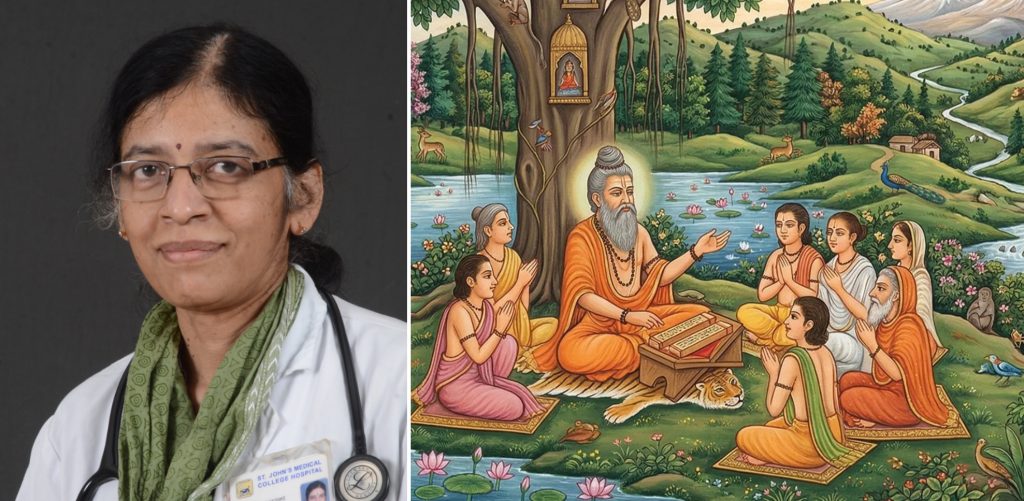
Dr. Srilakshmi M. Adhyapak is a distinguished interventional cardiologist who serves as Professor and Head of the Department of Cardiology at St. John’s Medical College Hospital, Bengaluru. Alongside her medical profession, she has maintained a sustained interest in poetry, drawing inspiration from nature, philosophy and mythology. Her literary works include Ramayana and Other Poems, A Magical Refraction and Other Poems, The Song Divine: The Bhagavad Gita in Verse and Kathopanishad in Verse.
Her engagement with India’s philosophical and spiritual literature continues through this new volume. By presenting the Kenopanishad and Ishopanishad in verse, she brings their questions and insights into an English poetic form, offering readers another way to approach these enduring texts.
The book also contributes to the larger purpose of the Divine Dialogues series, which seeks to make India’s philosophical heritage accessible through literary interpretation.
An Invitation to Contemplation
The Kenopanishad and Ishopanishad offer readers an opportunity to reconsider the relationship between consciousness, existence and human responsibility. Their teachings address the source of awareness, the presence of the divine in the universe and the ethical implications of recognising the interconnectedness of all life.
Their importance does not depend upon the period in which they were composed. They continue to speak to the questions that accompany human existence across generations.
Kenopanishad and Ishopanishad in Verse by Dr. Srilakshmi M. Adhyapak invites contemporary readers into this continuing philosophical conversation. Through poetry, it brings the wisdom of two revered Upanishads into a form that can be read, reflected upon and revisited.
The inquiry begins with a simple question: By whose direction does the mind think? It gradually extends towards a larger understanding of existence itself. Between these two movements lies the enduring wisdom of the Upanishads, inviting every reader to look beyond the familiar and examine the foundations of life and consciousness.