“Why am I like this?”
I used to ask myself this often. Was it OCD, I wondered, looking at my own struggle to make everything perfect. A piece of writing had to be compelling. A painting had to be flawless. A room had to stay dust free and precisely arranged, every single time. The comfort I felt after getting these things exactly right was unlike anything else. But that same need slowly turned into a hindrance, in my personal life and in my professional one. “It is not OCD, it is perfectionism,” someone told me once.
Not long after, quite by coincidence, I came across a short film that stayed with me. It was set in some near future, where a garden had been designed entirely by artificial intelligence, every leaf and stone placed with total precision, nothing out of order anywhere. The owner of that garden did something I did not expect. He called in a human being and asked him to make it imperfect. To let a branch grow crooked, to leave a stone slightly out of line, to bring in whatever a machine would never think to leave behind. Later, when guests walked through that garden, it was not the AI’s precision they noticed or spoke about. It was the human touch, the small, deliberate imperfections, that they kept returning to. Watching that story, something clicked that had nothing to do with gardens at all. If perfection could now be manufactured on command, then perfection was never really the achievement I had built my whole sense of worth around. It made me ask a much older, much more personal question. Why had I spent so many years treating my own imperfection as something to hide, apologise for, or fix, instead of simply something to live with.
I think most of us carry some version of this without ever naming it. A mother who cannot let a birthday be anything less than exactly planned. A man who redoes a piece of work three times because the first two were good but not good enough. A student who would rather submit nothing than submit something imperfect. We tell ourselves this is discipline, or high standards, or care. Sometimes it is. But often it is fear wearing the costume of excellence, the fear that anything less than flawless will finally reveal that we were never quite enough to begin with.
I have watched this need cost people things that mattered more than the outcome they were protecting. A relationship strained because one partner could not let a disagreement stay unresolved and untidy for even a night. A parent’s evening lost to redoing a child’s school project until it looked adult rather than nine years old. My own years spent polishing a sentence past the point where the polishing was serving anyone but my own unease. None of it made the writing better. It only made the waiting longer, and the person doing the waiting more tired.
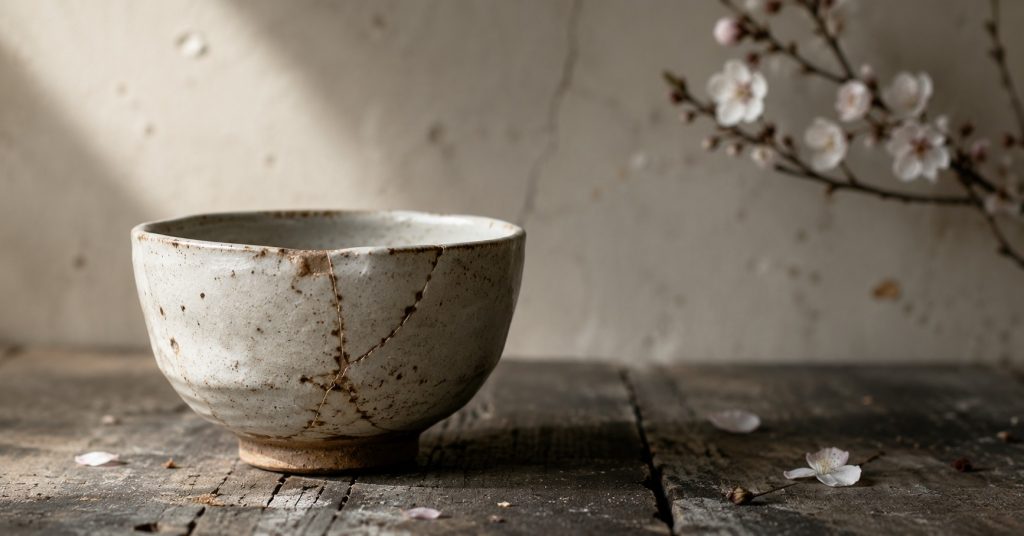
There is an old Japanese idea, wabi-sabi, that has stayed with me since I first came across it. It holds that beauty lives precisely in what is incomplete, impermanent, imperfect. A bowl with a visible crack, mended in gold instead of hidden, becomes worth more than the bowl that was never broken, because the crack tells a true story the unbroken bowl cannot. For a long time this felt like a nice idea about pottery and little else. I understand it differently now. The crack was never the failure of the bowl. It was evidence that the bowl had lived, been used, been dropped, survived, and was still standing.
I think of my own life this way now, more often than I used to. The years I could not manage to finish something I had started. The plans that fell apart despite every careful step I had taken to protect them. The moments I said the wrong thing to someone I loved and could not take it back cleanly. For a long time I treated each of these as evidence against myself, proof that I had failed to be careful enough, disciplined enough, whole enough. I am slowly learning to read them differently. Not as failures I need to explain away, but as the actual texture of a life that was lived rather than merely managed.
This matters most, I think, in what we pass on to our children. A child raised to believe that anything short of flawless has no value will learn to hide the parts of themselves that are still becoming, instead of letting anyone witness the becoming at all. A child’s early attempts at writing, at drawing, at speaking in front of a room, have always been clumsy. That clumsiness was never a flaw waiting to be corrected out of them. It was proof of a mind actually growing, and growth was never supposed to look finished.
None of this is an argument for carelessness, or for giving up on trying to do things well. There is a real difference between a mistake that carries meaning and simply not trying. The point was never to abandon effort. The point is to stop confusing effort with the total absence of error, and to stop mistaking our own unfinished edges for something shameful that needs to be corrected before we can be loved, respected, or at peace.
We are not, and were never meant to be, perfect. We forgot, somewhere in our long rush to smooth every rough edge, that the roughness was often the only part of us that was truly ours. Maybe the task now is not to keep correcting ourselves into some flawless version we were never going to reach anyway, but to let our own unevenness stand, unhidden, and to finally stop apologising for it. To embrace imperfection, not as defeat, but as proof that a person actually lived here.
Preeth Padmanabhan Nambiar
In short: This is a personal reckoning with perfectionism, the compulsive need to make every piece of writing, every room, every effort flawless, and the toll that took over the years. A short film about an AI-designed garden, made imperfect again by a human hand and appreciated most for that very imperfection, becomes the moment that reveals something deeper: chasing perfection was never really the point, and our unevenness, the mistake, the crooked branch, the imperfect edge, is often the most honest and human part of us. Drawing on the Japanese idea of wabi-sabi, the piece makes the case for accepting imperfection in our own lives rather than treating it as something to constantly correct.